
On-Premise AI Automation: Architecture

Oct 13, 202613 min read
Large language models and workflow orchestration engines are deployed within a self-managed infrastructure to define on-premise AI automation. This setup, which often involves hosting platforms like Activepieces in a private cloud, ensures that sensitive data never exits your corporate firewall.
On-premise AI automation is the practice of deploying large language models and orchestration engines within a self-managed infrastructure to ensure data processing remains entirely within a private corporate firewall.
By hosting the entire stack, from the model weights to the execution environment, you'll eliminate the risk of third-party data retention. This also reduces the network latency that's inherent in round-trip calls to public inference endpoints.
On-premise AI automation defined by data sovereignty
The difference between private cloud and air-gapped installs
Dedicated hardware within a provider's data center, such as AWS Outposts, typically characterizes a private cloud deployment. An air-gapped install functions with no external internet connectivity. In an air-gapped environment, the system must be entirely self-contained, requiring local container registries and offline license verification.

While many vendors strip governance features from their self-hosted builds to drive cloud adoption, Activepieces includes the same enterprise governance suite (including SSO, SCIM, custom RBAC, audit logs, and release management) in its air-gapped edition as it does in the managed cloud.
Organizations like MoneyGram and FundingSocieties run this in production to maintain total sovereignty without sacrificing administrative control.
This configuration ensures that every API request and data transformation remains local. The physical or virtual boundaries of your own network define the security perimeter rather than the service terms of a cloud vendor.
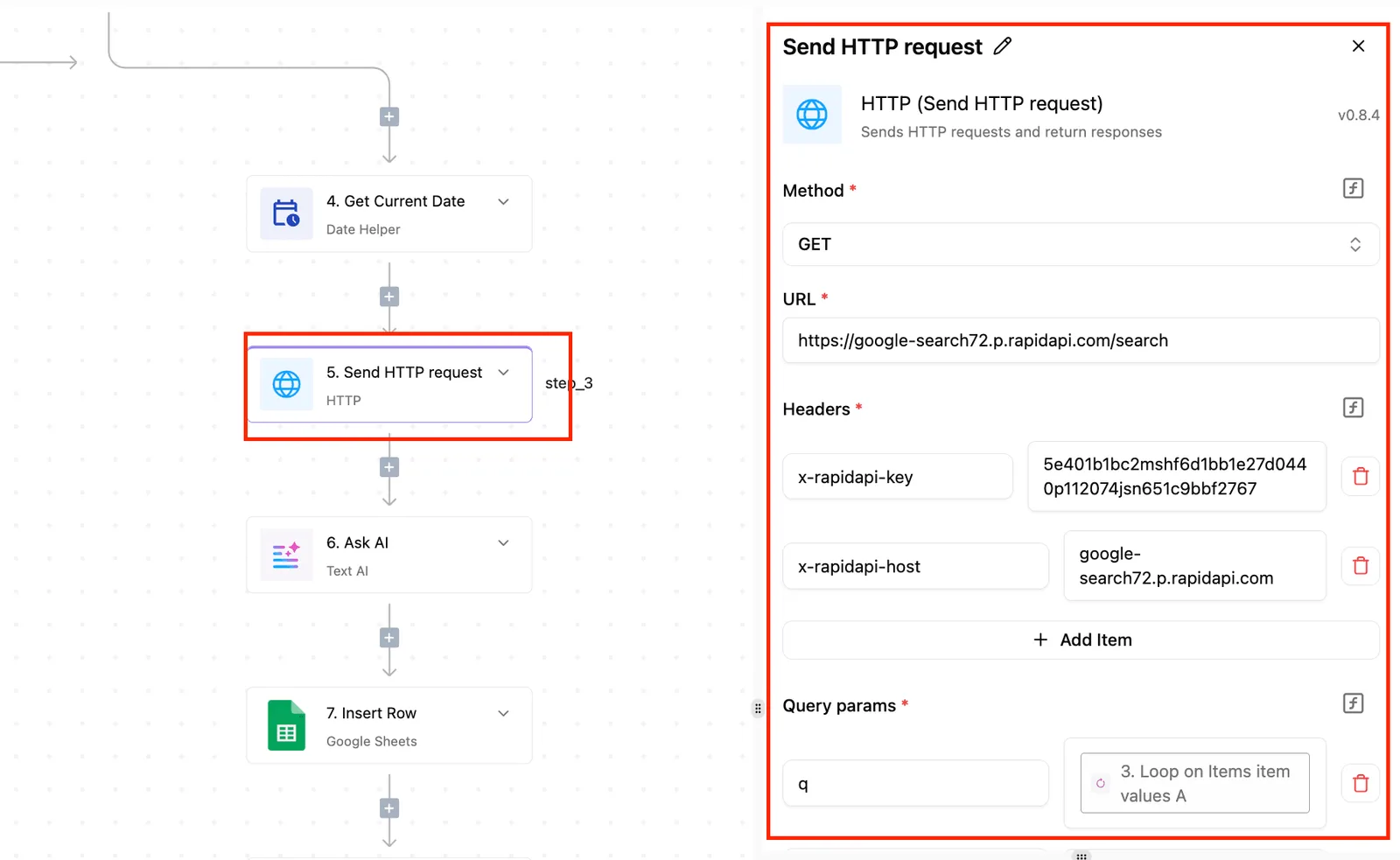
Why regulated industries are moving away from public LLM APIs
Regulated industries are shifting toward local execution because public APIs introduce variables in data integrity and compliance auditing that you can't control.
The physical or virtual boundaries of your own network define the security perimeter rather than the service terms of a cloud vendor.
Research by Ertas AI shows that 28% of errors in AI knowledge pipelines stem from OCR and parsing failures, which means nearly a third of system inaccuracies originate before the data even reaches the model.
| Error Type | Percentage of Pipeline Failures | Impact |
|---|---|---|
| OCR and parsing failures | 28% | Automated decisions rely on incorrectly digitized text |
| Poor chunking | 19% | Queries retrieve fragmented information |
| Metadata issues | 12% | Prevents system from correctly filtering or sourcing information |
| Duplicate entries | 8% | Wastes compute resources on redundant data points |

Once these processes move on-premise, your engineers can audit the raw logs of every transformation step. This ensures that data quality issues are caught before they reach the model.
Everything below works on Activepieces' free plan. Start without code or a credit card.
Architecture options for private AI deployments
Selecting a private AI hosting architecture requires balancing physical control over the silicon against the operational overhead of managing high-density compute clusters.
Local GPU clusters for total isolation
A complete air-gap is possible with local GPU clusters. Sensitive weights and inference logs never touch a network path connected to the public internet. This physical isolation eliminates the risk of side-channel attacks through shared hypervisors.
Because you own the hardware, there aren't any egress fees for moving large datasets between storage and compute. This makes the path cost-effective for continuous, high-volume fine-tuning.
Private Cloud VPCs for managed scalability
Logical isolation within a public provider's infrastructure is provided by a Virtual Private Cloud (VPC). This allows you to deploy flagship models like Mistral Large 4 or GPT-6 Astra without managing physical hardware cooling and power.
Dedicated instances and private endpoints ensure that traffic stays within your corporate perimeter. It simplifies the integration of existing IAM (Identity and Access Management) policies.
| Architecture | Hardware Cost | Latency | Security Isolation |
|---|---|---|---|
| Local GPU Cluster | High | Zero | Physical Isolation |
| Private Cloud VPC | Medium | Low | Logical Isolation |
| Edge Deployment | Low | Zero | Localized |
Edge deployments for low-latency field operations
Inference capabilities are placed directly on local gateways or industrial hardware in edge deployments. Mission-critical tasks continue even when backhaul connectivity is severed.
By running optimized models like Gemini 3.5 Flash-Lite or Ministral 3 3B on-site, you avoid the round-trip delay of a centralized data center. This is necessary for real-time safety systems and autonomous robotics.
Walkthrough: Building a private RAG automation workflow
A private Retrieval-Augmented Generation (RAG) workflow ensures that sensitive corporate data remains within your local network perimeter throughout the entire inference cycle. By eliminating external API calls, you'll maintain absolute custody over the prompts and retrieved context that define your intellectual property.
Step 1: Hosting a model with Ollama or vLLM
Open-weight models like Mistral Large 4 can run on internal hardware when you self-host an inference server, so your sensitive data never needs to leave your own secure infrastructure.
vLLM, a high-throughput serving engine, or Ollama, a tool for local model management, act as the execution layer for these models. Deploying these services on-premise ensures that the model weights and intermediate activations aren't exposed to third-party infrastructure providers.
Step 2: Connecting a local vector store like Qdrant
Document embeddings are stored in a local vector database such as Qdrant to enable semantic retrieval without cloud-based indexing services. By using a local embedding model like Mistral Embed, the system transforms raw text into numerical vectors entirely within your secure environment.
Distinguishing embedding models from generative LLMs
An embedding model is a specialized AI designed for a single task: converting text into a list of numbers called a vector.
While a generative LLM like Mistral Large 4 is built to understand context and write human-like responses, the embedding model acts as a translator that turns words into coordinates for mathematical searching.
These two models serve different stages of the automation pipeline. The embedding model creates the searchable index of your private documents, whereas the LLM uses the results of that search to generate the final answer.
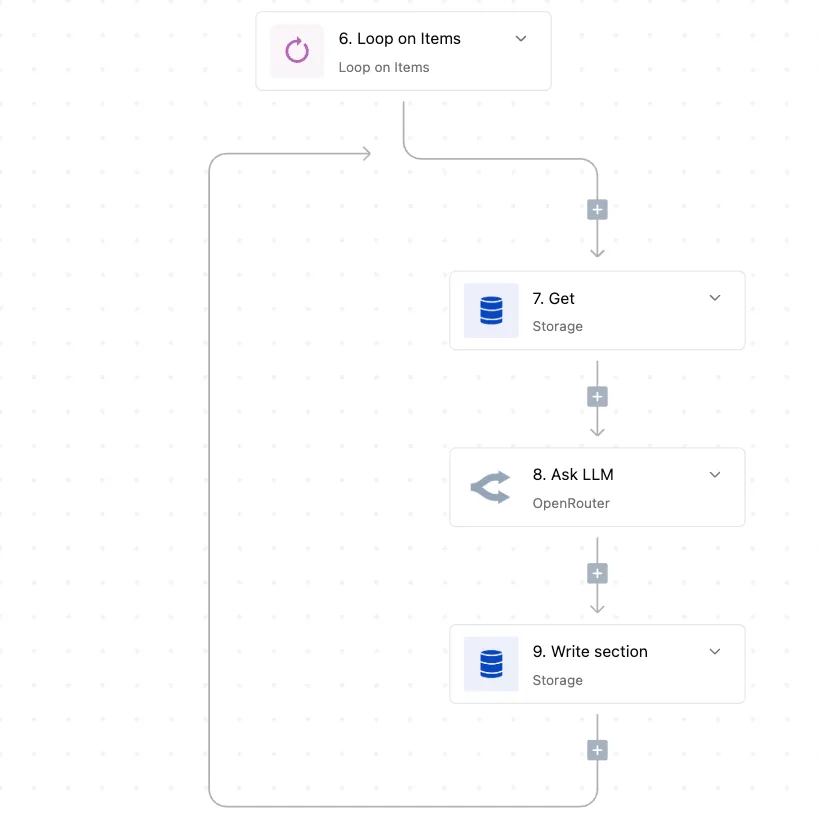
Running both locally ensures that neither the search index nor the final reasoning process ever touches the public internet.
To ensure data remains isolated, the following sequence outlines the technical implementation:
- Select and quantize a model, such as Mistral Large 4, to fit the available local GPU VRAM.
- Initialize a vector database with local embeddings to prevent the indexing process from leaking data to external APIs.
- Connect the orchestration layer to the local inference endpoint via internal IP addresses.
- The air-gapped response loop confirms no packets are routed to the public internet.
Step 3: Orchestrating the workflow with a self-hosted engine
Movement of data between the vector store and the inference server is coordinated by the orchestration engine. The logic of your business process is prevented from being visible to an external SaaS vendor by a self-hosted orchestration tool.
While many vendors gate essential controls behind cloud-only tiers, Activepieces provides the same governance capabilities (including SSO, SCIM, custom RBAC, and audit logs) in its air-gapped edition as it does in the managed cloud.
Organizations like MoneyGram and FundingSocieties run this self-hosted build in production to maintain total sovereignty without sacrificing administrative oversight.
Step 4: Testing the air-gapped response loop
Outbound traffic must be monitored while the RAG system processes a query during the final validation step. This confirms that no data packets exit your firewall.
A successful air-gapped test proves that the system can generate accurate, context-aware responses using only internal resources.
Easier to see it running than to read about it: set it up free, no card.
The true cost of self-hosted AI infrastructure
A significant upfront capital investment in specialized hardware is required for self-hosting AI infrastructure. This eliminates the recurring per-token billing cycles associated with public cloud providers.
Hardware CAPEX vs. API OPEX calculations
The transition from operational expenses to capital expenditures for high-performance compute clusters represents the primary financial shift in on-premise AI. Deploying enterprise-grade hardware, such as H100 or A100 Tensor Core GPUs from NVIDIA, requires a substantial initial payment.
For high-volume workloads, the cumulative cost of per-token fees eventually exceeds the purchase price of the physical hardware. The self-hosted route becomes more economical after a certain utilization threshold is crossed.

The hidden cost of cooling and electricity
Dense GPU clusters introduce continuous utility costs. High-performance chips generate significant thermal output, necessitating industrial-grade cooling systems and high-density power distribution units. Because these systems must run 24/7 to maintain hardware stability, electricity becomes a significant part of the total cost of ownership.
Maintenance and model fine-tuning overhead
Specialized engineering time is required to maintain a private AI stack. Unlike public APIs where the vendor handles versioning, your on-premise team must manage the following tasks:
- Orchestrating containerized environments via Kubernetes or Docker ensures high availability of inference endpoints.
- Updating drivers and firmware for the physical GPU nodes patches security vulnerabilities and maintains compatibility with new libraries.
- Executing fine-tuning runs on proprietary datasets improves model accuracy for specific domain-specific vocabularies.
Governing private workflows with Activepieces Enterprise
Sensitive data and AI agent logic stay within a private network when using Activepieces as a self-hosted automation core. It doesn't expose execution traces to a cloud provider.
How to deploy in containerized environments
Deployment via Docker, Docker Compose, or Kubernetes is supported by Activepieces. The automation engine can live in the same air-gapped environment as your compute hardware.
Physical power density and thermal management become the primary constraints when running these workflows locally. A single NVIDIA DGX H100 server draws 10.2 kW at peak.
A standard 42U rack can only support four units before exceeding typical data center power-per-rack cooling capacities.
While eight H100 GPUs only draw 5.6 kW, the full system load for an 8x H100 SXM configuration reaches 11 kW, meaning the supporting infrastructure must account for nearly double the power consumption of the processors alone.

Your engineers must provision power for the entire chassis overhead rather than just the accelerators.
Managing secrets and SSO in a private network
Every credential Activepieces touches can be routed to your own secret manager instead of the local database, a capability available in both the self-hosted edition and the enterprise cloud tier.
By configuring the instance against an external secret manager, you ensure that no vendor ever holds the API keys or OAuth tokens your business runs on.
By integrating with internal Single Sign-On (SSO) and SCIM (System for Cross-domain Identity Management), the platform ensures that an employee's access to automation tools is revoked the moment they leave your company directory.
You can coordinate these hardened deployments, including support for air-gapped license activation, through the Activepieces sales team.
Audit logs for compliance-heavy environments
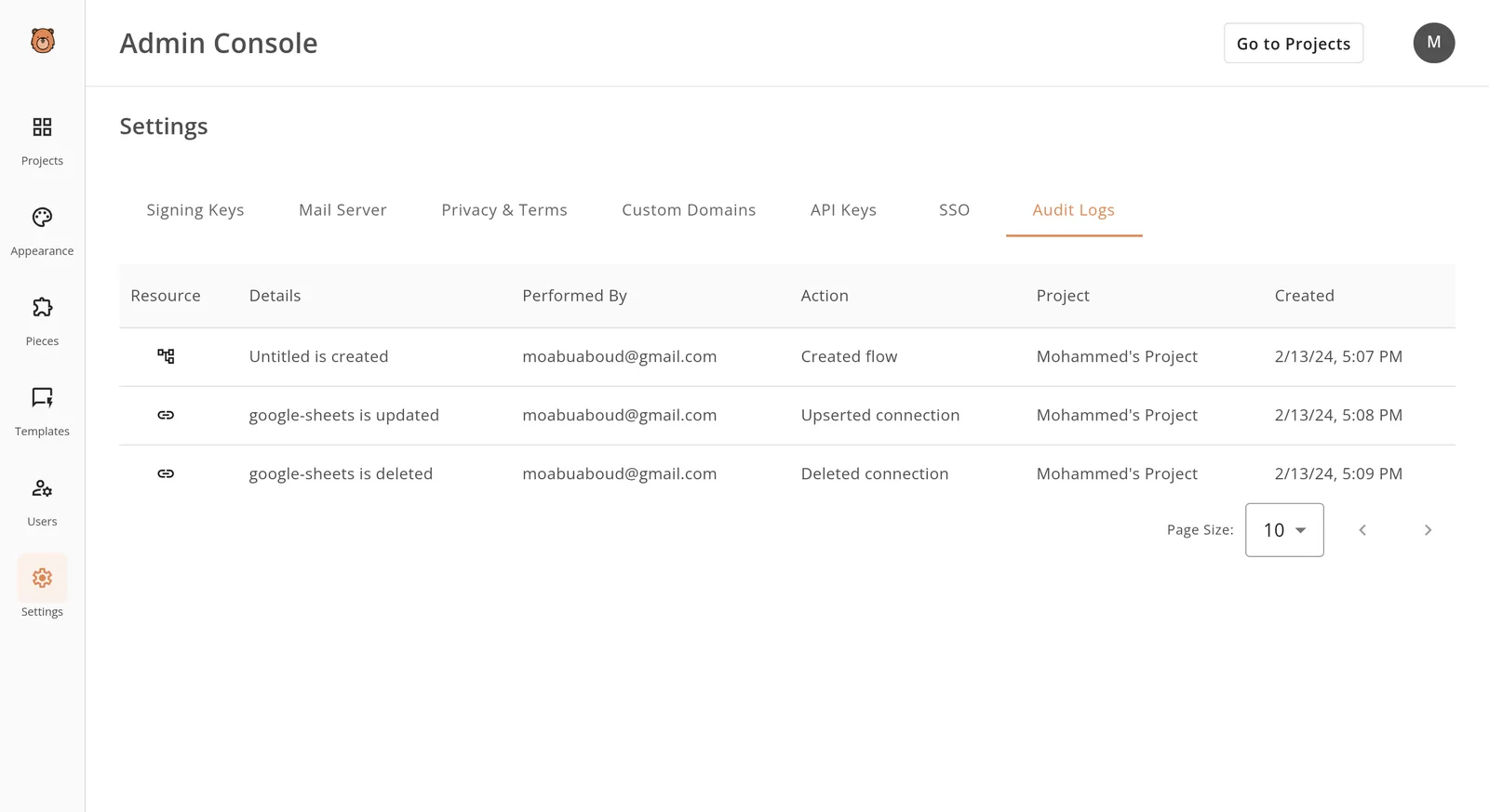
Granular Role-Based Access Control (RBAC) and comprehensive audit logs are the center of enterprise governance within Activepieces. Every API call made by an agent is recorded locally.
This includes fetching a document for RAG or posting a summary to an internal instance of Mattermost. This provides a forensic trail for compliance officers to verify that sensitive data processed by models remained within authorized network segments.
The Monday morning private AI checklist
A systematic inventory of where data leaves your internal network is required to secure your intellectual property.
Auditing data egress points
Exactly which proprietary datasets your system transmits to external endpoints is revealed by mapping every outbound API call. These endpoints include OpenAI's GPT-6 Astra or Anthropic's Claude Fable 5.1.
This audit serves as a baseline for risk management. It highlights the specific services that must be replaced by local inference engines to maintain a zero-trust architecture.
Identifying high-sensitivity automation candidates
Workflows that interact with Protected Health Information (PHI) or internal trade secrets are high-sensitivity candidates for on-premise migration. Primary targets include processes that require the reasoning capabilities of a model like Mistral Large 4 but involve restricted financial data.
Selecting the initial hardware pilot site
Dedicated rack space that's physically isolated from general-purpose compute is required for a successful pilot site.
By selecting a site with sufficient cooling and power for high-density GPU clusters, you ensure that large-scale models like DeepSeek-V4-Pro-0813 can operate without thermal throttling. Once the physical environment is secured, you can begin the transition from external dependencies to a fully sovereign automation stack.
Frequently asked questions about private AI?
How much VRAM is needed for a 70B parameter model?
Enough Video Random Access Memory (VRAM) to hold the entire model weights and the KV cache during inference is required to run a 70B parameter model. This ensures the system avoids swapping to slower system memory.
If the VRAM capacity is lower than the model’s footprint, the inference speed drops from tokens per second to seconds per token, rendering real-time agentic workflows unusable.
To optimize these requirements, engineers use quantization: a process of reducing the precision of model weights. This allows these large models to fit into the memory of a single high-end enterprise GPU or a cluster of consumer cards.
Can I run on-premise AI without an internet connection?
The only architecture that supports a completely air-gapped environment is local AI deployment. This ensures that no data packets ever transit beyond your physical firewall. In this configuration, the inference server and the automation engine must be hosted on internal container orchestration platforms.
- Docker: is a containerization platform used to package the AI environment and its dependencies into a single immutable image.
- Kubernetes: is a container orchestration system that manages the scaling and failover of model instances across multiple local nodes.
- Local Model Weights: are the binary files representing the LLM, which must be side-loaded via physical media or a local artifact registry.
What is the best open-source model for business logic?
Mistral Large 4 stands as the frontier open-weight model for complex business logic and multimodal reasoning. It provides the necessary performance for high-stakes decision-making without a third-party API dependency.
For high-volume tasks like routing or classification where latency is the primary constraint, Mistral Small 4 serves as a hybrid reasoning model that consumes fewer compute resources.
When the task involves parsing unstructured documents into structured data, OCR 4.1 provides the specific bounding box coordinates and confidence scores. These are required to validate the accuracy of the extraction before the data enters a system of record.