
Pipedream Self Hosted: Options and Alternatives (2026)

Oct 27, 202614 min read
On its own pages, I found no downloadable self-hosted edition of Pipedream, which is a managed cloud service.
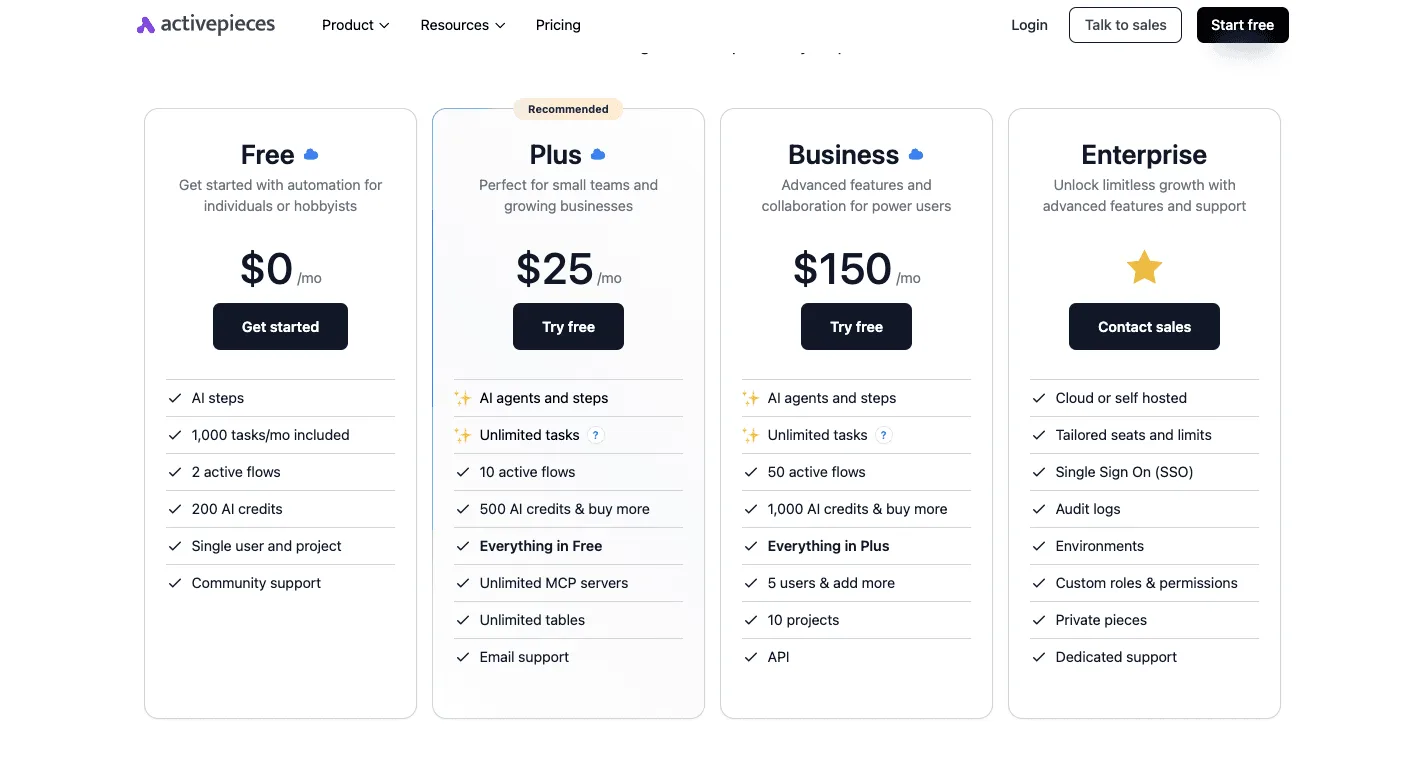
If your requirement is "runs inside our network", you're looking at a negotiated enterprise arrangement, a workaround, or a different tool. Activepieces runs on your own servers under an MIT-licensed core with 746 integrations, so you can automate workflows across your entire technology stack.
Confirm which on the vendor's page, not in a summary of it.
Self-hosted Pipedream on your servers
What self hosted means in this context
If you can read the compose file or the deployment manifest and run the workflow engine on hardware you control, that is self hosted here. It also means execution and stored data stay inside your own boundary.

That's a narrower claim than "private" or "single tenant". A vendor-operated environment dedicated to your account is still the vendor's infrastructure.
Which Pipedream pages this article relies on
On 27 October 2026 I checked Pipedream's own public pages:
- the pricing page, for what each plan includes and whether any plan names a deployment option
- the documentation, for any install or hosting instructions
- the security and trust material, for statements about where workloads run
Where a page is silent, I treat that as "not stated", not as "not offered". A claim that matters to your purchase should be read on the vendor's page by you, or by whoever signs off the change.
The fastest way to settle a shortlist is to try one. Activepieces is free to try, no credit card.
Pipedream's stance on hosting and licensing
I found no self-hosted tier on any page I can cite, and Pipedream is sold as a cloud-hosted service.
Treat "self-hosted" as unconfirmed until you read the vendor's pricing page yourself. The findings below are the artifacts to open, and what each one does and doesn't show:
- The pricing page lists plans by credits, and none of the figures I hold name a self-managed option.
- The docs describe how to build and run workflows on the hosted platform, which I couldn't confirm includes install instructions for the runtime.
- The security page is where isolation and SSO statements would sit, and I have no quotable text from it.
- The GitHub repository's LICENSE file sets the scope of what's public, so read it before assuming the whole platform is open.
- I didn't verify any dedicated-environment or on-premises price.
Hosting model stated on the pricing and docs pages
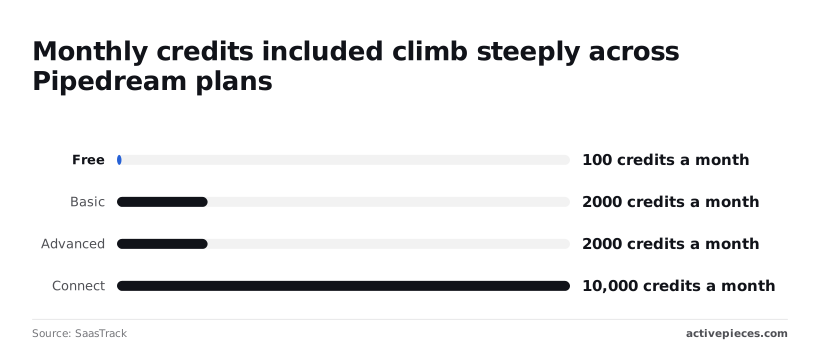
Within a short test, a free account runs out. The SaasTrack library, a third-party tracker rather than Pipedream, lists Free at 100 credits a month.
According to SaasTrack, Basic and Advanced both show 2000 credits, so moving up between them adds no volume and the difference must be features.
Connect shows 10000, which is the tier sized for embedding. Confirm all four on the vendor's page, since third-party listings go stale.
Don't mistake a public repository of integration components for the runtime. Its licence tells you whether you can reuse connectors, and says nothing about running the scheduler, event store or execution layer yourself. I didn't verify the licence text here.

I couldn't verify any enterprise, SSO or dedicated-environment terms, so an enterprise arrangement is a question for sales, answered in writing.
Pipedream plans compared with Activepieces on the same requirements
Since I couldn't verify Pipedream's enterprise terms, the table marks those cells as unconfirmed rather than guessing.
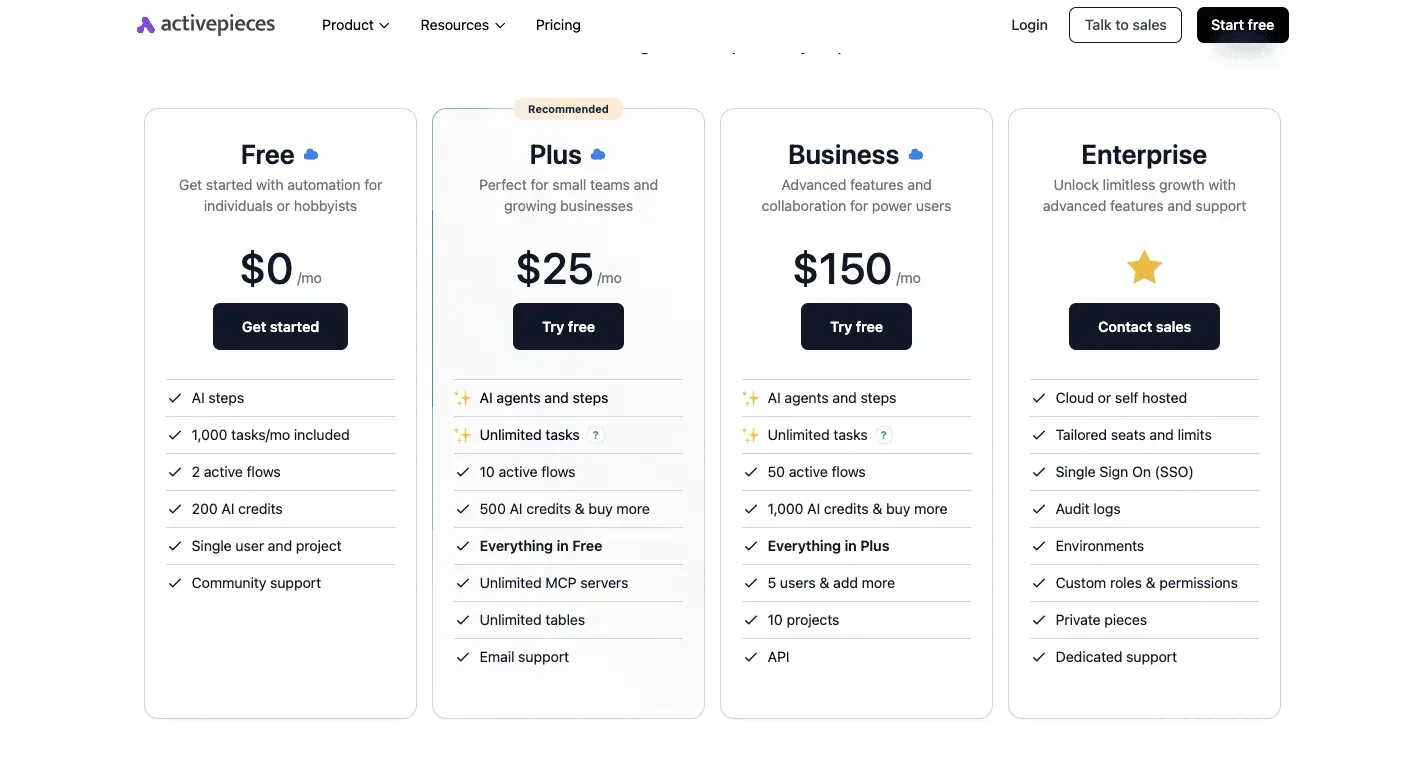
Activepieces answers the self-hosting question with an MIT-licensed core whose source tree, including 746 integrations under packages/integrations/community, you can read and run, while Pipedream's answer stays in writing from sales, so you cannot inspect or modify their integration code.
In the table below, both vendors face the same five requirements, each cell tied to the vendor's own pricing page and the check date. Some cells are settled and some still need a written answer.
| Requirement | Pipedream | Activepieces |
|---|---|---|
| Self-hosting | Cloud-hosted product; self-hosting not verified, so treat as cloud only until sales confirms in writing. pipedream.com/pricing, 27 Oct 2026 | Open-source edition you can run yourself, or use the vendor's cloud. activepieces.com/pricing, 27 Oct 2026 |
| SSO/SAML | Confirmed on the pricing page: SSO is included only on the Business plan. pipedream.com/pricing, 27 Oct 2026 | Confirm on the page which plan carries it before relying on it. activepieces.com/pricing, 27 Oct 2026 |
| Enterprise controls | Not verified; a sales conversation. pipedream.com/pricing, 27 Oct 2026 | Listed on the vendor page; read the plan terms for the exact scope. activepieces.com/pricing, 27 Oct 2026 |
| Starting price | Read the entry tier on the page; no figure carried here. pipedream.com/pricing, 27 Oct 2026 | Read the entry tier on the page; no figure carried here. activepieces.com/pricing, 27 Oct 2026 |
| Usage metering | Metered per the unit on the page. pipedream.com/pricing, 27 Oct 2026 | Metered per the unit on the page. activepieces.com/pricing, 27 Oct 2026 |
Reading the limits and metering differences
Before price enters, a requirement for your own network boundary narrows the choice, because self-hosting is the one row where the two products differ in kind.
Activepieces still needs its own check, because running the open-source edition doesn't mean every paid control comes with it.
The paid governance set, covering single sign-on, user provisioning, custom roles, audit logs, release management and external secret managers, behaves the same in the air-gapped self-hosted build as in the managed cloud in its Frankfurt EU region, so a stripped-down self-hosted build isn't the catch.
Confirm each control against the plan that names it.
Identical workflows can bill differently, because each vendor counts usage in its own unit. That is why the metering row matters next. Run one representative workflow through both calculators before comparing starting prices.
Requirements driving self-hosting searches
Of the five requirements behind a self-hosting search, only some need your own servers, and cost is one of them. The list pairs each driver with the cloud feature that may meet it, or says where it needs your own infrastructure.
- Data residency may be met by a choice of hosting region, but a rule that data never leaves your boundary needs your own infrastructure.
- Private network access may be met by a fixed outbound IP address you can allowlist, but a database with no public route needs a runner inside your network.
- High-volume cost may be met by a negotiated plan, but running it yourself swaps the per-event bill for server and staff cost.
- Exportable workflow definitions may ease vendor dependence, but only software you run yourself removes it.
- Credentials handling may be met by encrypted secret storage and scoped access, but a rule that secrets never leave your environment needs your own infrastructure.
The first three drivers are taken in turn below, and the last two surface inside them.
For data residency and compliance reviews, ask the reviewer for the exact clause. The cloud can often satisfy "data stays in region" but can't satisfy "data stays on hardware we control".
On private network and database access, an allowlisted IP address covers a database that accepts connections from named addresses. It doesn't cover one reachable only from inside a private network.
In that case the workflow engine has to run inside the network, which is the point where an enterprise arrangement or a different tool enters.
For cost at high event volume, take the result of your calculator run and ask what happens when volume doubles. If the cloud bill grows in step, price the alternative honestly: servers, upgrades, on-call hours, and the time spent keeping it patched.
Reading a table only gets you so far. Build the same workflow in Activepieces and compare it yourself.
Common self-hosting search mistakes
Each of these ends in a cost or an outage nobody budgeted. Five misreadings account for most failed searches for Pipedream self hosting.
- Reading open-source code as a self-hostable platform leaves you with connectors and no runtime to execute them.
- Relying on outdated forum posts means you build against an arrangement the vendor may no longer offer.
- Running one component locally proves a single integration works and tells you nothing about hosting the product.
- Skipping sales leaves you guessing at enterprise terms that only the vendor can confirm.
- Underestimating operations burden turns a saved subscription into unplanned on-call hours.
Treating public integration code as a hosted platform
Open the source tree and check what it contains. If it holds integration definitions (the triggers and actions that talk to other services) but not the scheduler, the execution engine or the deployment manifests, you have a library of parts.
A public repository isn't a compose file you can bring up, and no licence on the code changes that. Confirm what the vendor's documentation says is available to run yourself.
Check the date on any forum thread, because it describes the product as it stood then. Cloud products change plans and terms, and a confident answer from a past year's a claim about a past offering.

Even where a self-run arrangement exists, you inherit patching, upgrades, backups, monitoring and the pager. Price those hours against the subscription you meant to avoid, as the previous section set out. If the arithmetic only works when nothing breaks, it doesn't work.
Pipedream self-hosting options compared side by side
Ask Pipedream for enterprise terms, stay on its cloud with private access, build your own, or adopt a self-hostable platform: those are the four routes, and each should be tested against the same four questions. The table below sets them side by side.
If the arithmetic only works when nothing breaks, it doesn't work.
Treat every cell as a lead to confirm on the vendor's own licence, pricing and security pages, because those pages change and a stale cell is how a procurement ticket gets rejected.
| Route | Licence terms | SSO free vs paid | Setup effort | Cost |
|---|---|---|---|---|
| Pipedream enterprise | Negotiated contract | Ask in the contract | Vendor-led | Quoted by sales |
| Pipedream cloud private access | Standard cloud terms | Check the plan page | Low | Plan-based |
| Build your own | Yours | Yours to build | Highest | Engineering time |
| n8n | Fair-code, not OSI open source | Paid tiers | Moderate | Free to run, paid for SSO |
| Activepieces | Open-source core, paid enterprise | Check the edition page | Moderate | Free core, paid enterprise |
| Windmill | Open-source core, paid enterprise | Split by protocol | Moderate | Free core, paid enterprise |
| Temporal | Open source | Cloud product feature | Highest | Free to run, paid cloud |
Look at the table and you see that "free to self-host" and "free SSO" are separate claims. Read the licence file and the SSO page independently before shortlisting.
When the requirement is isolation or access control rather than location, staying on Pipedream cloud fits. Ask what private access actually covers, and get the answer in writing, since enterprise terms are quoted by sales and can't be verified from a public page.
When you need behaviour no product offers, building it yourself fits, and only then. You own the queue, retries, secrets and upgrades, so the cost's engineering time that never appears on an invoice.
Among self-hostable platforms, n8n, Windmill and Temporal each ship source you can inspect. Read the compose file and the licence before the marketing page, then check which features sit behind the paid edition.
With an MIT-licensed core and the enterprise directories (packages/ee/) under a separate commercial licence, Activepieces has both deployment modes. Confirm which edition carries your SSO requirement on its pricing page.
Testing self-hosting requirements
Write down the one requirement behind the search, get Pipedream's answer in writing, then test a single workflow against two alternatives. The six steps below are ordered like a change ticket, so each one leaves a document you can attach rather than an opinion.
- Write the one requirement driving self hosting.
- Ask Pipedream sales for terms in writing.
- Re-check every claim on the vendor's own pages.
- Shortlist two alternatives.
- Pilot one workflow.
- Estimate operations hours.
Put the requirement in one sentence, such as "customer data must not leave our network" or "we need a private network path to our database."
Data residency, network isolation and audit control point to different products, so an unwritten requirement lets a vendor's nearest feature stand in for it. This sentence also becomes the test you run in the pilot.
Get written answers from Pipedream sales
Email Pipedream sales and ask whether your requirement can be met, under which agreement, and what the limits are. Ask for the answer as a document, not a call summary.
Then compare it against the pricing and docs pages, since a sales reply that contradicts the public page needs a second question. Do the same for each shortlisted alternative, and for any open-source one, read the licence file in its repository yourself.
Pilot one workflow on each self-hosted alternative
Pick one real workflow that touches your constraint, such as a webhook that writes to an internal database. Build it on each candidate and record what you had to install, patch and monitor.
Hours spent on upgrades, backups and credential storage are the operations cost, and only the pilot shows them before you commit. Multiply that by your workflow count for the estimate in step six.
Frequently asked questions
None of this replaces reading those pages yourself; each answer below is limited to what Pipedream's own pages state.
Hosting and deployment
Is there a free self-hosted version of Pipedream? No. Pipedream's docs describe no compose file, image or installer for its workflow platform, but confirm self-hosting on the vendor's pricing page.
Anyone offering you one is describing a different tool or an unofficial workaround, and you can't verify it against a vendor page.
Can I run Pipedream workflows in my own cloud account? Not as a documented, self-serve option. Workflows execute on Pipedream's infrastructure.
Any arrangement that changes where they run's a conversation with their sales team, and the terms exist only in the contract. Ask for the deployment diagram in writing before you plan around it.
Plans, SSO and licensing
Does Pipedream offer SSO, and on which plan? Single sign-on's a feature of their higher paid tiers, not the free one.
Which tier, and at what price, 's on the pricing page, and that page changes. Read the plan comparison there and confirm identity-provider support against the security or docs pages, since "SSO" can mean SAML, OIDC or only social login.
Is Pipedream open source? Partly. The public GitHub repository holds the registry of prebuilt triggers and actions, and you can read that source tree.
Keeping the answers current
How often should I re-check these claims? Re-check before every purchase decision and after any announced ownership or plan change, since hosting terms are exactly what an acquisition can alter.
Record the page address and the date you read it beside each answer, the way you would log a source for a change ticket. A claim without a date is one you can't verify later.
Related reading
References
Still comparing
The fastest way to settle it is to build something.
Open source under MIT, so you can self-host the same thing later.
Start free Talk to sales