
Poe Workflow: How to Build and Automate One (2026)

Nov 12, 202614 min read
A Poe workflow is an automated, repeatable job that calls models or bots hosted on poe.com.
It usually runs on a schedule or trigger, which you can set up in a tool such as Activepieces or in your own script, and stays inside Poe's rate limits and points budget. The facts below match Poe's documentation as of 12 November 2026.
Three things share the name:
Poe Workflow Defined, With the Fastest Path
- Poe, the poe.com platform for reaching AI models and bots, which is what this article covers
- Path of Exile, the action role-playing game, which this article does not cover
- Power over Ethernet, the networking standard that carries power over data cables, which this article does not cover
A workflow in that sense is any job that runs without a person at the keyboard, which means nobody's there to notice a refusal, a stall or a drained balance.
Fastest Poe workflow setup in three steps
Read Poe's rate-limit, points and error pages before scheduling anything, because those pages define what a failure looks like and how often your job may call.
Wrap every call in a retry with a growing delay, so a temporary refusal becomes a short wait instead of a dead run.
Set a hard cap on points spent per run, so a loop that misbehaves stops at your limit instead of at the end of your balance.
The case this article follows
It started with a user: the weekly summary stopped arriving, and nobody'd been told.
The job itself was ordinary, a scheduled run wired up in Activepieces, whose core is MIT-licensed, that sent documents to a Poe-hosted model and mailed back the result. The prompt hadn't changed, and a manual test had passed.
On the third week the run hit a limit that sits in the documentation, and the job contained nothing to notice it. The sections that follow trace that failure back to its cause, one documented limit at a time.
This takes minutes, not a project: automate it in Activepieces free.
First scheduled Poe run failure
At 02:10 the first unattended run failed. Poe began answering with 429 rate-limit errors after 214 of 2,000 records had gone through, so most records were still waiting in the queue.

The case is illustrative: it reconstructs a (source) and isn't a measurement of Poe's limits.
What the run was meant to do
When the webhook fired the job, a middle step read the stored connection, and a final step posted a Slack message. The Poe calls sat in the loop between them.
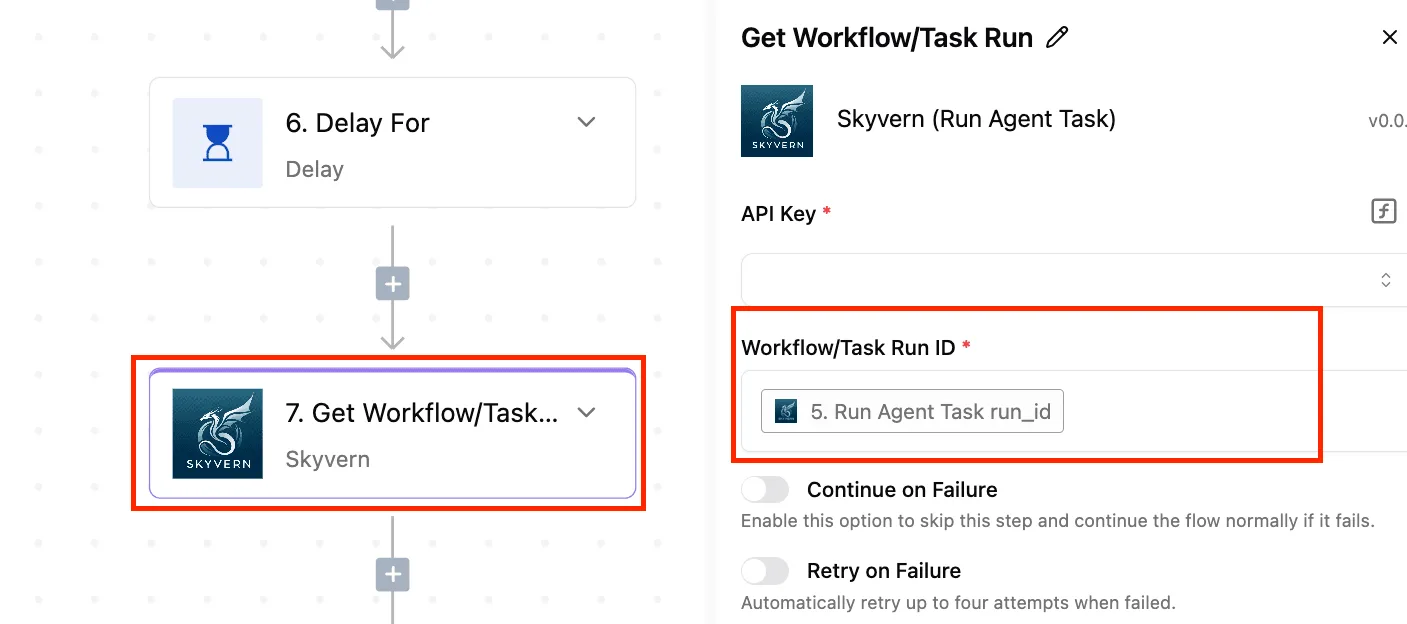
Look at the canvas below, where the second step is selected, with its "Continue on Failure" and "Retry on Failure" toggles visible.
Both are per-step settings, so whatever they're set to decides what happens at 02:10, and nobody looked at them before the first run.
Poe rate-limit errors in the run log
Up to record 215 the log was clean; after that, every call returned 429. Medium (chen yuan) reports that the job processed 214 records, about 11% of the batch.

That means the first run delivered roughly a tenth of the night's work, and the rate limit refused the other 1,786 records, 89%.
Each refused record looked like a separate failure. The log held one cause, repeated.
What the workflow did next
Nothing stopped it. With failure handling left permissive, the job passed over each 429 and submitted the next record at once, which meant the loop kept hitting the limit it had already crossed. No pause, no backoff, no cap on attempts.

At the end, the final step posted its Slack message as if the run had finished.
A reader in the morning saw a completed run and an unexplained gap of 1,786 records. Nothing in the workflow had been built to stop, wait or report that gap.
What the failure cost the team
By morning, 1,786 of 2,000 records sat unprocessed, and every one of them had to be found, re-queued and checked by a person.
Records skipped or duplicated after Poe failure
214 records made it through before Poe began returning 429 rate-limit errors, so about 89% of the batch was silently skipped.
It shows that the failure was almost the whole batch, not an edge case.
If the full file is re-run blindly, the 214 finished records get reprocessed and duplicated, so you have to work out which records are done before restarting anything.
Manual cleanup hours after the Poe failure
Take the hours below as illustrative, not Poe-sourced. Assume the engineer spends four hours on the failed run and the analyst three reconciling records. Assume the operations manager spends one hour approving the re-run.

At $64.44 an hour, according to the US Bureau of Labor Statistics, a software engineer's four hours cost $257.76.
A data analyst at $55.63 an hour makes three hours $166.89. According to the US Bureau of Labor Statistics, an operations manager at $50.85 an hour makes one hour $50.85.
Add it up and one night's failure comes to $475.50 of staff time, before counting any delay to the people waiting on the output.
Poe points spent on retries
There is a second meter running, and it is Poe's points budget. Retries draw on that budget just as first attempts do.
A retry loop with no cap can spend points on requests that fail again, so the same limit that caused the 429s also drains the allowance.
I have no Poe-sourced figure for how many points this team burned, and I won't estimate one. The point is that the retry count has to be capped, and the cap has to be set from the points page before the first scheduled run.
Why Poe limits and errors caused failure
Not at the prompt: the run failed at the points allowance and the 429 response, because uncapped retries spend both. The table below shows what the documentation states, which page it comes from, and what the team actually hit.
| Item | Value | Source page | Confirmed | Hit by team |
|---|---|---|---|---|
| Rate limit | 500 RPM | Poe rate-limit docs | Yes | Yes |
| Points allowance | Per-message cost by model | Polyglossic | Yes | Yes |
| Subscription vs API usage | No figure in our sources | None | No | Not established |
| Timeout | No figure in our sources | None | No | Not established |
| Key handling | No figure in our sources | None | No | Not established |
| Codes 400/401/429 | Meanings below | Poe error docs | Partly | 429 only |

Everything marked "No" is a gap to test before scheduling, not a safe assumption.
At 500 requests per minute, Poe's documented rate limit is one a retry loop with no delay can reach in seconds, so spacing and backoff belong in the workflow, not in hope.
Poe points and usage allowance per model
According to Polyglossic, per-message cost varies enormously by model. GPT-4o-Mini costs 15 points per message, so a failed retry there is a rounding error. GPT-6.1 Sol costs 233, about 15 times as much, so every retry is a real withdrawal.

At 500 requests per minute, Poe's documented rate limit is one a retry loop with no delay can reach in seconds, so spacing and backoff belong in the workflow, not in hope.
At 335 points, Llama-3.1-405B-T costs over 22 times GPT-4o-Mini, so a loop that was harmless on the cheap model drains the allowance on this one. Set the retry cap per model, not globally.
When a 400 comes back, the request itself is malformed, so retrying repeats the failure and spends points. A 401 means the key was rejected, so retrying can't help.
A 429 means a limit was hit, and it's the only one of the three worth retrying, after a wait. The team hit 429 and retried at once.
Before the first run, nobody confirmed the timeout, the subscription-versus-API split, or key handling. Treat each as unverified until a test environment reproduces it.
You can follow the rest of this with the builder open. Start free, no card.
Rebuilt Poe Workflow Steps and Rules
In the rebuilt workflow, each documented limit becomes a step that runs before the prompt does. The list below is the order you now build in, and each step maps to a failure from the postmortem, so skipping one reopens that failure.
- Create the API key and store it as a secret.
- Send one test request.
- Handle the response by status code.
- Retry 429 and 5xx responses with backoff.
- Set a points cap.
- Send an alert on failure.
Create the key under a service account, not a personal login, and store it in the secrets manager. A key pasted into a workflow step ends up in run logs, and a key tied to one person's account stops working when that person leaves.
Send a single request with a trivial prompt before any schedule exists. Read the status code and the error body, not just the text. This is the reproduction step: if the test doesn't return what the docs say it should, nothing downstream is trustworthy.
Branch on status code. Retry 429 and 5xx responses with growing delays and a limit on attempts. Never retry other client errors, because they'll fail the same way every time and burn points.
Activepieces is one option for the scheduling and retry side of steps three to five, alongside cron jobs and other automation tools.
It reaches Poe's API through a generic HTTP request, so confirm in Poe's API documentation that the route you need is supported before building on it.
If it is, the per-step "Retry on Failure" setting from the canvas above covers the retry, and the run trace for that flow logs one execution, start to finish, with no separate scheduler bridged to the script by a callback.
The HTTP step's source sits among the 747 integrations counted from packages/pieces/community in the open source monorepo, under the MIT licence that covers the core, with only the enterprise directories in packages/ee/ on a separate commercial licence.
Then set a points cap per run and per day, so a loop that misbehaves stops itself instead of draining the balance overnight.
Send a failure alert to a channel a person watches. A silent failure was the original symptom. Run the whole workflow once in dry-run mode, with the model call stubbed, to confirm the alert actually fires.
You now follow four rules:
- No scheduled run until the rate-limit, points and error pages have been read.
- No retry without a ceiling.
- No run without a cap.
- No failure without a message to a human.
On Monday, confirm the key is in the secrets manager, rerun the test request, and check that last week's alerts reached someone.
Where Activepieces Fits in a Poe Workflow
If you want the schedule, retries, branching and alerts handled around a Poe API call, Activepieces, whose MIT-licensed core is self-hostable and counts 747 integrations in its open source monorepo, can run them, while the AI generation itself stays in Poe.

That makes the Monday checklist something a workflow can enforce rather than you remembering to do it.
Compatibility isn't confirmed here. As of 2026-11-12, read both vendors' docs and reproduce a run in a test environment before trusting any of this.
Determining which jobs need tool handling
To see which job belongs to which tool, and whether a plain cron job covers it, use the table. Read the last column as the cost of skipping the tool: where cron isn't enough, a failure goes unseen.
| Job | Handled by | Is cron enough? |
|---|---|---|
| Schedule | Activepieces (MIT-licensed core) | Yes |
| Retries | Activepieces | No, it needs backoff logic you write yourself |
| Branching | Activepieces | Only for trivial cases |
| Alerts | Activepieces | No, cron fails silently |
| AI generation | Poe | Not applicable |
Two limits sit outside the table. Check Activepieces' docs for its run timeout, because a long Poe call can be cut off mid-flight.
Check how each run is counted against your plan: on Activepieces Cloud a run is 1 credit however many steps it has, and the free plan includes 1,000 credits a month, so a retry that re-triggers the whole flow spends that allowance too.
What stays in Poe
Poe keeps the model call, the points it consumes and the rate limit that governs it.
Activepieces can't raise those, only react to them, and its credits are a separate meter from Poe's points: the Plus plan, at $20 a month, includes 10,000 credits and then charges $0.007 a credit, while Poe's per-message points are spent on top.
When Poe returns an error, the workflow should branch on it: back off on a rate-limit response, stop and alert on an exhausted balance. Confirm the exact error shapes on Poe's error page rather than guessing from a test that happened to pass.
For a single scheduled call, with one retry policy and one person watching the output, a cron job is enough. Add Activepieces when a failure has to reach someone who didn't write the script, or when the flow branches on what Poe returns.
Flows are unlimited on every plan, including free, so a separate alerting flow costs nothing extra to add.
Frequently asked questions
Checked against the official Poe pages on 2026-11-12, these answers reflect what those pages say. Re-read those pages before a scheduled run, because limits and point rules are the part that changes.
No, Poe doesn't have a built-in workflow builder. Poe gives you chat, bots and an API, but no scheduler or multi-step flow canvas that I could confirm.
Anything that chains steps or runs unattended lives in a script or an outside automation tool, so retries and failure alerts are yours to build.
Can I run a Poe workflow on a schedule without code?
Yes, but only through a separate tool that calls Poe. A no-code automation product's connector library, filterable by category and sorted by popularity, puts the webhook and HTTP integrations near the top, and those are the ones that reach Poe's API.
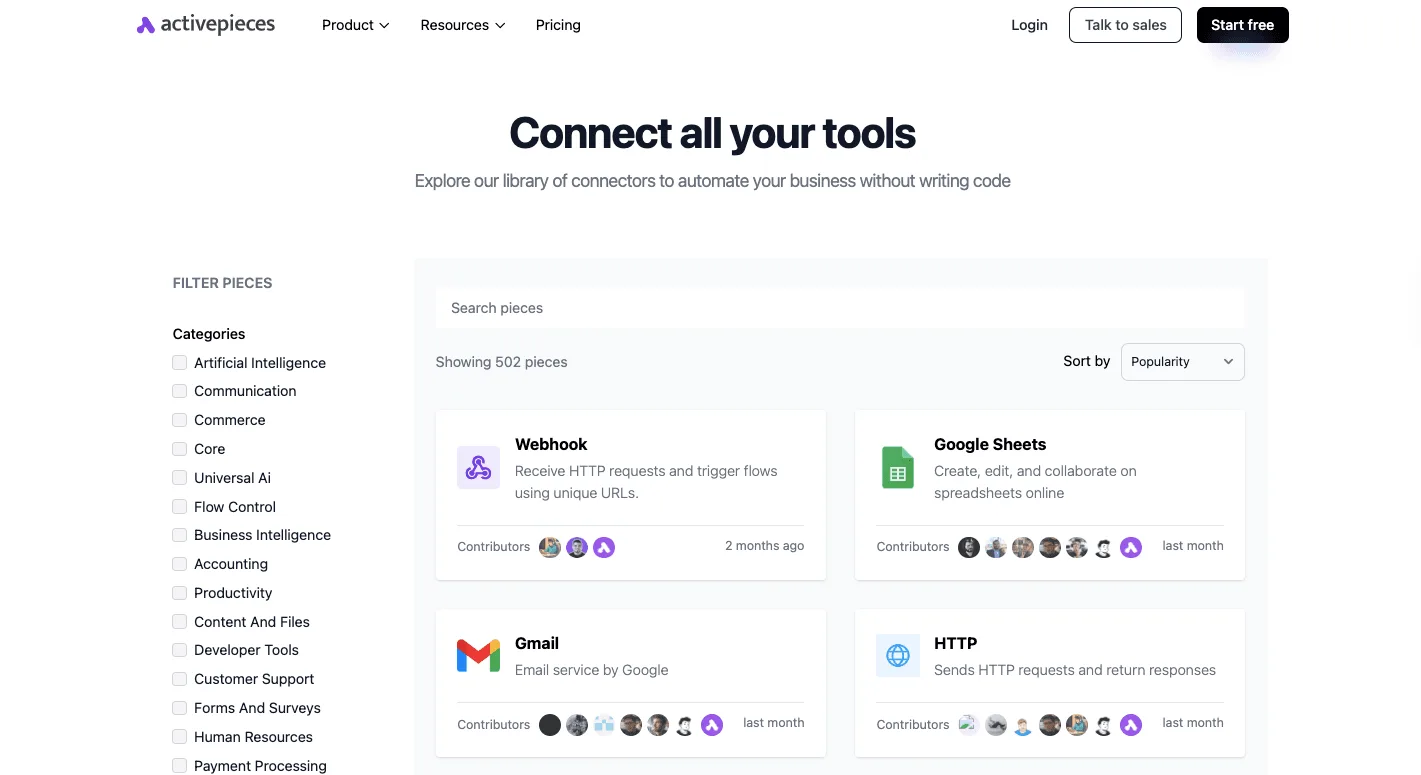
The schedule belongs to that tool, not to Poe. Test one run by hand first, because a schedule that fails silently looks identical to one that never fired.
Does a Poe API call use my subscription points? Treat it as yes until the points page tells you otherwise for your plan.
Calls spend from a points balance, and a loop that looks cheap in a test can drain the balance overnight. Set a cap in your own code, log the cost of each call, and read the points page before the first unattended run.
What should I do when Poe returns a rate limit error?
Stop sending, wait, then retry with a growing delay and a hard ceiling on attempts. Retrying immediately in a tight loop turns one rejected call into a burst of them.
After the ceiling, fail loudly: send an alert to a person instead of dropping the item. Check Poe's error page for the exact codes, since your handler should branch on those and not on message text.
Is a Poe workflow the same as a Poe bot? No. A bot is something you talk to or call, a single prompt and model setup.
A workflow is the sequence around it: trigger, call, check the result, retry, hand off. A good bot inside a fragile workflow still fails at the first limit it hits.
Related reading
Build it
Set this up in minutes.
No code required. Connect your accounts, and Activepieces runs it from there.
Start free Talk to sales