
Private AI for Business: A Guide to Secure Deployment

Oct 13, 202614 min read
Private AI is a structural commitment to hosting large language models and execution engines within a self-managed infrastructure to ensure sensitive information never exits your corporate firewall.
This architecture eliminates the third-party transit risks inherent in cloud-based services by treating the model as a local asset rather than a remote service.
Keep business data inside your perimeter
The difference between public and private LLMs
Every prompt travels over the open internet to a vendor’s server when using public LLMs, creating a permanent record of your corporate queries outside of your internal control. By contrast, private LLMs function by bringing the compute to the data.
Proprietary documents and customer records stay on local hardware or a private cloud instance. By keeping the model local, you prevent the accidental ingestion of trade secrets into a vendor’s global training set.
Why data sovereignty is the primary driver
Data sovereignty is the legal and technical requirement that digital assets remain subject to the laws and governance of the jurisdiction where they were collected.
When you use tools like Activepieces to automate workflows, a self-hosted deployment ensures that the logic and the data stay within your company’s physical or virtual boundaries.
For your self-hosted deployments, this level of isolation is the only way to satisfy strict regulatory frameworks that prohibit data residency in foreign cloud regions.
The three tiers of AI privacy
- Public SaaS involves accessing models via public APIs. The vendor processes data on shared infrastructure.
- VPC-Hosted models reside within a Virtual Private Cloud. This setup ensures network isolation while still using a cloud provider’s hardware.
- Air-Gapped On-Premise models and orchestration engines run on physical hardware with no external internet connection. This is the highest level of security for your classified or highly regulated environments.
This takes minutes, not a project: automate it in Activepieces free.
Open-weight models vs proprietary performance
Open-weight models now deliver parity with top-tier closed systems. Your private infrastructure choices don't force a compromise on raw intelligence. You can deploy frontier-level reasoning within your own security perimeter without the performance tax previously associated with self-hosting.

Why 70B parameter models dominate deployments
High-reasoning capabilities and manageable hardware requirements meet their optimal balance in the current generation of mid-sized models. LLMRun reports that Llama 3.3 70B reaches a score of 86.3% on MMLU.
This means a single high-density node can now handle complex agentic workflows that previously required a massive cluster or a cloud API.
Similarly, Qwen2.5 72B hit 85.3% on the same benchmark, placing it among the highest-performing models of that generation for complex reasoning tasks, which showed that users could expect state-of-the-art logic from a single model.
This score is a viable alternative for multilingual environments that need to maintain strict data residency.
Evaluating MMLU and coding benchmarks
Massive Multitask Language Understanding (MMLU) scores demonstrate that open models have closed the gap with proprietary giants. The following data illustrates that intelligence is now a commodity available for your local deployment:

87.2% MMLU was the leading score held by DeepSeek v3 in that benchmark, illustrating how capable open models had become for highly technical architectural decisions at the time.
Phi 4 achieved 84.8% in that benchmark, demonstrating that smaller architectures could rival the capabilities of significantly larger counterparts, so developers could deploy high-performance AI on more efficient infrastructure. This score enables sophisticated reasoning in edge computing scenarios with limited memory.
Llama 3.1 405B scored 84.5%, proving that even the largest open weights were competitive for massive-scale synthetic data generation, showing that organizations had reliable options for building their own training sets, which meant developers could reduce their dependence on proprietary APIs.
You can produce high-quality training sets without relying on proprietary APIs. Mistral Large 3 sits at 80.0%, offering a robust multimodal foundation for document-heavy enterprise processing, making it an ideal choice for businesses managing complex paperwork, so firms can automate data extraction with greater confidence.
Hidden costs of open-weight model licensing
Weights are accessible, but the infrastructure to serve them at scale introduces significant operational costs. Running a model like Mistral Large 4 requires a dedicated GPU cluster, meaning the "free" license is exchanged for an upfront capital expenditure in H100 or A100 hardware.

You must also account for the specialized labor required to maintain low-latency inference engines, as private deployments don't benefit from the managed auto-scaling provided by cloud vendors.
Infrastructure requirements for self-hosted AI models
Self-hosting AI requires a dedicated hardware stack where you exchange the convenience of cloud scaling for total physical control over data residency. This infrastructure shift necessitates a precise alignment between the chosen model’s parameter count and your available hardware.
GPU vs CPU hardware for LLM inference
GPU-based inference is the standard for private deployments. Parallel processing provides the low-latency responses required for real-time agentic workflows. While CPU-only inference is technically possible, it often results in token generation speeds that are too slow for interactive use.
The following table illustrates how model size and precision levels dictate the minimum Video Random Access Memory (VRAM) required to load a model into a single or clustered GPU environment.
| Model Size | FP16 (High Precision) | FP8 (Balanced) | 4-bit (Compressed) |
|---|---|---|---|
| Llama 3 8B | 16GB | 8GB | 5GB |
| Llama 3 70B | 140GB | 70GB | 40GB |
| Llama 3 405B | 810GB | 405GB | 230GB |
Multi-node GPU clusters are a necessity for large-scale models like Llama 3 405B, which increases the complexity of your local networking fabric.
Choosing between open-weight and proprietary models
You must choose between open-weight models that offer full transparency and local versions of proprietary architectures. Mistral Large 4 is a state-of-the-art multimodal framework for teams that need to process both text and visual data within their own perimeter.
DeepSeek-V4-Pro-0813 is a flagship choice for high-reasoning tasks where vision support isn't a requirement. Codestral is a dedicated completion engine for your development teams who must keep their proprietary source code off third-party training sets.
The role of the Vector Database in private RAG
A vector database acts as the long-term memory for private Retrieval-Augmented Generation (RAG) by converting your internal documents into searchable mathematical representations. This component ensures that the LLM only accesses authorized internal data.
By hosting the vector store locally, you ensure that the semantic index of your entire knowledge base never leaves your encrypted local volume.
You can follow the rest of this with the builder open. Start free, no card.
Total cost of ownership and deployment speed
Private AI infrastructure requires trading immediate capital for long-term sovereignty. While public APIs offer instant access, private deployments demand a deliberate setup phase to ensure the underlying compute is as secure as the data it processes.
Private cloud VPC vs on-premise hardware costs
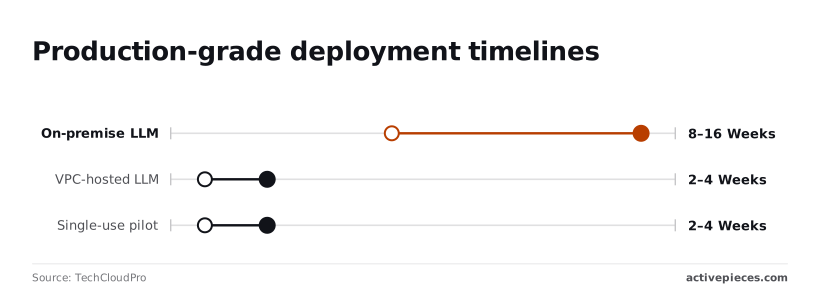
2 to 4 weeks is the time it takes to move from architecture to a live environment in a Virtual Private Cloud (VPC), according to TechCloudPro. This means you can begin validating models like Mistral Large 4 within a single month.
In contrast, full on-premise LLM integration requires 8 to 16 weeks to reach production.
Procuring high-end silicon like the NVIDIA H100 SXM5 involves an upfront cost of $30,000 per unit, whereas renting the same chip at a median hourly rate of $3.99 converts that massive capital expenditure into a manageable operating expense, allowing companies to scale compute resources without locking up significant cash, effectively lowering the barrier to entry for smaller AI research teams, which means startups can access enterprise-grade power without depleting their runway.
Even a single-use pilot takes 2 to 4 weeks to stabilize. This ensures that even temporary tests are built on secure networking, so your developers must account for this lead time.

Ongoing maintenance costs for private LLM hosting
Operating private AI means owning the full stack, from driver compatibility to model quantization. When you host a model such as DeepSeek-V4-Pro-0813 locally, your team is responsible for the orchestration layer.
Roughly 20% is added to the total headcount cost of the project to cover specialized site reliability engineering. This "Day 2" burden is the price of control. Without a managed provider, a single driver mismatch can take down the entire inference engine.
Quantifying the cost of a data breach vs. private hosting
The premium paid for private infrastructure acts as an insurance policy against the catastrophic legal and brand liabilities of a leak. While a VPC setup costs significantly more than a standard SaaS subscription, the investment is dwarfed by the average cost of a data breach.
**The premium paid for private infrastructure acts as an insurance policy against the catastrophic legal and brand liabilities of a leak.
$4.8 million is the current global average cost of a data breach, so companies must prioritize cybersecurity investments to avoid devastating financial losses.
By keeping sensitive reasoning tasks within a controlled perimeter, you eliminate the risk of your proprietary data being ingested into a provider's global training set.
Orchestrating secure workflows with Activepieces
Activepieces executes automated actions between your internal databases and private language models without exposing sensitive credentials to third-party cloud orchestrators. This architectural choice ensures that every step of a business process remains within your firewall.
Deploying automation within a private network
Deploying Activepieces within a private network allows you to maintain an air-gapped automation layer that functions independently of external internet connectivity. The core platform is MIT-licensed and supports deployment via Docker, Docker Compose, or Kubernetes.
Infrastructure teams can manage the service using their existing container orchestration patterns. Because the Community edition permits unlimited runs on local hardware, you can scale complex agentic workflows without incurring variable execution costs.
Regulated organizations like MoneyGram and FundingSocieties run this air-gapped edition in production to maintain absolute sovereignty over their automation logic. The self-hosted air-gapped documentation lists the same enterprise governance features (including SSO, SCIM, custom RBAC, audit logs, and release management) as the managed cloud tier.

Connecting private LLMs to internal business apps
The platform bridges the gap between raw compute and functional utility by allowing AI agents to call local models, such as Mistral Large 4, to process data stored in your internal systems. This integration is the PII Scrubbing Workflow.
- First, the system ingests a raw document from internal storage.
- Second, it runs a local NER (Named Entity Recognition) model.
- Third, it redacts 40+ entity types at 99.4% accuracy, ensuring that sensitive information is almost entirely scrubbed from datasets before they are processed, so privacy compliance is maintained with minimal manual oversight.
- Finally, it passes cleaned text to the reasoning engine.
Every credential the system touches can be routed to your own secret manager rather than an external database. This architectural isolation is why teams at Alan and Moneypenny can automate across sensitive departments without creating a central point of failure.
Enterprise governance: SSO, RBAC, and audit logs
Standardizing on a private automation engine requires centralized control over who can modify critical business logic or access connected secrets. Activepieces provides this governance by allowing you to route every API key and OAuth token to your own secret manager rather than a vendor database.
This ensures that no third party, including the platform provider, ever holds the credentials your business runs on. Role-Based Access Control (RBAC) restricts workflow permissions by department, while detailed audit logs track every execution and configuration change.
For you, if you require these governance tools or support for air-gapped deployments, specific licensing and implementation guidance is available through the Activepieces sales team.
Business use cases for air-gapped AI agents
Air-gapped AI agents allow you to automate workflows involving highly sensitive data without ever exposing that information to the public internet. By hosting the execution environment on your internal infrastructure, you maintain a hard boundary between your proprietary intelligence and the outside world.
AI agents for legal contract review
Legal teams use private agents to summarize contracts and identify liability risks without uploading privileged communications to external servers. When your firm runs Mistral Large 4 on its own hardware, the model processes every clause locally.
Trade secrets remain within the physical control of your IT department. This setup is the only way to satisfy strict "no-cloud" mandates often found in government defense contracts.
Internal knowledge bases for proprietary R&D house data
R&D departments utilize private AI to query decades of experimental results that represent your company’s core intellectual property.
Using Gemini Embedding 2 on a local server allows your researchers to perform semantic searches across your entire document library without the risk of their research trajectory being leaked through API metadata.
Secure customer support for regulated industries
Financial and healthcare institutions deploy private agents to handle inquiries involving personally identifiable information (PII). By routing these requests through Claude Haiku 5.5 in a self-hosted environment, you can sanitize incoming data before it reaches any human agent.
You can also automate routine status updates while keeping the database connection entirely behind your corporate firewall. Finally, you generate audit logs that prove no customer data left your sovereign network.
A Monday morning roadmap for private AI implementation
Implementing private AI requires a transition from consumption-based cloud thinking to resource-based infrastructure management. This shift ensures that data never leaves your local network.
Stability in your local stack is determined by the sequence of these steps:
- Audit VRAM availability on existing or rented hardware to determine the maximum parameter count the system can support without offloading to slower system memory.
- Select a quantization level, such as GGUF for CPU/GPU compatibility or EXL2 for dedicated GPU performance, to balance model precision against hardware constraints.
- Deploy an inference engine like Ollama for ease of use or vLLM for high-throughput production needs to expose the model via a local API.
- Connect the first internal application to verify that the network routing maintains total isolation from the public internet.
Frequently asked questions about private AI for business
Can private AI be truly air-gapped?
True air-gapping is achieved when the entire inference stack and orchestration layer reside on a local network with no physical or logical path to the public internet. This configuration ensures that sensitive data never leaves your premises. This provides a level of security that satisfies the most stringent regulatory requirements for defense and intelligence sectors.
Do private models perform as well as GPT-6 Astra?
Modern open-weight models frequently match or exceed the performance of legacy proprietary systems in specialized benchmarks. While GPT-6 Astra remains a flagship for general reasoning, you'll often find that Mistral Large 4 or Claude Fable 5.1 provide superior results. These models work well for specific agentic coding and long-horizon tasks when fine-tuned on your internal datasets.
What is the minimum hardware for a private LLM?
Parameter count and the precision of weights determine the minimum hardware requirement. Running a compact model like Ministral 3 3B requires significantly less VRAM than a flagship like Gemini 3.1 Pro. This means you can often begin testing on existing workstation GPUs before investing in dedicated data center clusters.
How does SSO work with self-hosted AI?
Self-hosted AI platforms integrate with your existing identity providers through standard protocols to ensure that only authorized personnel can access specific models or automation workflows.
By connecting to a central directory like Okta or Active Directory, you maintain a single source of truth for user permissions. This simplifies the offboarding process and prevents unauthorized data access when a team member leaves your company.
Related reading
References
Build it
Set this up in minutes.
No code required. Connect your accounts, and Activepieces runs it from there.
Start free Talk to sales