Resemble AI Pricing 2026: Plans, Rates & Add-On Costs

Nov 11, 202616 min read
Resemble AI sells four tiers, Flex, Team, Business and Enterprise, and the public page publishes plan prices and per-second processing rates, though concurrency and the rules on cloning are not spelled out.

Resemble AI is a voice API vendor. It provides text-to-speech, voice cloning and related speech tooling that developers call from apps, agents and automations.
Ask an accountant's first question, what one run costs, and the headline price alone won't answer it for this vendor. The limits that set your real cost sit in other columns.
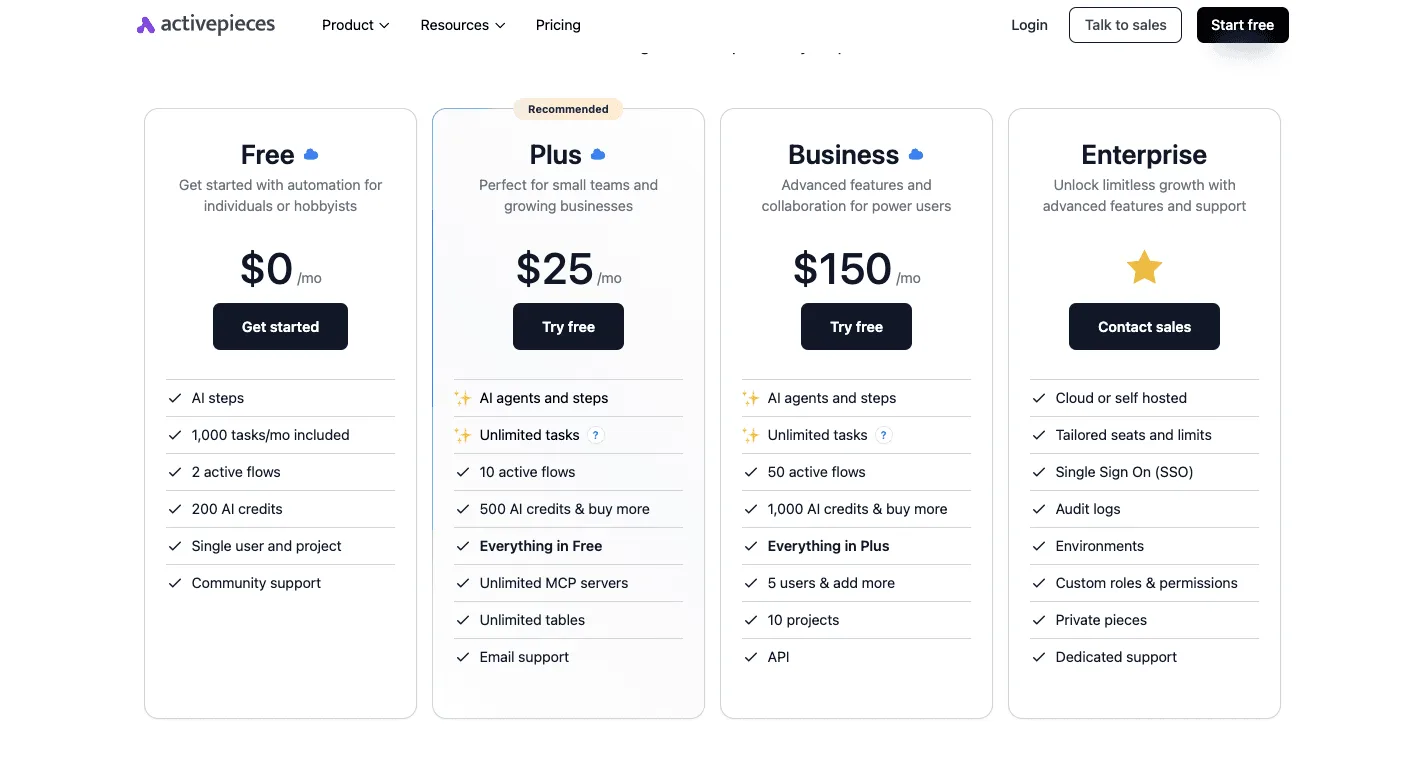
If you call the API from a workflow in Activepieces, whose free plan gives you 1,000 credits a month at $0, every call still counts against Resemble's plan usage and concurrency limits.
Resemble AI pricing structure
Resemble AI plans compared in one table
Six columns decide a build, and the table lists each tier against all of them: price, included usage, voices, languages, concurrency and commercial use.
A cell reading "not published" means a figure couldn't be confirmed, so treat that cell as a question to put to the vendor, not as a zero.
| Plan | Price | Included usage | Voices | Languages | Concurrency | Commercial use |
|---|---|---|---|---|---|---|
| Team | not published | not published | not published | not published | not published | not published |
| Business | not published | not published | not published | not published | not published | not published |
| Enterprise | not published | not published | not published | not published | not published | not published |
The gaps are the finding. You can't multiply a rate by your volume when the rate, the allowance and the concurrency cap are all missing. Get each figure in writing before you pick a tier.
What the free tier allows
I couldn't confirm free-tier terms on the check date, so I won't guess at them. Before you prototype on any free allowance, check three things: whether you may use generated audio commercially, whether the plan allows cloning, and whether it caps concurrency.
A free tier that bars commercial use is a trial, and you rebuild anything you build on it when you move to a paid plan.
Resemble AI Enterprise pricing quoted through sales
At Enterprise, pricing moves behind a conversation. Any tier that needs a sales call to understand its own price is one you can't cost from the outside.
Ask for the per-minute rate, the concurrency ceiling and the cloning rules in writing, then run the same arithmetic on two or three alternatives. The rest of this integration shows how to do that.
If you are running this arithmetic for your own team, see what the same workload costs on Activepieces.
Resemble AI costs by volume
On Flex, Resemble AI costs $30 a month at 1,000 minutes, $300 at 10,000 and $3,000 at 100,000. Flex's audio detection rate is $0.03500 per second, while Team and Business pay $0.01500 per second.
Because Resemble AI's pricing page publishes plan fees and per-call rates, every monthly total here is my arithmetic. The table prices each volume on Flex. Read the cost-per-minute column first: it doesn't move, so only the plan fees can break the line.
| Minutes | Plan fit | Monthly cost on Flex | Cost per minute | Behaviour at the cap | Published or derived |
|---|---|---|---|---|---|
| 1,000 | Flex | 1,000 × 60 × $0.0005 = $30 | $0.03 | No cap; the bill scales with use | Rate published, total derived |
| 10,000 | Flex or Team | 10,000 × 60 × $0.0005 = $300 | $0.03 | No cap; the bill scales with use | Rate published, total derived |
| 100,000 | Team or Business | 100,000 × 60 × $0.0005 = $3,000 | $0.03 | No cap; the bill scales with use | Rate published, total derived |
Nothing stops your build, and nothing stops the invoice either; the no-cap column cuts both ways. Any fixed fee is a poor trade here: Team's $280 a month on annual billing would be nearly ten times the usage cost.
Resemble AI cost at 10,000 minutes monthly
$300 on Flex is already above Team's $280 a month on annual billing. Team on monthly billing costs $350 versus $280 billed annually, which saves $840 a year, so the monthly rate is what buys you the freedom to leave.

Flex passes that figure at about 11,700 minutes. If your volume sits near 10,000 and is steady, the plan fee is the number to negotiate, and one that hides behind a sales call deserves suspicion.
Resemble AI cost at 100,000 minutes monthly
At 100,000 minutes a month, Flex reaches $3,000. Business costs $800 a month billed annually, or $1,000 billed monthly, so the pay-as-you-go line is three to nearly four times the fee.
Flex passes the Business annual fee near 26,700 minutes, which means Business annual is more economical at higher usage. Check Business's allowances, concurrency and cloning rules before you count on the saving.
Hidden costs and tier limits
Five limits do the pushing: concurrency, clone add-ons, consent rules, enterprise-only assurances and detection billing. Most only appear once you cost a real workload instead of a demo.
Check them in this order, because each turns a flat plan price into a variable bill.
- Your plan sets concurrency and Resemble publishes no requests-per-second limit, so you can't size capacity from the pricing page and have to ask before launch.
- Clone add-ons cost $2 per voice per month: for Rapid and $5 for Pro, so a product that gives each customer a cloned voice pays that charge for every customer, every month.
- Consent rules govern who may be cloned, so a user-upload feature needs a verification flow before it needs a plan.
- SLA and SOC 2 are enterprise-only, so a buyer who requires either pushes you off self-serve whatever your volume.
- Resemble bills detection at $0.035 per second, or $2.10 a minute, so screening every inbound call adds a charge that grows with traffic, not with your plan.
When simultaneous callers each hold a stream open, concurrent requests are what break a voice agent first. Ask what your plan allows at peak, not on average, and what happens at the ceiling: queueing, errors or throttling.
Read the consent terms before designing onboarding, because plan tier, per-voice add-ons and consent requirements all gate cloning. If your users clone their own voices, you inherit the verification work and the cost of every stored voice.
You will rarely see a published speed claim match a workflow that waits on a full audio file. Test time to first audio on your own plan, with streaming on, from your own region.
A slow first byte makes a live conversation feel broken however cheap the minute.
Check whether your plan's terms cover commercial deployment, redistribution inside a customer-facing product, and resale. A prototype that's fine on one tier can breach the licence the day it takes payment.
Give detection, clone add-ons and anything else outside the base plan price their own line in your cost model. A bill that reads cheap per minute can double once the extras run on every call.
Activepieces makes every connected integration available as a tool, and if a voice vendor's integration doesn't exist yet you can generate it with AI and add it privately to your own instance, so a flow that guards those per-call extras for Resemble moves to another vendor by swapping the integration.
Its core carries the MIT licence, and the 747 integrations are counted straight from the packages/integrations/community directory of the open-source monorepo on GitHub, so the step doing the calling is code you can read.
It's a way to wire the API in, not a reason to choose Resemble.
Resemble AI against ElevenLabs, Cartesia and Play.ht
At 10,000 minutes a month, Resemble's Flex plan and Cartesia's promotional rate both come to $300, while ElevenLabs agents come to $1,000, over triple the cost, so cost-conscious teams will default to Flex or Cartesia.

That's the spread the last line warned about, and the cheapest row may not stay cheapest.
The figures below come from Cartesia's pricing page.
Price per minute at each volume
Read the table for what each priced option costs at 10,000 minutes. Take from it the per-minute rate, and note which rows are promotional.
| Provider and plan | Cost at 10,000 minutes | Per minute |
|---|---|---|
| Resemble Flex | $300 | $0.03 |
| Cartesia promo | $300 | $0.03 |
| Cartesia regular | $600 | $0.06 |
| ElevenLabs agents | $1,000 | $0.10 |

While it lasts, the promo halves the bill, but Cartesia's regular rate is $600 a month, so you should build your budget assuming this higher rate. Budget at $600 and treat $300 as a bonus, meaning you're protected regardless of whether the promo lasts.
It's not a like-for-like comparison: ElevenLabs agents at $1,000 a month is a conversational-agent product, not plain synthesis. It's dearer because it bundles more, and you pay for that bundle on every minute whether you use it or not.
I have no confirmed 10,000-minute figure for Play.ht, so I don't rank it here.
Scale this linearly only as a first pass. At 100,000 minutes the same rates imply $3,000 for Resemble Flex and $10,000 for ElevenLabs agents, a $7,000 monthly gap that's worth a written quote before you commit.
Concurrency, languages and latency
I have no verified concurrency caps, language counts or latency claims for these four, so I'm not printing any. Those are the limits that force a plan upgrade, and a rate card that omits them is the one to distrust.
Get each cap in writing, then load-test your peak simultaneous calls before you pick a plan.
Which one fits which kind of build
For plain synthesis at volume, Resemble Flex and Cartesia are the cheapest on the evidence above.
Their rates are $0.03 and $0.06 a minute respectively once the promo ends, leaving Resemble at exactly half Cartesia's rate, which means at 10,000 minutes Resemble costs $300 versus Cartesia's $600.
ElevenLabs agents suits a build where you want the agent layer bought rather than assembled. Play.ht stays unpriced until you can verify a figure.
Cost your own volume against two or three of these before you write any code.
Worth checking against a plan that does not meter every step: one credit covers a whole run on Activepieces.
The strongest case for paying Resemble's higher price
Pay the premium only when a regulator, a brand or an auditor will ask you to prove something that a per-minute rate can't show. Outside those cases, most builds pay for features they never switch on.
**Pay the premium only when a regulator, a brand or an auditor will ask you to prove something that a per-minute rate can't show.
Why Resemble's higher price can be justified
If one undetected fake, or one clone made without provable consent, gets through, it can cost more than a year of minutes. The objection says per-minute cost is the wrong yardstick, so the safeguards are the product and the minutes are incidental.
That holds in four cases:
- Regulated work, such as banking or healthcare calls, where you must run deepfake detection on audio you receive.
- Brand-sensitive voices, where watermarking lets you prove which audio is yours and which is a forgery.
- Private deployment, where audio and voice data can't leave your own infrastructure.
- Audit-grade consent controls, where you must show a record that the voice owner agreed to the cloning.
In these cases, a cheaper API that lacks the control isn't a cheaper option. It's an option you can't use, so the comparison ends before price comes into it.
Why the bill still has to be costed first
If none of those four describes your build, the premium is a rounding question, and you can only answer it with your own numbers.
CheckAPICost breaks a voice agent's cost per minute into text-to-speech at 3.2 cents, telephony at 1.4 cents, the language model at 1.2 cents and speech-to-text at 0.43 cents. Together that's 6.23 cents a minute, or about $623 at 10,000 minutes a month.

Speech synthesis is roughly half that total. So the voice vendor is the one line where your choice moves the bill, and a single cent added to it costs you $100 more at 10,000 minutes.
Telephony, the language model and transcription cost about the same whichever voice vendor you pick, so they won't rescue a premium you didn't need.
Price the features you'll actually use, then run the same volume through two or three alternatives. If detection, watermarking, private hosting and consent logs aren't on your requirements list, you're paying for them anyway.
Call Resemble AI from a workflow with Activepieces
You can't lower Resemble's price with Activepieces, but it gives you a place to build a flow with branches that guard the calls that create the bill.
It's an MIT-licensed automation tool with unlimited flows on every plan, including the free one, so a metering flow adds no per-flow fee.
Its HTTP integration (the built-in step for arbitrary REST requests) is enough to drive Resemble's API, so you can enforce the limits you just costed instead of discovering them on an invoice.
Build the flow in this order, because each step feeds the next and a failure at one should stop the rest:
- Keep the Resemble API token in an Activepieces connection, not pasted into a step. The token then lives in one place, so rotating it after a contractor leaves means one edit instead of a hunt through every flow.
- Use the HTTP integration to post the text and a voice identifier to the synthesis endpoint. Check Resemble's current documentation for the exact path and fields, since they differ between the standard and streaming interfaces.
- A synchronous call returns audio details directly, which suits short text. For longer text, treat the job as asynchronous: either have Resemble call a webhook trigger in a second flow, or poll on a delay. Webhooks cost you fewer billable flow steps than polling, so prefer them when your host can receive inbound requests.
- Download the returned file and write it to your own storage, then save its location alongside the source text. Generated links may expire, so the file you didn't copy is the file you pay to regenerate.
- Route a rate-limit response (HTTP 429) into a delayed retry with a growing wait and a fixed attempt ceiling. Without the ceiling, a concurrency limit turns into a loop that re-bills the same request.
Controlling Resemble AI costs with a usage counter
When a retry or a duplicate trigger fires, a quiet flow becomes an expensive one.
On Activepieces a run is 1 credit however many steps it has, so a guard step adds nothing on that side of the bill; the Resemble call is the cost worth guarding.
Before each synthesis call, read a monthly counter, add the length of the text you are about to send, and stop the flow if the total would pass the budget you set.
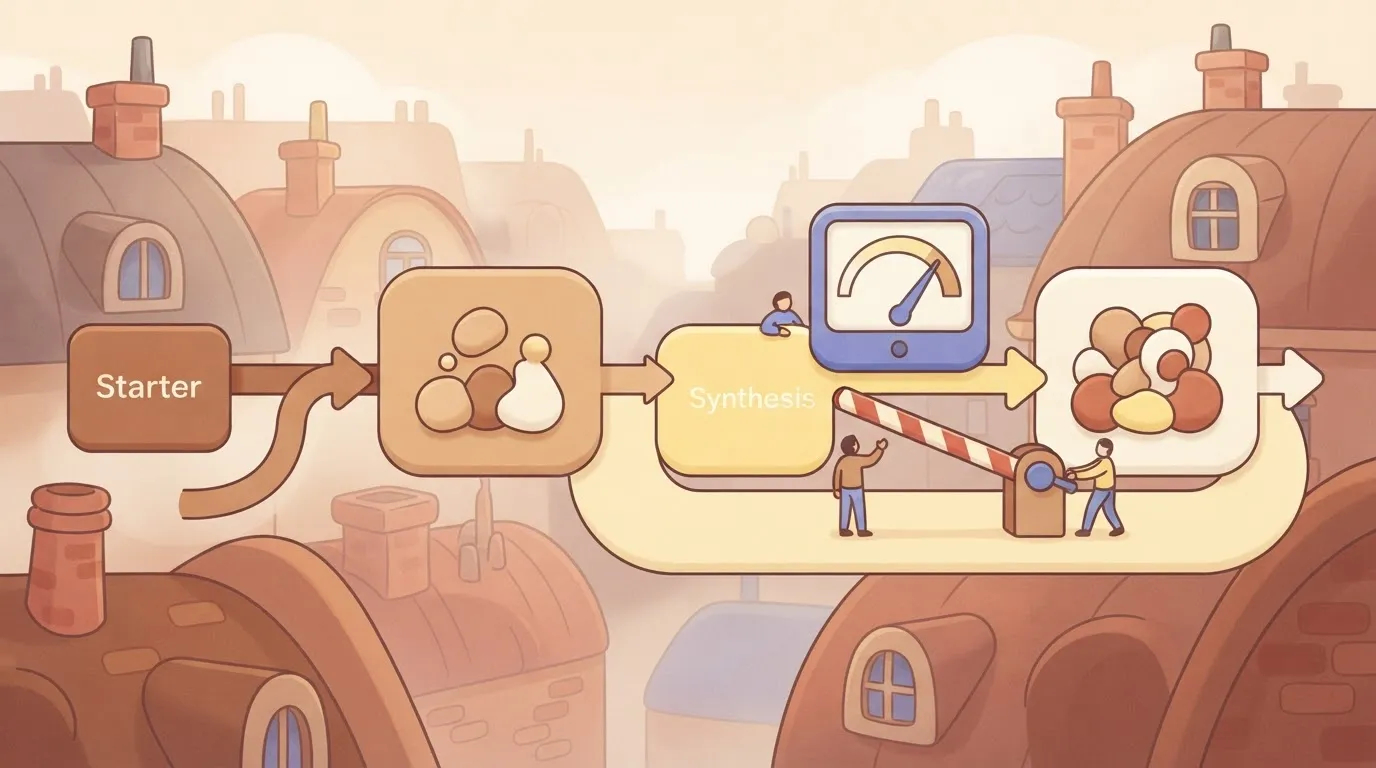
Hash the text and voice together as a key too, so identical requests return the stored file instead of paying for the same audio twice. The counter is only your estimate, so reconcile it against Resemble's own usage reporting each month.
- Confirm Resemble's current concurrency, cloning and commercial-use limits in writing, and note which of them sit behind enterprise-only terms.
- Estimate your monthly minutes from real text volume, then price that figure at the per-minute rate.
- Set the counter's ceiling below the point where you'd need a higher plan.
- Run the same flow against two alternative vendors and compare the cost per finished minute, not the headline rate.
Frequently asked questions
What is still unconfirmed
Reconciling the counter only works if you know what to ask, and four questions stay open until you read Resemble's own pages rather than anyone's summary of them:
- Whether Flex permits commercial use, answered by the licensing terms on Resemble's terms-of-service page.
- What a Rapid clone costs per month against a Pro clone, answered by the pricing page's cloning rows.
- How detection is billed, answered by the detection product's documentation rather than the speech pricing table.
- Whether the HTTP API publishes rate limits, answered by the API reference.
Until those are settled, every projection in this article carries a margin you can't size. The five questions below are the ones readers ask most.
Is there a free Resemble AI plan?
Check the pricing page on the day you build, because free allowances change and this article can't vouch for today's.
Treat any free allowance as a test budget, not a production tier, and confirm whether it covers commercial use and cloning before you demo to a customer.
Does Resemble AI charge per character or per minute?
The costing in this article runs on audio minutes, and that's the unit to model against. If another quote arrives in characters, convert it with your own scripts: synthesize a representative sample, time the audio, and divide.
Your speaking rate decides the exchange, not the vendor's rule of thumb.
Can I use Resemble AI voices commercially?
Commercial rights depend on the plan and on how the voice was made, so read the terms for your specific tier. Flex is the one to confirm in writing.
A stock voice and a clone of a real person can carry different conditions, and cloning usually requires consent from the speaker.
Does Resemble AI offer pay-as-you-go?
Look for a metered option on the pricing page, then ask whether it carries the same concurrency and cloning limits as the committed plans. Pay-as-you-go that caps parallel requests will cost you in queue time instead of dollars.
If the answer needs a sales call, treat that as information about the price.
Is Resemble AI cheaper than ElevenLabs?
It depends on your volume, and no headline rate settles it. Cost two or three vendors on the same basis: finished minutes per month, including retries, plus the concurrency tier you need and the monthly fee for each clone.
The cheapest per-minute rate often loses once those are added.
Related reading
References
Running the numbers
See what the same workload costs here.
Free forever plan, and every paid plan self-hosts at no extra cost.
See pricing Talk to sales