
Segment Pricing 2026: Free, Team and Business Plans

Oct 28, 202616 min read
Segment pricing is a ladder of four plans: a free tier, a self-serve Team plan, and two rungs of contracts you negotiate, Business and Enterprise.
Teams that already wire their data pipelines together with tools like Activepieces will find the free tier a low-risk place to start, while the Team plan suits those who want to buy without talking to anyone, and the Business and Enterprise contracts are where you sit down and haggle.
Segment meters all of them on monthly tracked users. I wrote this on 28 October 2026, and because Segment changes its tiers, confirm every number on its pricing page and docs before you commit.
Segment is a customer data platform: you send it events from your site, app and servers, and it routes them to the analytics, advertising and warehouse tools you use. Everything on the bill follows from how it counts the people behind those events.
Segment pricing plans and limits
What an MTU is and how Segment counts it
An MTU, or monthly tracked user, is a distinct user ID that sends Segment at least one event in a calendar month. You pay for people, not for events.
A high-traffic product with few users can cost less than a quiet one with many, which is why your MTU count, not the list price, drives the bill.
An MTU, or monthly tracked user, is a distinct user ID that sends Segment at least one event in a calendar month. You pay for people, not for events.
If your identity setup is loose, the count inflates. Anonymous visitors, logged-in users and devices can each register as separate identities until you merge them. Model that count before you compare plans.
Every current plan in one table
The table shows each plan's price and limits. Read it for the shape of the ladder: two tiers you can price yourself, and two tiers where you can't.
| Plan | Monthly price | MTUs included | Overage rate | Key limits (sources, Reverse ETL records) |
|---|---|---|---|---|
| Free | $0 | A small fixed allowance | No overage billing; the allowance is the ceiling | Tightest caps on sources and Reverse ETL records |
| Team | Published, self-serve | Set by the plan you pick | Published on the pricing page | Higher caps than Free, still fixed by plan |
| Business | Contact sales | Contact sales | Contact sales | Contact sales |
| Enterprise | Contact sales | Contact sales | Contact sales | Contact sales |
The two "contact sales" rows are the point. Once you outgrow Team, you can no longer calculate your own bill from a public rate.
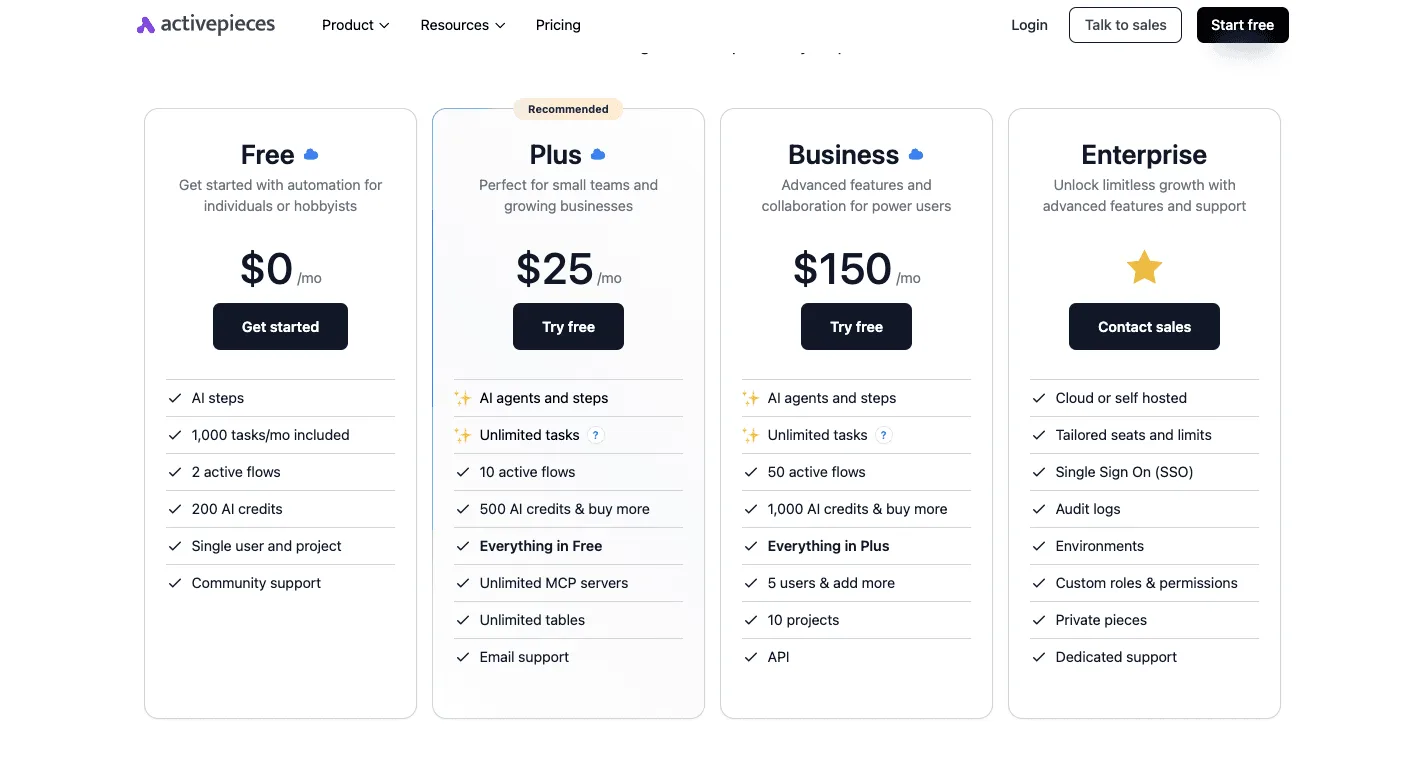
That matters if you're weighing Segment against a workflow tool you can price in advance: Activepieces lists unlimited flows from Free through Ultimate on its public pricing page, credits per run are the only meter, and its self-serve Team plan is $200 a month flat for 50,000 credits.
What each plan includes and where its limits sit
Free and Team are bounded by caps you can read and test against. Free suits a proof of concept, and Team suits a small production setup.
Check the source count and Reverse ETL record limits first, since Reverse ETL, which pushes warehouse data back into your tools, is where a growing team tends to hit a ceiling.
Business and Enterprise lift those caps, but their terms exist only in a quote. Treat the first quote as an opening position, and bring your modeled MTU count to the call.
If you are running this arithmetic for your own team, see what the same workload costs on Activepieces.
What Segment costs at realistic monthly usage
A 50,000-MTU app pays $575 a month, not $120, which means the flat tier covers only 20% of usage.
Segment's Team plan costs a flat $120 up to 10,000 MTUs, then about $11 to $12 for each additional 1,000, so the per-unit rate improves with larger orders.

The chart shows the bill at five volumes: flat at first, then close to a straight line.
Past 10,000 MTUs, the bill grows more slowly than usage.
A 5,000-MTU product team
At 5,000 MTUs the bill is $120 a month, according to the Twilio Segment docs. That works out to $0.024 per tracked user.
At 10,000 MTUs the same $120 buys half that unit price, so a small SaaS product is paying for headroom it hasn't used. Growth costs nothing until you pass 10,000.
A 50,000-MTU consumer app
At 25,000 MTUs the bill is $300: $120 plus 15 blocks of 1,000 at $12 each, or 1.2¢ per MTU. Reaching 50,000 adds 25 blocks at $11, which brings the bill to $575.
That's $0.0115 per user, about half the unit cost at 5,000 MTUs. Ten times the users still costs nearly five times the money.
At 100,000 MTUs the bill reaches $1,125. Volume discounts here are small, so expect to negotiate for anything meaningful.
Limits and fees that appear after signup
The first surprise is anonymous visitors. A consumer app that tracks logged-out traffic counts every device as a tracked user, so the MTU figure can sit well above your registered accounts. Model visitors, not customers.
The second is that the published rate card thins out around 100,000 MTUs. Beyond it, a quote conversation replaces the calculator, and you arrive without a comparable number unless you built one.
Then come the extras. Price every add-on you need before comparing Segment with a rival whose list price already includes it.

Segment against RudderStack, PostHog and mParticle on cost
Three of the four vendors here can be modelled from a public page: Segment bills on monthly tracked users, RudderStack and PostHog bill on events, and mParticle publishes no price. That gap decides which rival is comparable to Segment at all.
Billing unit and free tier compared
The table below shows what each vendor charges for and whether you can price it without talking to anyone. Read the billing unit column first, because it determines whether your bill follows people or activity.
, so the cells say what is known and leave the numbers to each vendor's own page.
| Vendor | Billing unit | Free tier | Published entry price | Bill when traffic doubles | Check date |
|---|---|---|---|---|---|
| Segment | MTU | Free plan offered, allowance not quoted here | Self-serve Team plan is published | Flat if the same people generate the extra traffic | Not checked for this article |
| RudderStack | Events | Free plan offered, allowance not quoted here | Published, not quoted here | Rises with event volume | Not checked for this article |
| PostHog | Events | Free allowance offered, size not quoted here | Usage-based rates are published | Rises with event volume | Not checked for this article |
| mParticle | Not published | None published | Unpublished | Unknowable without a quote | Not checked for this article |
The missing check dates are a warning in themselves. Vendors reprice often, so a comparison without a date is a guess, and you should confirm each row against the vendor's page on the day you decide.
List prices cannot be set side by side, because Segment and its event-billed rivals aren't measuring the same thing. You have to convert your own traffic into both units first.
Cost when traffic doubles
Doubling traffic doesn't mean doubling the bill, and which way it breaks depends on the unit. Under MTU billing, if the same visitors simply do more, Segment's count barely moves.
If doubled traffic means doubled distinct users, the count doubles and so does your position on the pricing ladder, which is where the jump to a negotiated contract appears.
Event billing behaves the opposite way. RudderStack and PostHog charge for every extra page view, click and server call, so a product with chatty tracking pays for its own verbosity even when the user base stays put.

Before you pick one, count both your users and your events per user.
You cannot run mParticle through this exercise. Its price arrives only after a sales conversation, so the doubling cost is whatever the quote says. A vendor that won't state a rate can't be budgeted against, and that alone is a cost.
Worth checking against a plan that does not meter every step: one credit covers a whole run on Activepieces.
The strongest case for paying Segment's price
When you feed many destinations with a small team, Segment's price can still be the cheaper option. It stops being cheaper when you have few destinations or mostly anonymous traffic.
Supporters put it as a build-versus-buy sum. Take the engineer's loaded hourly cost, multiply by the hours Segment saves, and compare that with the invoice.
Three features carry that argument, and each replaces a specific piece of work. The total of those integrations is the figure the invoice has to beat:
- The integrations catalogue replaces writing and maintaining a connector for every downstream tool (analytics, advertising, email, support). Someone also has to track each vendor's API changes, and that upkeep never ends.
- Tracking plans replace the hand-kept spreadsheet of event names and properties, plus the validation code that stops a typo from corrupting a dashboard. Without them, a small team spends its time arguing about what an event means.
- Warehouse syncs replace the pipeline that lands raw events in a database such as Snowflake or BigQuery, along with its retries, schema changes and backfills.
For a team of two or three developers sending the same events to a dozen tools, that work would eat a real share of the year. Under those conditions the premium is easy to defend.

When the sum works against Segment
Shrink the inputs and the same sum turns against Segment. With only two or three destinations, each direct integration is usually a small job, often a vendor's own SDK.
The catalogue then saves less than you pay for it, because you're renting breadth you won't use.
If most of your monthly tracked users are visitors you never identify, the case weakens further. You pay for each of them while getting little of the profile-building and cross-tool identity that justify the price.
A content site with a thin login funnel pays for volume and receives little of the value.
Whether the saved engineering time covers the premium therefore depends on two inputs: how many destinations you actually use and how many of your counted users are real, known customers.
Where Activepieces fits next to Segment
Activepieces takes an event and fans it out to apps through 746 integrations, which is the part of Segment's job that doesn't need a customer data platform.
It only substitutes for Segment when your real need is routing a handful of events to a few places, and that's a smaller job than the MTU-priced product is built for.
If the work is "when this happens, tell the CRM, the email tool and a Slack channel," you're paying for identity and pipeline machinery you never use.
Run the arithmetic the way I would for any per-unit service. A workflow that fires on an event and calls three apps has a cost you can estimate from your own event volume.
Activepieces' public pricing page lists unlimited flows from Free through Ultimate and meters credits per run, where a run is 1 credit however many steps it has, so that three-app workflow costs 1 credit per event.
Zapier's pricing page bills a task per action and Make's a credit per module, so on both the same workflow costs more with every step you add.
Free includes 1,000 credits a month, and Plus is $20 a month for 10,000, then $0.007 a credit over; that $20 gets you 10 times the free tier's quota. You can calculate it without booking a call.
A bill that scales with distinct users, as Segment's does, is harder to forecast because the unit is set by how identities are counted, not by what you actually ran.
Segment webhooks into a workflow
Activepieces can start a flow from a webhook, and Segment can send events to a webhook destination, so the two connect directly, and the Free plan's 1,000 credits a month cover 1,000 such runs.
The screenshot below shows the shape of such a flow on the builder canvas: a "Catch Webhook" trigger first, a "Read Connection" action second, and a "Send Message To A User" Slack step third. The Slack step is selected, with its configuration panel open.

Take from it that the Slack step reads the connection from step 2 and has plain fields for user, message and username, plus a Test Step button. You can check the output against sample data before anything goes live.
The consequence for cost: Segment still counts the user who triggered the event, so this setup doesn't lower your MTU count. It moves the downstream fan-out into a tool you can price by usage, which matters only if the destinations you need are few.
When Segment is still the right tool
Identity resolution, Segment's client SDKs, warehouse syncs: Activepieces, whose core is MIT-licensed, does none of these three.
It receives events someone else has already collected and stitched together, so it can't merge an anonymous visitor with a logged-in customer, and it doesn't capture data in your app or load it into a warehouse on a schedule.
If you depend on any of those three, the MTU model is the price of that capability. The right move is to model your count carefully rather than swap tools. If you don't, a webhook plus a workflow may cover the job for less.
A Monday checklist for sizing your Segment bill
Spend one morning on six steps before you compare plans. A high share of anonymous visitors is the one condition that can turn a comfortable estimate into a contract conversation.
If most of your traffic is people who never log in, your MTU count tracks your marketing reach, not your customer count, and the bill follows it.
The steps below run in order, since each one feeds the next:
- Export three months of MTU counts from your current analytics, or from Segment's usage view if you already have a workspace. Three months shows you the spread, so one campaign spike doesn't set your assumption and one quiet month doesn't hide it.
- Split anonymous from identified users, counting visitors with only an anonymous ID separately from those you have tied to an account or email. This split tells you whether you're paying for customers or for browsers, and it's the number most estimates skip.
- List the destinations you need: write down every tool that must receive data, such as your warehouse, ad platforms and email tool. Some destinations may push you toward a higher tier, so you want that list in hand before anyone quotes you.
- Redo the arithmetic at current volume and at double. Doubling shows whether your cost grows in a straight line or hits a tier boundary, and that boundary is where the self-serve plan stops being the answer.
- Get the overage rate in writing: ask what you pay per MTU past your plan's limit and whether it changes at renewal. A rate you can't see on a public page is a rate you can't budget, so don't accept it verbally.
- Set an MTU alert by configuring a notification well below your cap. An alert costs nothing, and without one you learn about a traffic spike from the invoice.
Put the results from steps two and four side by side. If your anonymous share is low, the list price will probably be close to what you pay.
If it's high, your own count, not the plan's sticker, decides the bill, and the answer to the next question depends on it: whether self-serve is enough or you need to negotiate.
Frequently asked questions
Is Segment free for small startups?
Segment has offered a free tier with a capped number of monthly tracked users, which is enough for a prototype or a very early product.
The cap is the catch: it's counted in tracked users, not in events or seats, so a product with a busy anonymous visitor base can hit it sooner than the team count suggests.
Model your MTU count before you build on the free tier. The migration cost later is usually larger than the savings now.
What happens if I go over my MTU limit on the Team plan?
Expect a conversation, not a smooth meter. Self-serve plans are built around an included MTU allotment, and exceeding it on the Team plan is billed at the rates posted on the pricing page, while Business contracts are negotiated.
That's the exact point where the list price stops predicting your bill. I'd treat the limit as a planning ceiling, and check the current terms in your account or order form before you rely on any overage behavior.
Does Segment charge per event or per user?
Per user, specifically per monthly tracked user, which is a count of distinct people or identifiers that sent data in a month. Event volume isn't the primary billing unit.
The consequence is that one user sending a thousand events costs the same as one user sending one, while a surge of anonymous visitors, each counted separately, can raise the bill without any gain in real customers.
Your identity-resolution habits matter as much as your traffic.
Can I downgrade or cancel Segment mid-term?
It depends on which side of the self-serve line you're on. Self-serve plans are typically billed on a short cycle and are easier to change or end.
A negotiated contract usually carries a committed term, and leaving early is governed by what you signed, not by the website. So read the renewal and termination clauses before signing, and don't assume the flexibility of the Team plan carries over.
Is there a Segment startup or nonprofit discount?
Segment has run startup and nonprofit programs, but eligibility, terms and availability change, and I can't confirm what is on offer today.
Ask sales directly and get any discount in writing, including how long it lasts and what the price becomes when it ends. A discount that expires into a full-price renewal is only a deferral, so ask for the post-discount number before you accept it.
Related reading
References
Running the numbers
See what the same workload costs here.
Free forever plan, and every paid plan self-hosts at no extra cost.
See pricing Talk to sales