Soniox Pricing in 2026: Rates and Alternatives

Nov 11, 202615 min read
Your bill depends on which products you call and how each one meters usage, not on one rate, because Soniox sells speech-to-text, text-to-speech and translation as separate usage-priced products, whether you call them directly or from a workflow built in Activepieces.
Soniox is a speech AI provider with an API for transcribing audio in bulk or live, processing text as tokens, generating speech and translating between languages.
To get cost per run, multiply minutes by rate and add whatever sits outside that rate; the table below shows where each of those integrations lives.
Soniox pricing plans and limits
Direct answer: what Soniox costs today
Today Soniox charges per product, and each product has its own unit. Asynchronous transcription, real-time transcription, text tokens, speech synthesis and translation don't share a meter, so a pipeline that chains two of them pays two bills.
Take every number from the pricing page itself.
Plan table: price, inclusions and limits
For each Soniox product, the table lists the fields that set the bill:
- price
- billing unit
- what the price includes
- the limits
Read it as a checklist for the pricing page, not as a rate card. "Not stated" means this article doesn't carry a confirmed figure for that cell.
| Product | Price | Billing unit | Inclusions | Limits | Checked | Link |
|---|---|---|---|---|---|---|
| Real-time speech-to-text | not stated | not stated | not stated | not stated | 2026-11-11 | soniox.com/pricing |
| Text tokens | not stated | not stated | not stated | not stated | 2026-11-11 | soniox.com/pricing |
| Text-to-speech | not stated | not stated | not stated | not stated | 2026-11-11 | soniox.com/pricing |
| Translation | not stated | not stated | not stated | not stated | 2026-11-11 | soniox.com/pricing |
Prices and plan limits checked against soniox.com on November 11, 2026.
Re-verify anything dated earlier than your build, because the check date is only when I last compared against the page. Next, the question that decides whether you pay at all while testing.
Soniox free credit and trial terms
I can't confirm a free credit or trial amount, so I won't give one. Before you build on it, check four things:
- whether the credit covers every product or only some
- whether it expires
- whether the trial caps concurrency
- whether the trial allows commercial use

If the trial covers only async transcription, it tells you nothing about real-time cost.
If you wire the API into Activepieces, Soniox meters the same as a direct call, and Activepieces counts a run as 1 credit however many steps it has, so test with the product you'll actually ship.
If you are running this arithmetic for your own team, see what the same workload costs on Activepieces.
Soniox costs across usage levels
Whichever way you call it, the meter is the same. Soniox runs $1.70 to $2 a month at 1,000 minutes, $17 to $20 at 10,000 and $170 to $200 at 100,000, according to VoiceCost, so you can forecast annual costs reliably.
The low end is async at $0.0017 a minute and the high end is real-time at $0.002, which makes any volume cost instantly calculable.
You can check the arithmetic yourself in the table, though the bill is an estimate based on the hourly equivalent.
| Volume | Async at $0.0017/min | Real-time at $0.002/min | Monthly bill | Free allowance applied | Plan or sales trigger |
|---|---|---|---|---|---|
| 1,000 min | 1,000 × 0.0017 | 1,000 × 0.002 | $1.70 / $2.00 | None assumed | None in the quoted figures |
| 10,000 min | 10,000 × 0.0017 | 10,000 × 0.002 | $17 / $20 | None assumed | None in the quoted figures |
| 100,000 min | 100,000 × 0.0017 | 100,000 × 0.002 | $170 / $200 | None assumed | None in the quoted figures |
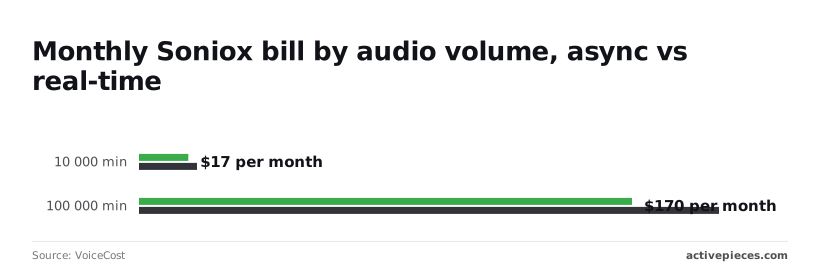
Budget with multiplication, not a quote request, because nothing in the quoted figures bends the line. What remains is the real-time premium at each volume.
At 1,000 minutes a month, async costs $1.70 and real-time costs $2.00. One 30-minute call is about 5.1 cents async, so the whole month is roughly 33 such calls.
At this size the pricing page is irrelevant. Your engineering hours cost more than the transcription.
At 10,000 minutes a month, the bill is $17 async or $20 real-time, meaning both options stay budget-friendly at this scale. The $3 gap is the real-time premium, about 20 percent of the async price, so the real-time option remains practical.
That's small, but it's the first point where choosing the wrong mode shows up on a statement. If a job can wait for a finished file, send it async.
At 100,000 minutes a month, async comes to $170 and real-time to $200, so the premium is now $30 a month, or $360 a year.
Real-time earns that only where a person is waiting on the words, such as live captions or a voice agent. A batch archive paying it is wasting money.
Even with no sales trigger in these figures, I'd still confirm your volume and limits with the vendor in writing before committing, since concurrency caps and usable minutes decide the real bill, not these rates.
Soniox hidden costs and limits
When your usage differs from the pricing page's assumptions, five levers move your Soniox bill more than the headline rate does:
- Whether Soniox charges for audio tokens, text tokens, or both
- Whether a job runs async or real-time, since the two have different prices
- The cap on simultaneous real-time requests
- File-size and duration limits on uploads
- The usage pattern that pushes you into a custom contract
I couldn't confirm a figure for the limits I describe below, so I name the lever and leave the number to the vendor's docs and your written confirmation.
Soniox billing unit and billable audio
Minutes are not the unit. Soniox meters in tokens. Audio going in is one token stream and transcribed or translated text coming out is another, each at its own rate.
Minutes are not the unit. Soniox meters in tokens.
Your cost per minute therefore depends on how dense the speech is and whether you request translation.
Even at equal length, a quiet call and a fast-talking sales call won't cost the same. Run a sample of your real recordings and divide the invoice by the minutes you actually used.
Soniox concurrency, file-size and duration limits
If your app opens one stream per user, the concurrency cap on real-time requests bounds how many users can talk at once, whatever you're willing to pay.
On async, the wall is a different one: file-size and duration ceilings mean a long recording must be split before upload. Splitting adds engineering time, and it can cut context at the seams. Budget for that work.
Features priced separately or bundled
When a workflow begins as a live demo and later moves to batch, its unit cost changes, because async and real-time carry different rates.
Check whether diarization, language identification and translation are bundled into the token rate or billed on top. The pricing page rarely says what a "transcript" includes, so test each feature on a sample and read the invoice line by line.
When Soniox needs a custom contract
Past a certain volume, or when you need more concurrent streams than the standard cap allows, the answer is a conversation with sales rather than a published rate. I distrust any tier I can't price from a public page.

Ask what triggers it, get the threshold and the post-trigger rate in writing, and treat your volume estimate as unpriced until you have both.
Worth checking against a plan that does not meter every step: one credit covers a whole run on Activepieces.
Soniox Against Deepgram, AssemblyAI and OpenAI Speech Pricing
At 10,000 minutes a month, Soniox has the lowest list rate of the four vendors. The gap is tens of dollars, not thousands, so the bundled features and limits matter more than the rate.
Convert 10,000 minutes and you get 166.7 audio hours, which puts the volume in human-scale perspective. Multiplying each published hourly rate from Soniox's pricing page by that figure gives the monthly bill before any add-ons.
The table covers batch rates only. Check each vendor's page for streaming rates, free credit and concurrency before you commit.
| Vendor and model | Rate per audio hour | Cost at 10,000 minutes |
|---|---|---|
| Soniox async | $0.10 | $16.67 |
| AssemblyAI Universal-2 | $0.15 | $25.00 |
| OpenAI GPT-Transcribe | not stated | not stated |
| Deepgram Nova-3 | $0.216 | $36.00 |
| OpenAI Whisper | $0.36 | $60.00 |
Where Soniox is cheaper
At $0.10 an hour, Soniox's async rate undercuts Universal-2 by a third, establishing Soniox as the clear budget leader, so any price comparison should start here. The chart below ranks the published batch rates, with Soniox lowest.

Its real-time rate is $0.12, so streaming costs 20% more than async, which still sits below every rival's batch rate except Universal-2's.
In dollars, against OpenAI's older Whisper rate the difference was $43.33 a month at 10,000 minutes, meaning it's worth factoring into decisions for operations at that volume. It was about $433 at 100,000 on those older rates, making provider choice a financially meaningful decision for large-scale operations.
That's real money for a high-volume transcription pipeline and noise for a prototype. Soniox also lists 60+ languages, so a multilingual product doesn't need a second vendor for coverage.
How competitor bundled features change Soniox pricing
Whether a low headline rate holds depends on whether the transcript you need comes out of the base price. AssemblyAI charges $0.21 an hour for Universal-3.5 Pro, which means buyers are committing to paying more than double the budget leader's rate.

That comparison only favors Soniox if you need those features and Soniox can supply them. If you need neither, the loaded figure doesn't apply and you pay the base rate.
If you do, price the full pipeline, including any redaction or speaker-labelling step you'd have to build or buy yourself.
Why Soniox headline rate matters most
Strongest argument for ranking by headline rate
If you rank on headline rate, the strongest argument is that it's the only price you can check before building. A vendor that wins on it has at least committed to a number in public.

Everything else is a guess. Add-on estimates, usage forecasts and "contact sales" tiers all give the vendor room to move the figure after you have integrated.
You can audit, screenshot and hold a published per-minute rate against an invoice. If two vendors have comparable accuracy, the cheaper published rate wins, and any extra analysis just adds assumptions to the comparison.
That's a sound rule for a pure transcription job: one language, no speaker labels, no redaction, and audio you send once. In that case the headline is close to the bill.
Why the ranking still shifts with billing unit and limits
In practice, real pipelines are not that job. Billing unit changes the arithmetic first: a vendor that bills per second of audio and one that rounds up per request charge differently on short clips, even at identical rates.
Then come the add-ons. Take Deepgram, a speech API vendor, priced for its Nova-3 monolingual pre-recorded model.
Switching on diarization, keyterm prompting and redaction more than doubles the hourly cost, so a vendor that looked cheapest as a bare model can finish behind a rival that bundles those features.
Read it as the size of the gap an unbundled feature can open.
Whether the cheap tier is usable at all comes down to concurrency caps and language limits. If your peak load exceeds the cap, you either queue jobs or move up a plan, and the plan you move to is the one you should have priced.
What would disprove the Soniox pricing claim
If the cheapest headline rate doesn't stay cheapest, the claim fails. Test that across vendors you actually shortlist, after you add the features you need, count billing in your real clip lengths, and stay under every limit at your peak.
Run that check on a sample of your own audio. If the order never changes, take the pricing-page figure and stop. If it changes even once, the headline was never the number that mattered.
Calling the Soniox API From an Activepieces Workflow
To measure what a run actually costs instead of trusting the pricing page, Activepieces lets you call Soniox's documented API from a scheduled flow with plain HTTP steps.
It doesn't change Soniox's rates. It gives you a place to count the minutes those rates apply to.
Send audio and fetch the transcript with HTTP steps
In the flow below you can see the shape: a schedule trigger, a code step that prepares input, then an HTTP step that calls an outside API. Your Soniox flow follows that skeleton, and the HTTP step is the part you replace.
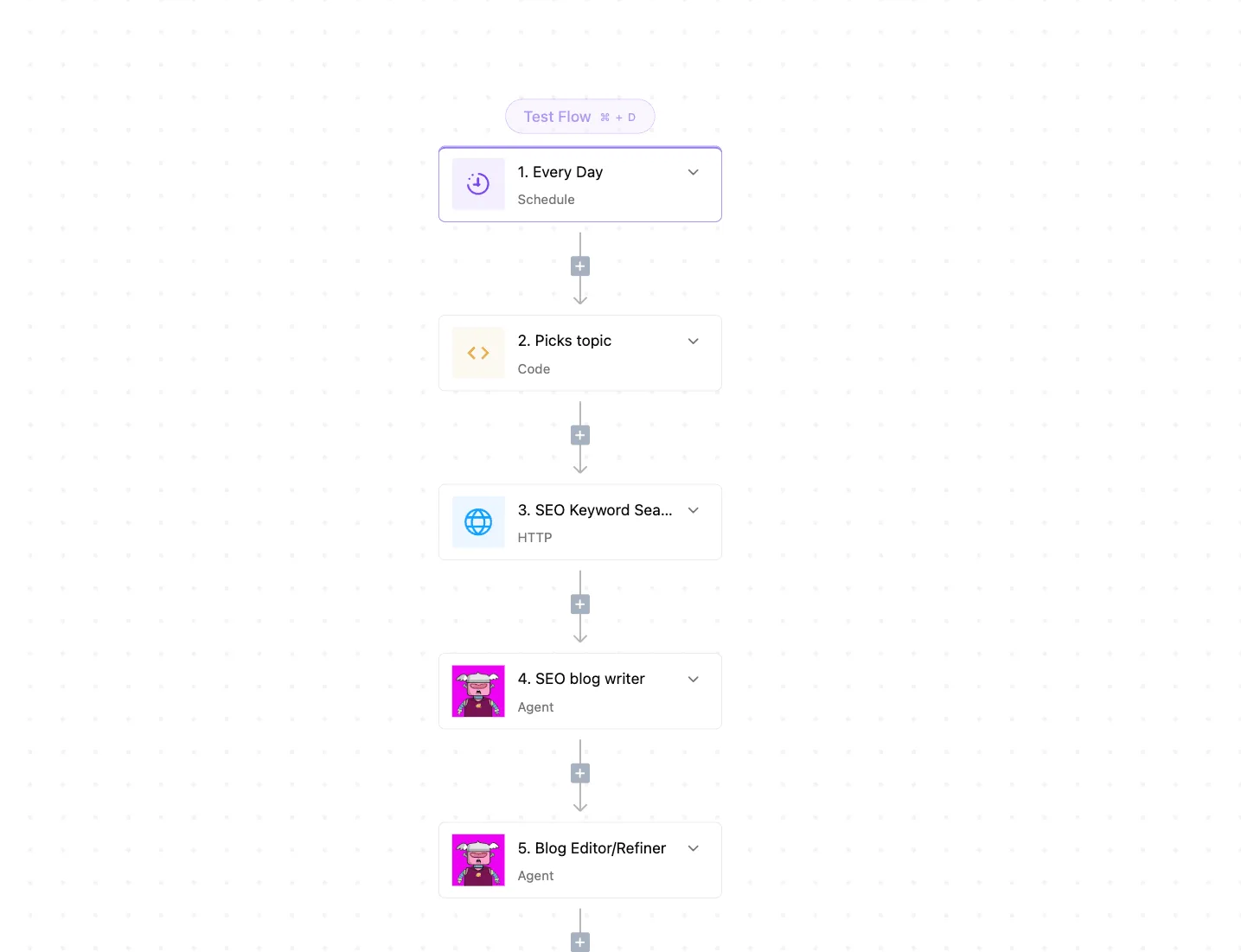
The agent steps after it are where a transcript would go for cleanup or summarising, and they're optional.
Upload the audio, create a transcription job, wait for it to finish, fetch the transcript: that is the sequence Soniox's docs describe for file transcription. Each stage becomes its own HTTP step.
If you'd rather have a ready-made Soniox step than raw requests and none exists yet, you don't wait on anyone's release schedule: Activepieces will have AI build the missing Soniox step for you, and it sits privately in your own instance.
The catalogue is 747 integrations counted from the open source monorepo, roughly 60% of them community-contributed, so the project has strong community backing.
Check the current Soniox docs for exact paths and fields before you wire anything.
Next, record what each run consumed.
Log minutes per run and alert on spend
Once the transcript returns, a code step should write one row per run to a sheet or database: file ID, audio duration, the date, and whether the job succeeded.
If a retry is billed, it's part of your cost per usable minute, which is why failed or retried jobs belong in that log too. Only a log that includes retries will show it.
Multiply logged duration by the rate you were quoted, and add a second branch that sums the month so far. When the total crosses a budget you set, send a message to email or chat.
If the rate or billing unit ever changes, the log is how you'll see it in your own numbers first.
- Build the four HTTP steps against a short test file and confirm the transcript comes back.
- Add the logging step and run it on a real batch.
- Compare the logged minutes with the usage Soniox reports. Any gap is a billing-unit question for the vendor.
- Set the spend alert, then rerun the cost comparison with your own measured volume.
Frequently asked questions
As read on 2026-11-11, the answers below are tied to Soniox's own pricing and terms pages. Where a page doesn't settle the question, the answer says what to measure in your own log.
Treat a free tier as unconfirmed until the account dashboard shows one. Sign-up credit is a one-time allowance, not a standing rate, so it should never appear in a monthly cost model.
Run your real audio through it once, record the billed units, and use that figure to price the paid rate.
Check what the billing unit is measuring before assuming silence is free. Streaming sessions are often metered by connection time or by audio sent, and neither stops when nobody is talking.
Send a test file that is mostly silence, compare billed usage with the speech actually present, and the gap is your overhead.
Can I use Soniox transcripts in a commercial product?
Read the terms of service rather than the pricing page, because the two answer different questions.
The pricing page tells you what a minute costs; the terms say what you may do with the output and whether your audio can be retained or used for training.
If your product resells or redistributes transcripts, get that clause confirmed in writing before launch.
Look for a commitment line on the pricing page, and treat any plan that needs a sales call to reveal its rate as a different product from the self-serve one.
A pay-as-you-go rate and a committed-volume contract can have different effective costs per usable minute. Compare them at your own volume, not at the figure each page leads with.
How do I stop an automation overspending on Soniox?
Put the limits in the workflow, not in your memory. Cap the audio length each run may submit, reject empty or duplicate files before they reach the API, and stop retries after a fixed attempt count so a failing step can't bill you repeatedly.
Add a spend alert at the account level if the dashboard has one, and compare the log's billed usage against it weekly. A runaway loop shows up there before it shows up on the invoice.
Related reading
References
Running the numbers
See what the same workload costs here.
Free forever plan, and every paid plan self-hosts at no extra cost.
See pricing Talk to sales