Tavus Pricing: Plans, Per-Minute Rates (2026 Guide)

Nov 11, 202614 min read
Tavus pricing is a tiered subscription with a per-minute meter on its developer API.
The numbers that set your bill are the included minutes, concurrency and replica terms, not the headline rate, so it pays to model them against real usage, even if that usage is just a workflow trigger in a tool like Activepieces that kicks off sessions on a schedule.
Tavus is a platform that lets developers add real-time, talking video avatars to an app or agent through an API.
Tavus Pricing in 2026: Every Plan and Rate
Plans table with the date it was checked
I couldn't confirm Tavus's published figures as of 2026-11-11, and a guessed price is worse than a blank, because you'd budget against it. So every cell I can't stand behind reads "contact sales".

| Plan | Monthly price | Billing unit | Included minutes | Overage | Concurrency | Replicas |
|---|---|---|---|---|---|---|
| Free | Free | contact sales | contact sales | contact sales | contact sales | contact sales |
| Paid tiers | contact sales | contact sales | contact sales | contact sales | contact sales | contact sales |
| Enterprise | contact sales | contact sales | contact sales | contact sales | contact sales | contact sales |
Treat the blanks as your to-do list: get each one in writing before you build.
What the billing unit is (minutes or credits)
If Tavus counts minutes, a conversation costs what it lasts. If it counts credits, you need to know how many credits a minute of video burns, or you'll budget against the wrong number.
The billing unit is what the meter counts, and it decides how fast a plan drains. Ask which one applies, and whether idle time with a live avatar on screen counts.
When you reach Enterprise, the limits become negotiable, and the tier is quoted rather than posted.
Tavus's consumer PALs tiers are a separate product from the developer API and are not priced here.
If you are running this arithmetic for your own team, see what the same workload costs on Activepieces.
Included minutes and concurrency limits by plan
On the developer API, the free plan gives you 20 minutes a month and one conversation at a time, which means you can validate a single integration point before the monthly reset.
What the free plan includes
20 minutes a month is what Free includes, according to APIs.io. That's two ten-minute demos, so a single stakeholder walkthrough can use up the month. APIs.io reports that Starter raises it to 60 minutes, three times the room but still one afternoon of serious testing.
Publisher's figures show Builder includes 175 minutes, Growth 1,300 and Business 4,000, so organizations must assess their testing volume to select appropriately. Against a 1,000-minute month, only Growth and Business cover the usage inside their allowance, per Publisher.
On Builder or below, you'd be paying overage on most of those minutes.
Tavus concurrency limits and session caps
When a second user opens your app while the first is mid-conversation, they get turned away or have to wait. Free and Starter both allow 1 concurrent session, per the publisher's pricing page. Builder allows 3, Growth 10 and Business 15.

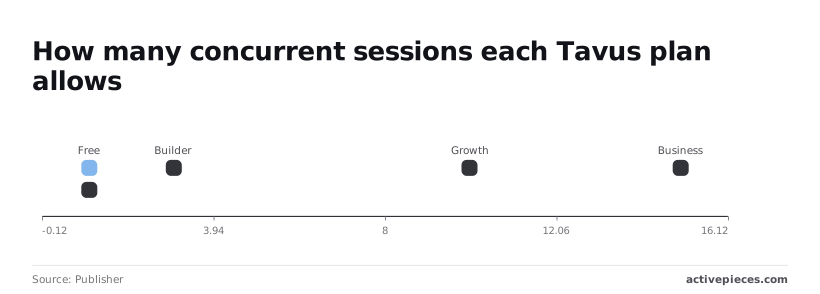
Moving from Free to Starter buys you more minutes but no extra simultaneous conversations, so if your users overlap, Starter doesn't fix your problem. At Business, a sixteenth simultaneous caller hits the same wall the second one hits on Free.
Nothing above settles whether a free-plan build can be put in front of paying customers. Read the plan's terms on commercial use and branding before launch.
Plan costs by monthly volume
As you grow, the cheapest plan changes. Builder wins at 1,000 minutes, Business beats Builder at 10,000, and Enterprise is cheapest of the three at both 10,000 and 100,000, so you should select based on your expected volume.
The table shows what each plan costs in total and per minute at three volumes.
| Monthly minutes | Builder | Business | Enterprise |
|---|---|---|---|
| 1,000 | $347.80 ($0.3478/min) | $397 ($0.397/min) | $975 ($0.975/min) |
| 10,000 | $3,498 ($0.3498/min) | $3,094 ($0.3094/min) | $2,535 ($0.2535/min) |
| 100,000 | $35,000 ($0.35/min) | $30,990 ($0.3099/min) | $25,940 ($0.2594/min) |

Totals are the effective per-minute figures from realtimeavatar.ai multiplied by volume.
At 1,000 minutes, Builder costs about $0.3478 a minute, Business $0.397 and Enterprise $0.975, per realtimeavatar.ai. Enterprise here is nearly triple Builder, so a pilot has no reason to be on it. Builder is the plan to start on.
At 10,000 minutes the order flips, making this the threshold where another plan becomes more cost-effective; by the time a customer reaches that point, they're committed to overpaying for the cycle.
Builder is $0.3498 a minute, Business $0.3094 and Enterprise $0.2535, according to realtimeavatar.ai. Business saves roughly $400 a month over Builder, so a launch crossing this volume should move up. Enterprise saves more, but only if you can commit to it.
At 100,000 minutes Builder is still $0.35 a minute, so it has stopped getting cheaper. Business is $0.3099 and Enterprise $0.2594, per realtimeavatar.ai. Enterprise saves about $5,000 a month over Business, so this is where a sales conversation pays for itself.
How the blended per-minute rates are built
These are not Tavus's rates. They are blended figures from a third party: the monthly fee plus any overage, divided by the minutes used. The fee and overage rate behind each plan are not stated in the source, and I haven't verified them.
Take Builder at 1,000 minutes: $347.80 ÷ 1,000 = $0.3478. If Builder includes 175 minutes, the total is the fee plus overage on the other 825, but neither input is given.
Solving across Builder's three rows implies a fee near $59 and an overage near $0.35 a minute, which is my inference, not a published rate.
It also explains why the blend drifts from $0.3478 to $0.35: the fee spreads thinner and the rate settles at the overage price.
Enterprise's $0.975 at 1,000 minutes doesn't fit that pattern. Its three rows don't lie on one fee-plus-flat-rate line, so a minimum commitment or negotiated bands probably sit behind them, though that is a guess.
Ask for the fee, included minutes and overage rate in the contract.
The plan table at the top reads "contact sales" while this section quotes allowances of 20, 60, 175, 1,300 and 4,000 minutes and caps of 1, 1, 3, 10 and 15, so you can match your usage to the right tier.
Those come from APIs.io, aialleyway.com and realtimeavatar.ai, not from Tavus. Treat them as unverified third-party figures, which is why the table stays blank.
Hidden Costs and Limits Builders Hit After Launch
Before you launch, each of five charges that can sit on top of the per-minute rate needs its own line in your estimate.
- Replica creation fees: check Tavus's pricing page for any one-time charge per replica, and reuse one replica across many conversations.
- LLM, TTS and STT components: check the API docs for which of these are bundled, and pick the setup that matches your traffic.
- Idle time billing: check the docs for when a session ends, and close sessions from your own code.
- Concurrency queuing: check your plan's limit on simultaneous conversations, and queue users on your side.
- Minute expiry: check whether unused included minutes carry over, and size the plan to what you use.
If making or tweaking a replica costs extra, every experiment adds to the bill before a single user arrives. A replica is the digital face and voice your users talk to. Settle on one replica before testing at scale.
Leave a conversation open with nobody talking and it may still be metered. Rounding rules can also bill a short session as a longer one. Either way, you pay for time nobody used, so end sessions explicitly rather than waiting for a timeout.
When a spike hits, extra users wait or fail, and that costs you more than the plan fee does. Your plan caps how many conversations run at once.
The language model (the "brain"), text-to-speech and speech-to-text can come bundled or from your own vendors. Bringing your own adds separate invoices, so total all of them against the bundled rate before choosing.
Worth checking against a plan that does not meter every step: one credit covers a whole run on Activepieces.
Tavus Against HeyGen, D-ID and Simli on Cost
None of the four vendors can be ranked on cost by its per-minute rate alone. The cheaper headline can sit on a plan whose session cap, avatar fee or licence terms push the real bill higher.
Comparison table of price, free tier and limits
I'm not reproducing rates here. Vendors revise them often, and a figure copied into an article is stale the day it's read.
The table below shows what to pull from each vendor's own pricing page, and which limit to check first.
| Vendor | What you are pricing | Limit to check first |
|---|---|---|
| Tavus | Real-time conversational video agents | Simultaneous conversations allowed on your plan |
| HeyGen | Interactive streaming avatars | Simultaneous sessions, and whether API use needs a separate plan |
| D-ID | Streaming avatar agents | Simultaneous sessions, and the commercial-use terms |
| Simli | Real-time avatar streaming API | Simultaneous sessions, and the cost of a custom face |
Take the limit in the last column to the plan page. If it blocks your expected traffic, that plan is not your plan, whatever its rate.
Where Tavus costs more and where it costs less
When you want everything bundled and your traffic is light, Tavus tends to cost more, because you pay for a full conversation system you may not use. It costs less when you'd otherwise buy speech, language model and avatar separately and pay three invoices.
If you already have the conversation layer, a narrower avatar-only service such as Simli can undercut it. Its low price then comes with your own integration work. Count that work as a cost before you call it a saving.
Calling the Tavus API from an Activepieces Workflow
Activepieces can call Tavus through its generic HTTP request step; I haven't confirmed a dedicated Tavus connector, so plan on building the call yourself. It automates usage, not pricing: it won't lower a Tavus rate or lift a cap.
What it does differently is meter itself by the run, at 1 credit per flow run, so a ten-step flow costs what a two-step shortcut does and splitting the work into a trigger, a call, a callback and a logging step adds nothing.

Zapier bills per task and Make per module, so on their own pricing pages the same careful build gets dearer with every step you add.
Trigger, API call and callback
Two kinds of step make up a workflow here: something that starts it, and something that does the work.
The screenshot shows that shape in a different job, a flow that fires when an instance stops and sends a POST request to revoke a Square access token.
The parts to copy are the trigger on the left of the flow and the HTTP panel on the right, with the method, the endpoint URL and an Authorization header holding the credential.
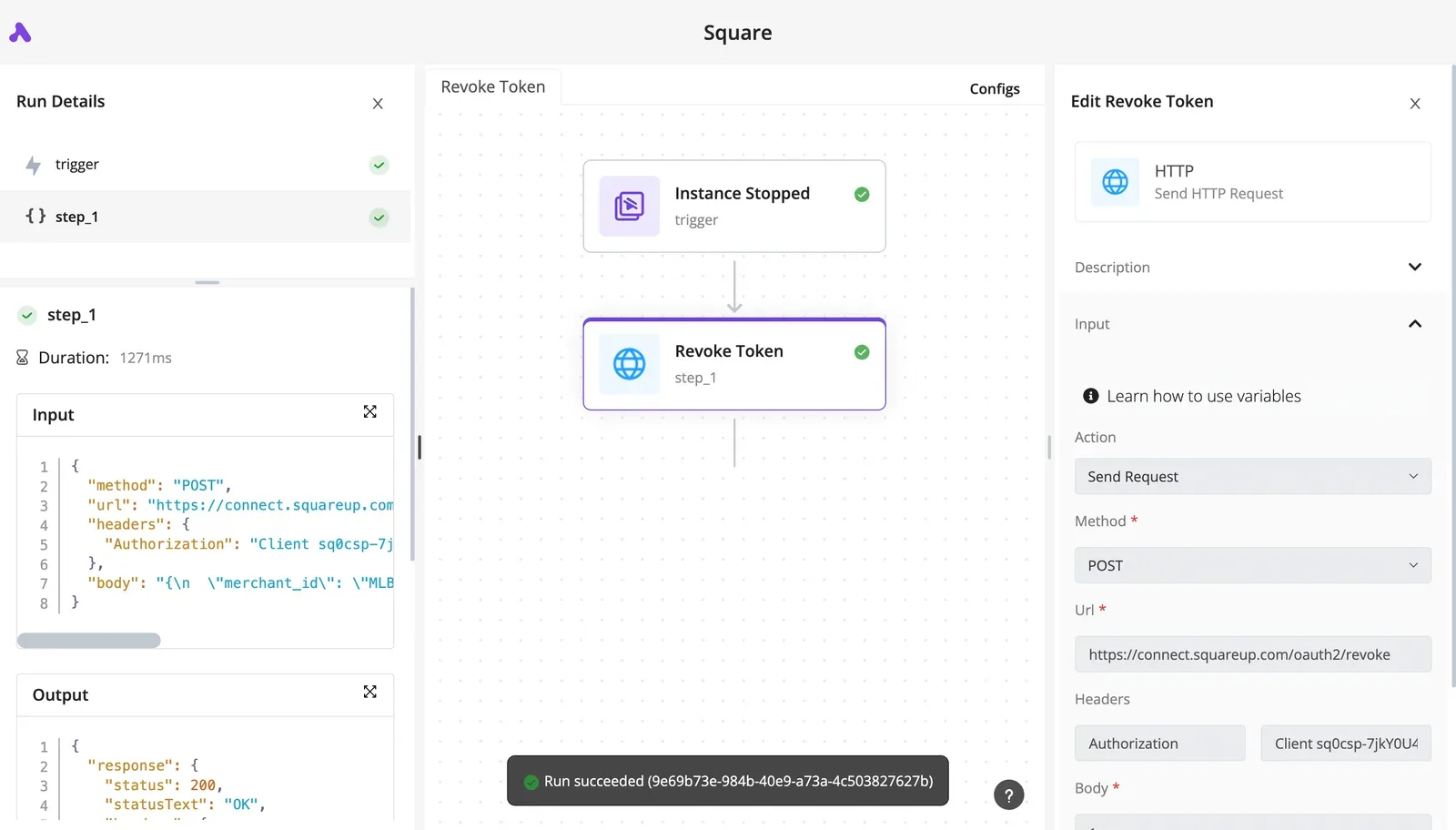
Your Tavus version swaps in a different trigger, such as a form submission or a booking. Its HTTP step creates a conversation using your Tavus API key in a header.
That header is a credential, and secret manager integration is an Ultimate feature, so on Free, Plus or Team keep the key out of anything you share and rotate it if a flow is ever exported.
Next, point Tavus's callback setting at a second Activepieces flow that begins with a webhook trigger.
That second flow costs nothing extra to own, since every plan has unlimited flows; only runs draw credits, with 1,000 a month on Free, 10,000 on Plus at $20 a month, and $0.007 a credit beyond the allowance.

Logging Tavus minutes to track your budget
The callback flow is where the cost control lives. Have it write one row per conversation to a spreadsheet or database: the start, the end, the duration and the persona or replica used.
Without that record, you only learn what you spent when the invoice arrives.
Add a check step that compares the running total against the allowance on your plan. When the total nears it, the flow sends you a message, or pauses the trigger that starts new conversations.
That's the contractor's rule: know the overage before you've built on top of it.
A Monday Checklist for Budgeting a Tavus Build
Do these steps in order this week and you'll know what a Tavus build costs before it's built, which beats learning it from an invoice.
Measuring Tavus usage before you commit
A pilot with real users tells you what a session actually runs, and that's the number every later step depends on.
The first four steps below get you from a guess to a figure you can defend:
- Re-read the pricing page and write down the date you read it. Plans change, and a dated note shows whether your estimate is stale or the vendor moved.
- Run a small pilot and measure average session minutes. People wander off, leave tabs open and chat longer than you planned, so your own guess will usually run short.
- Set your peak concurrency: the most conversations that could be live at the same moment. A concurrency cap bites at your busiest hour, not on your monthly average, so this number can force a plan change before minutes do.
- Compute three scenarios at low, middle and high monthly volume, using your measured session length. Include included minutes, replica fees and overage in each, so you see where the cost jumps instead of just where it starts.

If no one is watching the meter, an estimate does nothing.
- Set a usage alert below your cap, and a hard cap where the vendor offers one. The alert gives you time to react; the cap stops a runaway loop or a viral week from becoming your problem.
- Write down the upgrade trigger: the exact usage level or limit hit that moves you to a higher plan. Deciding it now, while nothing is on fire, keeps you from paying overage rates out of indecision.
Frequently asked questions
Each answer depends on the Tavus pricing page as it stood on the check date, 2026-11-11, so confirm against the live page before you commit a budget.
Free plan and billing unit
Does Tavus have a free plan? Read the plan table at the top of the pricing page to see whether a free tier is listed today. If one is, treat it as a trial, because free tiers limit minutes and simultaneous conversations.
Is Tavus billed per minute or per video? Live conversations are metered by the minute, so budget by minutes of actual talk. Check whether any video-generation line on the page is priced differently, and don't assume one rate covers both.
Commercial use
Can I use Tavus avatars commercially on a low plan? The plan table rarely answers this. The terms of service do, so read them before you ship anything customer-facing.
If you can't find a clear yes for your plan, ask Tavus in writing. A rights dispute after launch costs far more than a short email now.
Rollover and price changes
Do unused minutes roll over? Assume they don't unless the pricing page says otherwise. Included minutes on subscription plans usually belong to one billing period. If you buy more than you use, you are paying for minutes that vanish.
How often does Tavus change its pricing? Often enough that you shouldn't trust a number copied into a spreadsheet months ago. Re-check the page before each budget review and note the date you looked.
Related reading
Running the numbers
See what the same workload costs here.
Free forever plan, and every paid plan self-hosts at no extra cost.
See pricing Talk to sales