
Third-Party Plugins: Risks and Tradeoffs for Automation
Third-party plugin counts often obscure technical instability and maintenance burdens within automation software.

Covers workflow-automation builds for e-commerce and municipal clients: production reliability, contract requirements, and budget constraints.
ContributorSeptember 25, 202613 min read
This article was researched and fact-checked by an advanced research system.
When evaluating the long-term viability of an automation platform, many architects mistakenly equate a high volume of native integrations with technical maturity. However, this metric often masks underlying architectural debt or a reliance on brittle, community-maintained connectors that lack consistent oversight.
As engineering teams look to scale their operations, relying on a vendor that prioritizes quantity over quality can lead to significant maintenance overhead when critical APIs inevitably change.
Modern organizations are shifting toward platforms that emphasize robust SDKs and developer experience, ensuring that whether they are building custom logic or utilizing Activepieces to bridge disparate systems, the underlying infrastructure remains resilient.
Ultimately, a vendor’s health is better measured by its engine's extensibility and the reliabili
A community-driven plugin ecosystem refers to a software architecture where third-party developers contribute integrations, which in a monorepo structure allows for centralized auditing and governance to mitigate the risks of technical debt.
The 3:00 AM breakdown of a mission-critical workflow
When underlying components evolve at different speeds, a mission-critical workflow fails. This leaves the user to debug code they didn't write during peak demand.
This technical debt usually hides in the "Plugin Health Signal," a ratio that measures how much of a platform’s functionality relies on unvetted community contributions versus vendor-audited code.
The silent failure of a community-maintained Slack trigger
Nobody notices for three days when a community-maintained trigger for the Slack communication tool stops firing because of an unannounced API change.
The automation platform often reports a "success" state while the actual data pipeline sits empty. This happens because community contributors rarely have the budget for 24/7 monitoring.
While Activepieces ships an MIT-licensed core that allows users to clone the repository and audit the queue and worker architecture, many proprietary platforms hide these triggers behind a black box. This leaves the user with no way to patch the error themselves.
Visualizing who is actually responsible for the code running their business is how the Plugin Health Signal helps teams predict this risk.
(The Plugin Health Signal chart shows the ratio of vendor-maintained versus community-built connectors across three platforms. Platform A, with 90% community builds, represents the highest risk of unpatched failures; Platform B offers a 50/50 split; and Platform C, at 90% vendor-maintained, represents the highest reliability tier for enterprise production.)
A high concentration of community-built connectors indicates that the platform's growth is outpacing its engineering team's ability to provide long-term support.
Why 'verified' badges don't guarantee uptime
The badge often indicates only that the code worked on the day of submission. It does not mean that the vendor actively tests it against new software releases.
In production, these badges function as a marketing tool rather than a technical guarantee. The burden of maintenance still falls on the end-user when a "verified" plugin breaks.
In production, these badges function as a marketing tool rather than a technical guarantee.
The immediate cost of 400 lost enterprise leads
When several hundred enterprise leads are lost during a high-traffic event, the result is a wasted marketing budget and a permanent hit to the sales pipeline.
Because these leads often represent a high customer acquisition cost, the failure of a single lead-routing connector can cost a firm more in one night than the annual subscription of the automation platform itself.
The real cost is the lost revenue from prospects who moved on to a competitor because their inquiry was never acknowledged.
Everything below works on Activepieces' free plan. Start without code or a credit card.
Third-party plugin volume as a double-edged health signal
The developer velocity trap in low-code platforms
Minutes rather than weeks is the time it takes to deploy complex integrations in a marketplace overflowing with community-built connectors. This speed often obscures the long-term cost of ownership.
By skipping the build, developers also bypass the deep architectural understanding required to fix that connection when it inevitably fails.
Relying on these abstractions creates a "black box" dependency where the time saved during the initial build is frequently paid back with interest during a production outage.
If the vendor hides the internal logic of a plugin, a minor API update can halt a critical business process.
How community contributions signal long-term vendor viability health
A platform has achieved the critical mass necessary to survive beyond the original founding team’s roadmap when it has a diverse, active contributor base.
When independent developers build connectors for niche regional services, they are effectively de-risking the platform for enterprise buyers.
They ensure the ecosystem can adapt to local market needs without waiting for an official corporate release cycle.
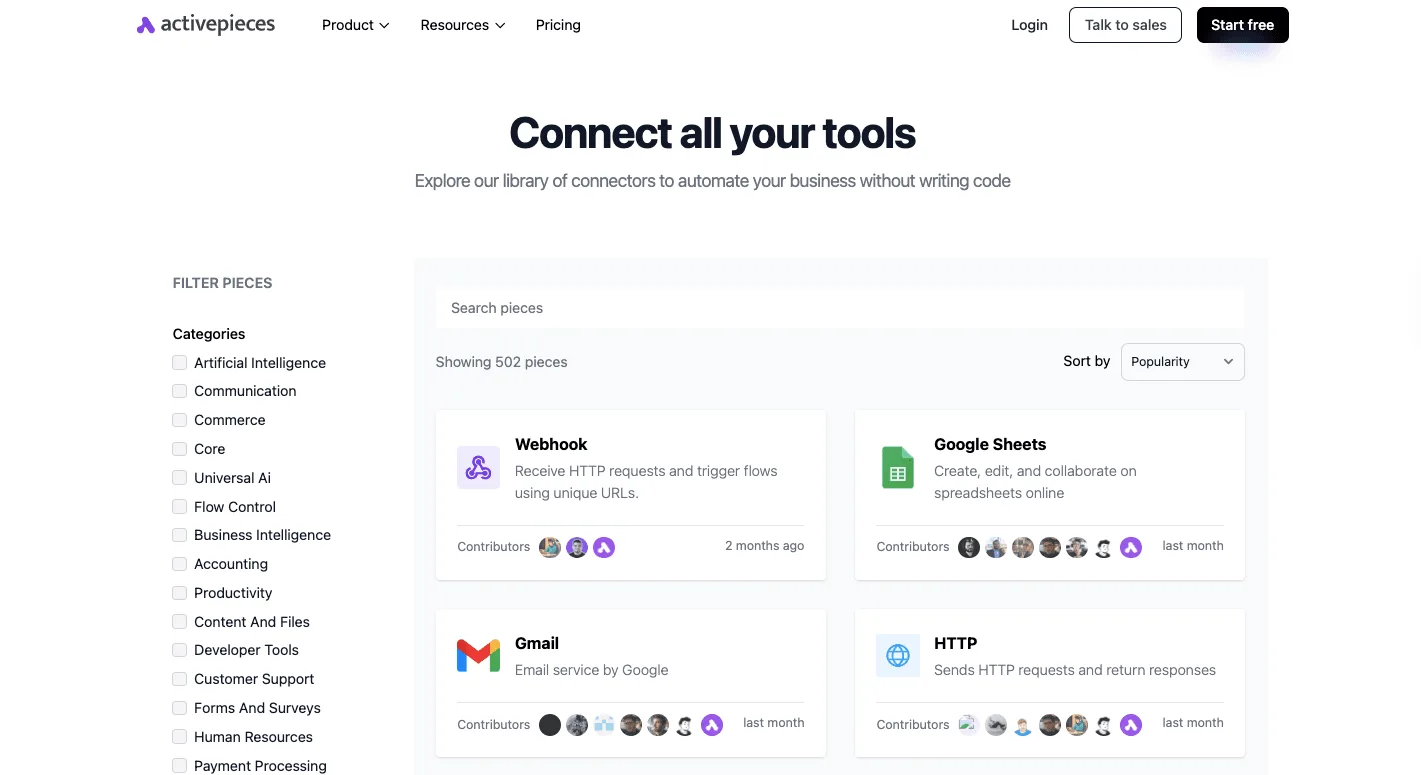
Roughly 60% of Activepieces' 735+ integrations are community-contributed, a scale made possible by its MIT-licensed core, which means the platform relies heavily on external developers to expand its utility.
You can compare packages/integrations/community against core in the public monorepo to see how this open contribution model avoids the headcount bottlenecks that limit closed catalogs.
This decentralized development model ensures that if a specific integration is vital to your operations, there is a documented history of community support and peer review to draw upon.
The hidden technical debt of unmaintained open-source connectors
Significant security and operational risks are introduced by unmanaged third-party plugins because they often lack the rigorous patching schedules found in first-party software.
While a community member may release a functional version of a connector, they are under no contractual obligation to update it when researchers discover new vulnerabilities.
The following data illustrates the regional disparity in the financial impact of such exposures.
| Region | Average Cost of Data Breach (USD) |
|---|---|
| United States | $10.22M |
| Global Average | $4.44M |
| Brazil | $1.22M |
Regional margins for error
For companies operating in the US, these figures demonstrate that the margin for error with third-party code is virtually non-existent.
A single unpatched connector can trigger a multi-million dollar recovery effort. The ability to audit and modify these community contributions is a fundamental requirement for maintaining a secure production environment.
The anatomy of a community plugin abandonment cycle
When the original author’s personal interest in a project diverges from the long-term stability requirements of the businesses using it, community-built plugins fail.
API versioning shifts and the lag in volunteer updates bounces
Every automation relying on a connection fails immediately when a major service provider makes a breaking change in their API.
Free time rather than Service Level Agreements governs the response time to these deprecations because volunteer contributors lack the contractual obligation of a vendor's engineering team.
When a plugin remains unpatched, business users must choose between manually processing data or letting their workflows remain broken until an unpaid stranger decides to push a fix.
The 'Ghost Author' problem in marketplace ecosystems
Marketplace metrics often prioritize the total volume of available integrations, a strategy that obscures the reality of maintenance debt by treating a broken plugin the same as a functional one.
[IMAGE PLACEMENT: Maintenance Debt Iceberg]
Once the "Ghost Author" stops responding to pull requests, the plugin becomes a liability that the vendor will not officially support and the user cannot easily replace without rebuilding the entire automation logic.

Why enterprise teams inherit the maintenance burden by default
"Free" software carries a hidden cost of ownership equal to the salary hours spent debugging someone else's unoptimized code.
When a critical workflow fails, the internal DevOps team cannot wait for a community consensus to form. To identify where the authentication failed, the team must deconstruct the original contributor's code.
Free" software carries a hidden cost of ownership equal to the salary hours spent debugging someone else's unoptimized code.
They must fork the repository to apply an emergency patch, creating a disconnected version that no longer receives official security updates.
By taking these steps, the team has effectively transitioned from being a user of a tool to being its primary maintainer, diverting focus from core business products.
Easier to see it running than to read about it: set it up free, no card.
How Activepieces maintains a secure third-party ecosystem
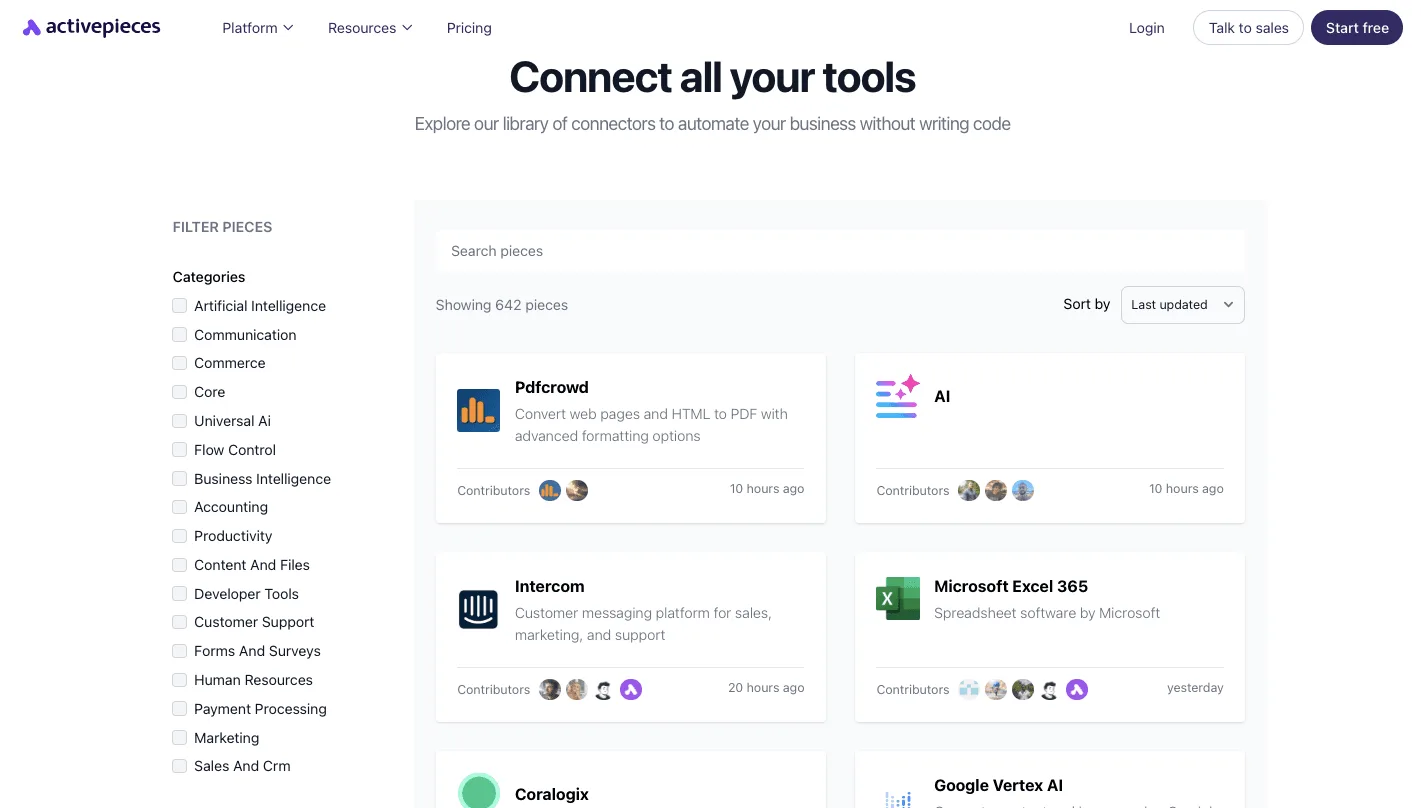
By hosting its 735+ integrations in a public monorepo, Activepieces mitigates the risk of unmanaged growth.
Every community-contributed "integration" undergoes the same automated validation and manual review as the core engine. This architecture ensures that while the ecosystem expands through user contributions, the underlying code remains auditable and consistent with the platform’s security standards.
A codebase you can read closes security reviews faster than a vendor's word, which is why MoneyGram and Alan run Activepieces in production.
You can clone the repository to trace the queue and worker architecture or load-test the MIT-licensed core before deciding to run it self-hosted or fully air-gapped.
Standardizing the 'integration' development lifecycle for safety
Activepieces requires all integrations to be developed within a unified TypeScript framework, with roughly 60% of the catalog contributed by the community under this standard. This means every contributor follows a predictable pattern for handling authentication and data transformation.
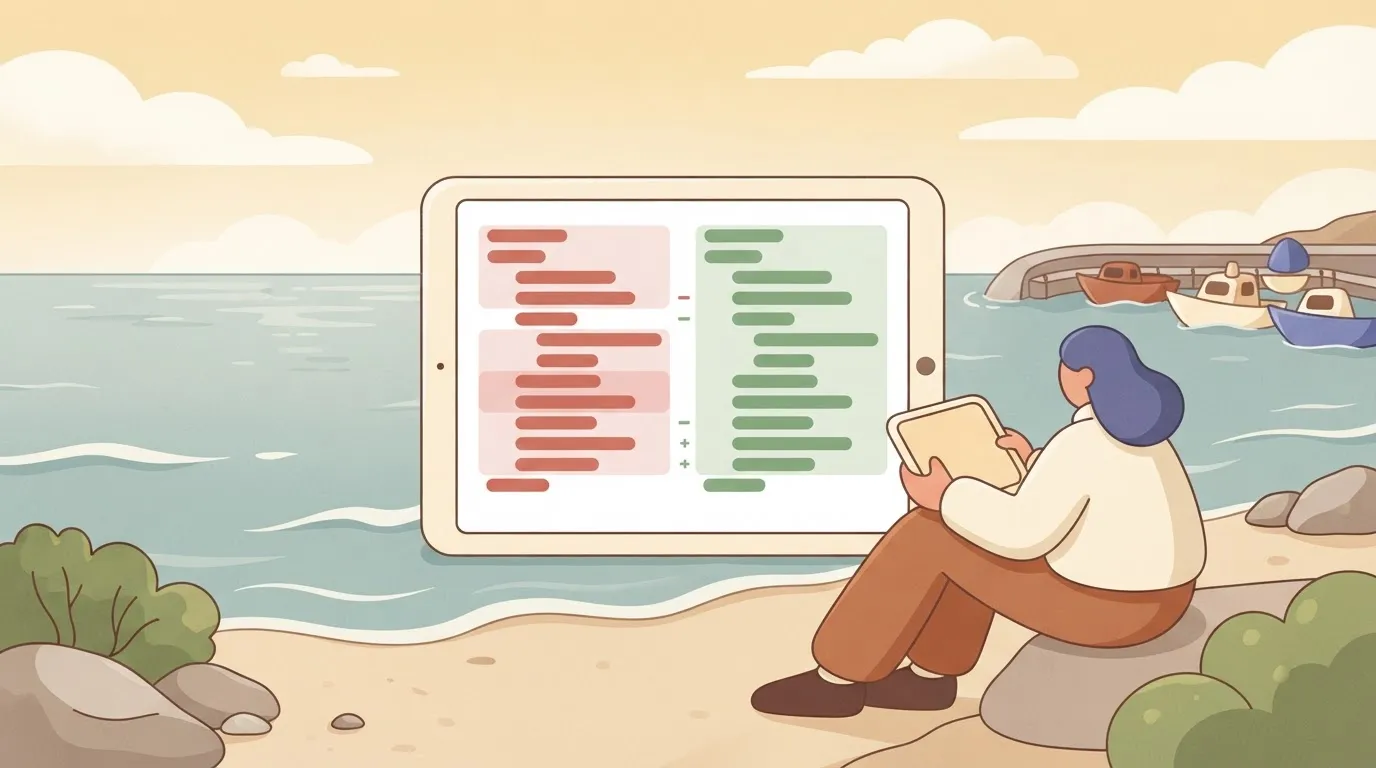
By mandating that integrations exist as distinct packages within a single repository, the platform allows security teams to run static analysis across the entire library at once.
This structure prevents the "black box" problem common in workflow tools where custom code snippets are hidden inside private user accounts.
How to verify community contributions safely
By categorizing integrations based on their origin and vetting level, the platform manages the tension between rapid innovation and system stability.
The following table outlines how Activepieces distinguishes between internal development and external contributions across its 735+ integrations:
| Dimension | Core Integrations | Community Pieces |
|---|---|---|
| Security Vetting | Vendor-led: Audited by the Activepieces core engineering team | Crowd-sourced: Peer-reviewed via public GitHub pull requests |
| Maintenance SLA | Guaranteed: Immediate fixes for breaking API changes | Best Effort: Dependent on community maintainers or core team intervention |
| Code Governance | Internal: Managed under strict internal versioning controls | Transparent: Fully viewable and forkable by any platform user |
Maintaining uptime when community authors go dark
By hosting all 735+ integrations in an open-source monorepo, Activepieces solves the "abandonware" problem by ensuring the code remains accessible regardless of the original author's status.
This allows the core team or other community members to take over maintenance if an original author stops responding to issues.
Because the code is not locked in a private silo, any user can fix a breaking change in an external API and merge the fix back into the main branch for the benefit of all.
This collective ownership model prevents the "maintenance debt" mentioned previously.
The Monday morning audit for workflow integration risks
A production-ready audit identifies which automations rely on community goodwill versus contractual guarantees so that a sudden API change doesn't halt your revenue operations.
Mapping mission-critical workflows to their original authors
To understand your exposure to unpatched security vulnerabilities, you must distinguish between core functionality and community-contributed extensions.
In the ecosystem of the automation tool n8n, for example, there are roughly 400 Core Nodes maintained by the internal team. These integrations receive prioritized security patches and breaking-change fixes.
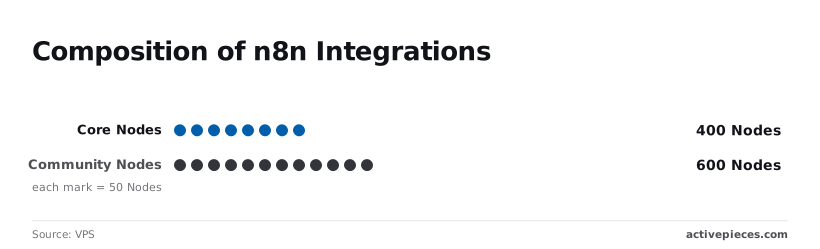
Conversely, there are over 600 Community Nodes available.
This places the burden of vetting and maintenance squarely on your internal engineering team.
- Identify 'Ghost' maintainers by checking if the node’s repository has lacked updates for 6+ months.
- Map critical path flows to connector provenance to prioritize manual code reviews.
- Verify credential storage for community integrations to ensure tokens aren't logged to insecure locations.
- Check version pinning for every community node to prevent unvetted updates from breaking production.
Establishing a 'Tier 1' list of vendor-guaranteed connectors
Standardizing on a "Tier 1" list limits your infrastructure to integrations that carry a formal Service Level Agreement (SLA).
This ensures that a middle-of-the-night API failure is the vendor's problem to solve.
If a workflow uses a node outside this list, it must be treated as "experimental" and not used for processing customer payments or PII.
Setting up automated redundancy for high-stakes API triggers
When a primary trigger fails, redundancy ensures that a secondary "watchdog" process captures the data.
Webhook listeners should be mirrored across two different cloud regions to survive a localized outage.
Staggering polling intervals for critical updates ensures that a rate-limit error doesn't trigger a cascading failure.
Dead-letter queues must be configured for every community-built destination to provide a holding pen for data that failed to send due to a connector bug.
Frequently asked questions about plugin ecosystem health
Is a platform with fewer plugins safer than one with thousands?
Because every available integration has undergone the same internal security audits as the core platform code, a smaller, curated library reduces your attack surface.
When a vendor limits their ecosystem, they are trading rapid expansion for a guarantee that a vulnerability in a third-party API wrapper cannot be used as an entry point into your broader network.
This centralized control prevents the "dependency hell" common in massive marketplaces. In those environments, outdated libraries are left unpatched for years, leaving your production workflows exposed to known exploits.
How do I know if a plugin is officially supported by the vendor?
The presence of a "Verified" or "Core" badge within the integration marketplace verifies official support. This badge dictates that the platform vendor is contractually responsible for fixing breaking changes.
If a plugin lacks this designation, the burden of maintenance shifts entirely to your internal team.
This means API version updates must be manually coded by your developers. Security patches rely on the responsiveness of an external contributor who may have abandoned the project.
Troubleshooting tickets sent to the platform provider will be rejected if the issue originates within the community-built code.
What happens to my workflows if a plugin author deletes their repository?
Only if the platform caches the plugin code or utilizes a monorepo structure will your workflows continue to function.
Otherwise, the next time the system attempts to initialize that step, it will fail because the source files no longer exist.
In platforms that pull dynamically from external repositories like GitHub, a deleted account results in an immediate production outage.
To mitigate this risk, enterprise-grade teams should prioritize platforms that mirror all community code onto their own internal servers.
They should also provide a version-locking mechanism so a deleted repository doesn't force an unplanned update.
Finally, they should allow you to fork the plugin code into your own private environment. This ensures you own the logic even if the original author disappears.