
Webhook Retry Logic: Best Practices for 2026

Oct 21, 202613 min read
Webhook delivery relies on a fragile push-based handshake where any network jitter or cold-start latency, even when processing events through a platform like Activepieces, triggers an immediate failure state.
Webhook retry logic is the systematic process of reattempting failed HTTP callbacks using exponential backoff and idempotency keys to ensure reliable data delivery between decoupled systems.
Because the sender does not wait for a pull request, the receiver must be ready to ingest, validate, and acknowledge the payload within milliseconds or risk the sender dropping the event entirely.
Expect frequent initial webhook delivery failures
Why HTTP 200 is the only success metric that matters
A successful webhook transaction requires the receiver to return an HTTP 200 status code within the provider's specific timeout window. The receiver returns this code to prevent the event from being marked as failed.
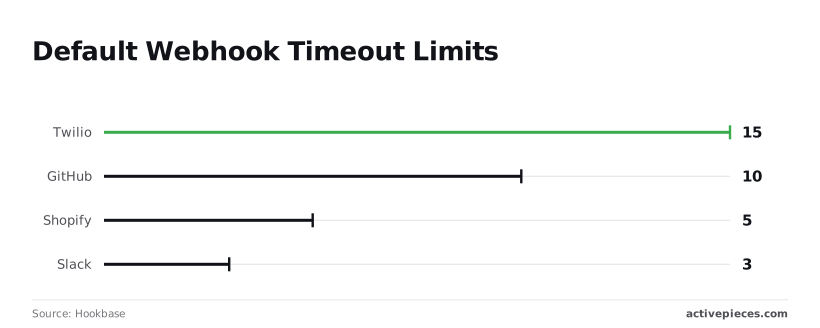
When the receiver’s logic exceeds these strict limits, the sender terminates the connection.
The following table illustrates the variance in these timeout budgets, showing how little time a developer has to move a payload into a queue before the sender cuts the line.
| Provider | Timeout Limit (Seconds) |
|---|---|
| Shopify | 5 |
| GitHub | 10 |
| Stripe | 30 |
| Twilio | 15 |
| Slack | 3 |
5 seconds is all Shopify allows for a response, according to Hookbase, meaning any downstream processing must be asynchronous. GitHub provides a 10-second window, while Stripe has a more generous 30 seconds, according to Hookbase.
Twilio enforces a 15-second limit, while Slack is the most aggressive at 3 seconds, so a receiver must acknowledge the POST before performing any meaningful work.
Queue-first architecture separates webhook ingestion from processing
To meet these deadlines, developers must adopt a queue-first architectural pattern. The receiver should not execute business logic while the sender is waiting; instead, it should immediately place the payload into a message queue or a high-speed database.
Once the payload is persisted, the receiver returns a 200 OK. This handoff ensures the connection is closed successfully before the timeout expires. A separate background worker then pulls the message from the queue to perform the actual processing.
Choosing a message broker for webhook queuing
Implementing this queue requires a message broker to act as the temporary holding cell for incoming data. Redis is the most common choice for high-throughput scenarios due to its in-memory speed, while RabbitMQ offers more robust routing features for complex enterprise environments.
The receiver script simply acts as a producer, pushing the raw JSON payload into a named list or exchange as its only task before responding to the sender.
The background worker is a separate, long-running process that monitors the broker for new entries. It uses a polling loop or a subscription model to fetch one message at a time, ensuring that if the worker crashes, the message remains safely in the queue.
This logic separates the "receptionist" who answers the door from the "accountant" who processes the paperwork, preventing a backlog in the office from blocking the entrance.
The hidden cost of silent failures in API integrations
"Silent" data loss occurs when a webhook fails and creates a state mismatch between the source and the destination. This often goes undetected until a reconciliation audit occurs.
Security reviews for these integrations often stall when a vendor asks for blind trust in their retry maturity. To provide checkable evidence instead, Activepieces ships an MIT-licensed core that allows teams to clone the repository and inspect the queue and worker architecture directly.
By verifying the engine's logic in their own environment or running it fully air-gapped, teams can prove reliability to auditors without relying on a vendor's word.
This "circuit breaking" behavior means a single missed invoice event can lead to a deactivated subscription sync, causing manual cleanup costs that far exceed the original engineering effort.
Why 2026 systems require more than a single retry attempt
15% of initial attempts fail due to transient issues, which is why modern systems must implement multi-stage retry logic.
According to Hook0, exponential backoff strategies reach a 92% recovery rate, whereas fixed interval retries only hit 85%, so the timing of the retry is as important as the attempt itself.

Providers differ significantly in how many chances they give a failing endpoint. 50 attempts are allowed by GitHub for extended downtime recovery as noted by Dev.to, which provides a significant buffer for systems to recover from prolonged outages.
Stripe provides 17 attempts to balance persistence and resource management, ensuring that servers are not overwhelmed by endless cycles of failed requests. 8 attempts is the limit for Shopify, according to Shopify, which requires faster intervention.
Slack allows 3 attempts, meaning the system has almost no margin for sustained errors. These varying limits necessitate a standardized ingestion layer that can handle retries locally when the source provider gives up too early.
This takes minutes, not a project: automate it in Activepieces free.
How exponential backoff prevents thundering herd traffic
Exponential backoff preserves system availability by progressively increasing the delay between failed delivery attempts. This spacing keeps a recovering service from being immediately overwhelmed by a backlog of queued requests.
Immediate retries: The fastest way to crash a recovering server
Attempting to resend a failed webhook notification the instant a network error occurs transforms a transient glitch into a self-inflicted Denial of Service (DoS) attack.
When a destination server briefly drops its connection, a sender that retries immediately will hit the same closed port or saturated buffer. Outbound worker threads are consumed for a request that has no chance of succeeding.
Attempting to resend a failed webhook notification the instant a network error occurs transforms a transient glitch into a self-inflicted Denial of Service (DoS) attack.
This creates a feedback loop where the sending system exhausts its memory pool, while the receiving system faces a bombardment of new requests the moment it tries to restart.
The 'Immediate' strategy shows vertical spikes that max out CPU capacity instantly.
Because these spikes occur at the exact moment of recovery, they often trigger automated circuit breakers that shut the system down again.
Linear retry intervals and the fixed-delay failure pattern
Implementing a static retry window synchronizes all failed tasks into a single, massive wave of traffic. Retrying every fixed number of seconds causes this synchronization.
Arriving as a unified "herd" every time the timer expires is the result if they all retry on a linear schedule. This creates a sustained high plateau of traffic that prevents the target database from recovering its connection pool.
How exponential backoff balances recovery speed and stability
Exponential backoff multiplies the delay after each failure to resolve congestion. This scatters the retry attempts across a widening time horizon and allows the receiving system to process the backlog in manageable increments.
Under this strategy, the first retry might occur after a short delay, but the tenth retry is delayed by several hours.
By introducing jitter (a small amount of random noise added to the delay) the system further ensures that two webhooks failed at the same millisecond do not synchronize their retry attempts.
Idempotency keys ensure data integrity during repeated delivery
Idempotency keys prevent the duplication of side effects by allowing the receiver to recognize and ignore a retransmitted payload that it has already processed. Without this mechanism, jittered retries would risk creating multiple entries for a single event.

Using unique event IDs to prevent duplicate records
A resilient receiver treats every incoming webhook as a state transition that must only occur once per unique event identifier. When the sender provides a unique ID, the receiver must validate this against its own record of completed transactions.
The Idempotency Check Sequence involves three steps:
- Extract the unique key from the header (e.g., Stripe-Signature or Idempotency-Key).
- Query the database for a matching key.
- If the key exists, return the cached 200.
This sequence ensures that the subsequent retry will not trigger a duplicate write operation. Following this check, the system either commits the new data and stores the key or terminates the process if the key is already present.
The Dead Letter Queue (DLQ) as the final safety net
The Dead Letter Queue (DLQ) is the terminal state for webhooks that have exhausted all automated retry attempts. Moving a failing message to a DLQ isolates the problematic payload, which prevents a single malformed request from blocking the processing pipeline.

A message enters the DLQ only after the exponential backoff logic reaches its final failure state, at which point the system preserves the original headers and body for manual inspection.
Setting a maximum retry ceiling to prevent infinite loop costs
A maximum retry ceiling terminates the delivery cycle after a defined number of attempts to prevent the system from consuming unbounded compute resources on unrecoverable errors.
The sender stops attempting delivery at the retry limit, which triggers an alert. The system purges the message or moves it to long-term storage at the end of the Time-to-Live (TTL).
The sender marks the webhook attempt as 'Failed' in the dashboard for the final status update.
You can follow the rest of this with the builder open. Start free, no card.
Automate webhook resilience using Activepieces
Activepieces manages webhook reliability by encapsulating retry logic and error branching directly into the workflow engine, preventing transient network failures from terminating a process before completion.
The engine that runs your automations is public code rather than a hidden configuration panel. By comparing the Flow Execution Engine in the public monorepo against the step-by-step trace in the run-details UI, developers can audit exactly how the MIT-licensed core handles each retry decision.
Enable automatic retries for failed steps
The Activepieces builder has a native toggle for exponential backoff within the configuration panel of each individual step. This ensures that temporary outages at the destination API do not result in immediate execution failure.
When a developer activates the "Auto Retry on Failure" option, the engine pauses the workflow upon receiving a non-200 status code and reschedules the specific action for a later time.
The following interface demonstrates the specific placement of these resilience controls during the configuration of a third-party API call.
[IMAGE PLACEHOLDER: A workflow builder canvas showing a two-step flow: a Webhook Trigger step connected to a "Get Icecream Flavor" action step from the Gelato integration. The second step is selected (highlighted with blue border). On the right side, the action configuration panel shows the following details:
- The selected action is "Get Icecream Flavor".
- The Gelato connection is active.
- There are options for "Continue on Failure" and "Auto Retry on Failure".
- A "Generate Sample Data" section shows "Tested Successfully 19 seconds ago" with an Output panel below.]

By selecting these options, the user instructs the runner to preserve the state of the webhook payload. Once the retry limit is reached, the system transitions the integration to a failed state to prevent infinite egress loops.
Building custom error paths for high-priority webhook events
For mission-critical data, the "Continue on Failure" setting allows the workflow to bypass a hard stop and enter a conditional branch designed for manual intervention or secondary logging.
- A Slack notification step alerts the engineering team if a webhook from a payment processor fails after all retries.
- A secondary database write records the raw payload of a failed step, providing a durable backup.
- A specialized "Error" tag is applied to the execution for bulk filtering.
Monitoring delivery health with execution history logs
The execution history log is the primary audit trail, recording the specific input, output, and retry count for every webhook received.
Because each log entry captures the exact state of the payload at the moment of failure, administrators can identify if a 400-series error was caused by a schema mismatch or a bug in the receiving integration's logic.
The Monday morning webhook reliability audit checklist
Weekly maintenance ensures that the documented state machine remains synchronized with the physical infrastructure.
Finding silent webhook failure points in integrations
A reliable webhook audit begins by mapping every endpoint that returns a 200 OK status before the payload has been fully persisted.
When a listener acknowledges receipt but fails during the subsequent database write, the sending server marks the delivery as successful and ceases all retry attempts. Developers must audit the "Success Rate" dashboard for 4xx/5xx spikes that indicate rejected payloads.
| Audit Task | Purpose |
|---|---|
| Verify SSL certificate expiry | Prevent immediate connection rejection |
| Check the 'Success Rate' dashboard for 4xx/5xx spikes | Identify unhandled payload errors |
| Rotate webhook signing secrets | Invalidate any potentially compromised listener access |
| Test the Dead Letter Queue (DLQ) manual replay trigger | Ensure failed messages can be re-injected into the workflow once the underlying issue is resolved |
Adding idempotency checks to write-heavy webhook endpoints
Idempotency keys ensure that processing the same webhook payload multiple times results in exactly one state change.
Without these checks, a Stripe payment notification that is sent twice due to a timeout will result in two separate ledger entries.
Idempotency keys ensure that processing the same webhook payload multiple times results in exactly one state change.
By checking a unique identifier against a cache of recently processed requests, the system can safely discard duplicates while still returning a success code.
Step 3: Transition from linear to exponential backoff intervals
Exponential backoff preserves system resources by increasing the delay between retries, which prevents a struggling service from being overwhelmed.
If a listener fails due to a database lock, a linear retry strategy will likely hit the same lock. An exponential delay allows the system enough time to clear the bottleneck, moving the integration into a resilient feedback cycle.
FAQ
What is the difference between a webhook and an API? An API is a request-response model where the client asks for data. A webhook is an event-driven model where the server pushes data to the client as soon as an event occurs.
Why do webhooks fail? Common causes include destination server downtime, network timeouts, SSL certificate errors, and unhandled exceptions in the receiving code.
How many retries are standard? Most providers offer between 3 and 50 retries, typically using an exponential backoff strategy over 24 to 72 hours.
What is a 200 OK status? It is an HTTP success code indicating that the receiver has successfully accepted the webhook payload.
What is a Dead Letter Queue? A storage area for messages that could not be delivered after the maximum number of retry attempts, allowing for manual troubleshooting.
Related reading
Build it
Set this up in minutes.
No code required. Connect your accounts, and Activepieces runs it from there.
Start free Talk to sales