
Webhook Signature Verification: How to Secure Integrations

Sep 30, 202614 min read
When a receiving server needs to confirm that an incoming HTTP request originated from a trusted source and remained unaltered during transit, it uses a cryptographic handshake called webhook signature verification.
Without this check, an endpoint is effectively a public door, leaving the system vulnerable to "replay attacks" where a malicious actor intercepts a valid request and resubmits it to trigger unauthorized actions.
By requiring a mathematical proof of identity, developers ensure that their backend logic only executes on legitimate data.
Verify data integrity and sender identity
How shared secrets power webhook signatures
Verification relies on a unique string of characters known only to the sender and the receiver. This string acts as a digital fingerprint for every transaction.
When an event occurs, the sender (such as the payment processor Stripe) uses this secret to sign the outgoing message.
Because the secret is never transmitted in the HTTP headers, an eavesdropper cannot forge a valid signature even if they capture the raw data.
In modern automation workflows, Activepieces manages these connections by providing a centralized environment to handle these keys, which prevents developers from hardcoding sensitive credentials into their primary application logic.
The platform ensures that the secrets used to sign these webhooks remain under your exclusive control; every credential can be stored in your own external secret manager rather than the Activepieces database.

This architecture, available in both the self-hosted edition and the enterprise cloud tier, means you can inspect the database yourself to confirm that sensitive keys are never stored there, alongside other governance features like custom RBAC and audit logs.
How the HMAC hash function works
The core of the verification process is the Hash-based Message Authentication Code (HMAC). This mechanism combines the raw JSON payload with the shared secret through a hashing algorithm like SHA-256.
This creates a unique, fixed-length string that changes entirely if you modify even a single comma in the payload.
The system discards the request as untrusted if the receiver’s locally generated hash does not perfectly align with the signature in the header.
This prevents "man-in-the-middle" attacks where a third party might attempt to change a transaction amount or a user ID before the data reaches the database.
Using timestamp headers to prevent replay attacks
Standard verification includes a Unix timestamp in the header to bound the validity of the signature to a specific window of time.
The receiver will reject the payload if the difference between the header’s time and the current system clock exceeds a predefined threshold, typically a few minutes.
This constraint ensures that an attacker cannot capture a successful request and re-send it hours later to duplicate an order or a credit. The expired timestamp would invalidate the entire cryptographic package.

This takes minutes, not a project: automate it in Activepieces free.
The high stakes of webhook security vulnerabilities
Webhook vulnerabilities represent a critical entry point for attackers because they bypass the traditional firewall protections that shield your internal databases.
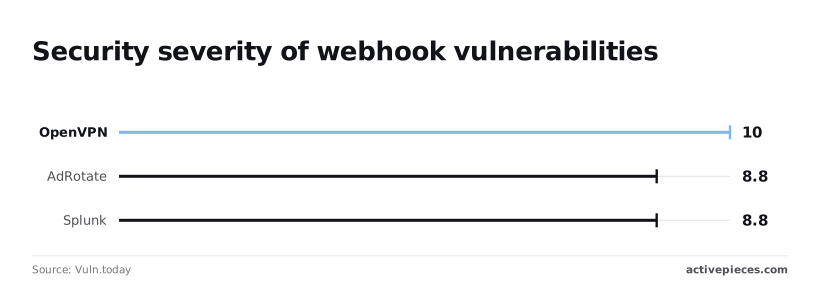
The severity of these risks is quantifiable. A vulnerability in OpenVPN, a popular virtual private network provider, recently received a maximum CVSS score of 10.
Webhook vulnerabilities represent a critical entry point for attackers because they bypass the traditional firewall protections that shield your internal databases.
This means a single unverified request could lead to total system compromise. Flaws in AdRotate, an advertising management plugin, and Splunk, a data analysis platform, both clocked in at 8.8. Even secondary integrations can become high-risk vectors if left unhardened.
Identify every 'naked' webhook URL
Locating every endpoint that accepts POST requests without a X-Hub-Signature or similar header is the first step of an audit. These "naked" URLs are effectively open doors.
Any script kiddie with a tool like Postman, an API development platform, can flood your server with fake data. If your logs show a 200 OK response to a request lacking a signature, you are currently processing unverified instructions that could corrupt your production state.
Verify the presence of a TTL or timestamp check spinning
Once you have identified your endpoints, you must confirm that your logic enforces a strict time-to-live (TTL) window.
The OpenVPN score of 10 illustrates that the ability to replay a valid message is just as dangerous as forging a new one. This allows attackers to trigger repeated actions like billing cycles or user deletions.
Your system is vulnerable to replay attacks that bypass cryptographic checks entirely if your verification logic does not compare the timestamp header against the current system time.
How to rotate webhook secrets safely
Static secrets are liabilities that grow more dangerous every day they remain in your .env files. You should implement a rotation policy based on the sensitivity of the data you transmit.
Static secrets are liabilities that grow more dangerous every day they remain in your
.envfiles.
Quarterly rotation is standard for low-impact notifications like marketing pings. Monthly rotation is required for any endpoint that touches PII or financial records.
Immediate rotation is mandatory the moment a developer with access to the environment variables leaves the company. For high-throughput environments, using an advanced reasoning model like Gemini 3.1 Pro or Claude Opus 5.5 can help automate the generation of rotation scripts.
This automation updates your keys without manual errors that could lead to production downtime.
Verify a webhook signature in four manual steps
Webhook signature verification is a security protocol where a sender hashes the payload with a secret key so the receiver can confirm the data is authentic and untampered.
This process transforms a public-facing URL into a secure gateway by ensuring that only parties possessing a specific cryptographic key can trigger your backend logic.
Without this check, your endpoint is a wide-open door. It is vulnerable to any actor who discovers the URL and sends a spoofed JSON body to disrupt your database or drain your resources.

Authentication begins with a unique string of characters known only to the service provider and your application.
When you configure an integration in a platform like Stripe, a financial infrastructure provider, the service issues a signing secret that is the root of trust.
The sender should never transmit this secret over the wire or commit it to a public repository. Its exposure allows an attacker to forge valid signatures for your system.
To ensure your current architecture meets these standards, follow this checklist to audit your environment:
Identify all unauthenticated webhook URLs in your codebase. Verify that every endpoint uses a unique secret rather than one shared key. Check for hardcoded secrets in version control. Confirm a defined process exists for rotating secrets if a leak occurs.
This audit provides a map of your attack surface and highlights where logic must be hardened.
The core of the verification process is the Hash-based Message Authentication Code (HMAC). This mechanism combines the secret key with the raw request body to produce a unique fingerprint.
When a provider sends a notification, they run the payload through an algorithm like SHA-256 and place the resulting string in a custom header.
Your server must perform the exact same calculation upon receipt. If your locally generated hash matches the header, the data is identical to what the sender intended.
Using a "constant-time" comparison function for this check is essential, as it prevents attackers from using timing attacks to guess your secret character by character.
A valid signature does not prevent a "replay attack," where an eavesdropper captures a legitimate request and sends it to your server repeatedly to trigger duplicate actions.
To solve this, providers include a Unix timestamp in the request headers, which is itself included in the signed string to prevent tampering.
By subtracting this timestamp from the current system time and rejecting the request if the difference exceeds a narrow window, such as five minutes, your logic maintains security.
This time-bound check ensures that even if a signed payload is intercepted, it becomes useless to an adversary shortly after the sender transmits it.
You can follow the rest of this with the builder open. Start free, no card.
Automate signature validation using Activepieces native triggers
Activepieces eliminates the need for manual cryptographic implementation by embedding signature verification directly into its webhook listener architecture. A codebase you can read closes reviews faster than a vendor's word, and Activepieces ships an MIT-licensed core that security teams can audit directly.
You can clone the repository to trace the worker architecture or run the platform fully air-gapped to ensure no data ever leaves your network.
This shift from custom logic to native configuration ensures that security is a prerequisite of the workflow rather than a post-script, preventing unauthenticated data from ever reaching your downstream logic.
Configuring the Webhook Secret key
Securing the entry point begins by mapping the specific signing secret provided by the source service, such as a payment processor or CRM, into the Activepieces Webhook trigger settings.
When you select the verification method (typically HMAC SHA256) and input the secret key, the platform assumes the responsibility of calculating the expected hash for every incoming request.
This native handling means your team does not have to maintain libraries for hashing or worry about the nuances of specific coding languages. This reduces the surface area for implementation errors that lead to security gaps.
Testing webhook signature verification with real payloads
The source service confirms validation by sending a signed request to the Activepieces URL while observing the trigger’s response.
Because the platform performs the check before the workflow proceeds, a successful test run confirms that the secret key and the hashing algorithm are perfectly aligned.
The following table summarizes how this native approach compares to traditional methods in terms of operational overhead and reliability.
| Method | Effort Level | Risk Profile |
|---|---|---|
| Manual Code | High | High risk of timing attacks and logic errors |
| Middleware/SDK | Medium | Medium risk of version drift and dependency bloat |
| Native No-Code/Activepieces | Low | Low risk due to standardized, platform-maintained logic |
This comparison highlights that offloading the math to the platform creates a more resilient integration. MoneyGram, Moneypenny, Alan and FundingSocieties run this in production to maintain secure, automated handshakes across their internal and external apps.
Handling failed verification attempts automatically head-on
Activepieces maintains a strict security posture by silently rejecting any payload that fails the signature check at the gateway level.
If the computed hash does not match the header provided by the sender, the workflow execution is halted immediately and the sender receives a failure response, typically a 401 or 403 status code.
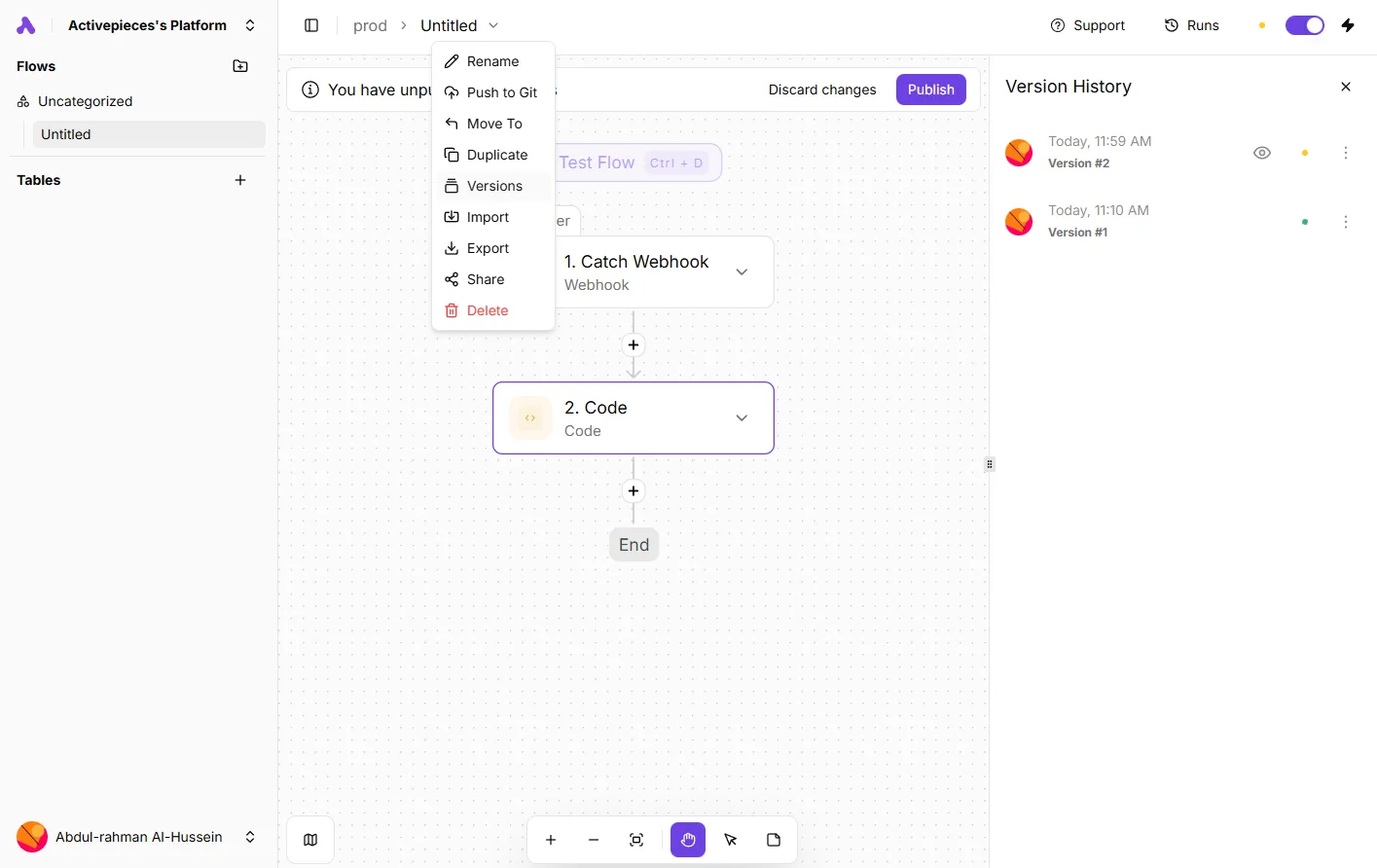
This automatic rejection ensures that malicious actors cannot trigger your automation steps or consume your task quota with forged data. It keeps your production environment both secure and cost-efficient.
The Monday morning webhook security audit checklist
Securing your infrastructure begins with a comprehensive review of every entry point where external services push data into your environment.
Relying on "security through obscurity" by using long, random URLs is a common trap that leaves your internal logic vulnerable to anyone who happens to intercept a single request header or log file.
Any endpoint that processes the request body without first validating a cryptographic signature against a shared secret is an unauthenticated or "naked" webhook.
You must audit your API gateway logs and serverless function triggers to find any listener that lacks a middleware layer for signature verification.
When an endpoint is naked, a malicious actor can spoof the payload of a service like the payment processor Stripe or the version control provider GitHub.
This potentially triggers unauthorized shipments or code deployments. Because these services provide specific headers for verification, any endpoint not checking them is essentially an open door to your backend databases.
Validating a signature proves that a message came from a trusted source, but checking the timestamp ensures the message is being processed in the correct temporal context.
You should examine your verification logic to ensure it compares the timestamp header provided by the sender against the current system time of your server.
If your code ignores the time of transmission, an attacker can perform a "replay attack" by capturing a valid, signed request and sending it to your endpoint repeatedly.
This could result in a customer being billed multiple times for a single order or a notification system flooding your team with redundant alerts.
The shared secret used to sign webhooks is a sensitive credential that loses its integrity the longer it remains in active use.
You need a documented process for rotating these secrets to limit the window of opportunity for an attacker who may have compromised a developer’s environment or a continuous integration log.
Establish a quarterly rotation for all production secrets to ensure that leaked credentials have a finite lifespan.
Use a "grace period" approach where the system accepts both the old and new secret for several hours to prevent downtime during the transition.
Audit access logs for your secret management tool, such as AWS Secrets Manager or HashiCorp Vault, to confirm that only authorized deployment pipelines are retrieving these keys.
Frequently asked questions about webhook security
Audit your infrastructure to find any endpoint that processes incoming data without a cryptographic handshake, as these represent open doors for injection attacks.
A "naked" URL is any public-facing route that lacks a verification middleware, meaning the application logic executes based on the headers and body of any request it receives.
You should prioritize checking endpoints connected to the following services:
Stripe, the payment processor, requires a signing secret to prevent fraudulent checkout completions. GitHub, the version control platform, uses secrets to ensure repository events are not spoofed by external actors. Twilio, the communication API, signs requests to protect against unauthorized SMS or voice command execution.
Ensure your verification logic includes a time-to-live (TTL) check to prevent replay attacks where an intercepted valid request is sent repeatedly to drain your resources or duplicate transactions.
Even with a valid signature, a request is dangerous if it lacks a fresh timestamp, as an attacker can capture a legitimate payload and rebroadcast it hours later.
When building these checks, modern developers utilize specialized reasoning models to audit the logic for edge cases:
Gemini 3.8 Flash, the flagship model for coding, can be used to generate robust timestamp comparison scripts that account for clock drift.
GPT-6 Sol, optimized for complex coding and agentic workflows, is effective for writing unit tests that simulate delayed network packets.
Claude Sonnet 5.5, which balances speed and intelligence, provides a reliable framework for reviewing middleware that rejects expired headers.
Establish a recurring calendar event to cycle your signing keys. Regular rotation ensures that a leaked secret does not grant an attacker permanent access to your ingestion pipeline.
If a developer accidentally commits a secret to a public repository or a former employee retains access to production logs, that key is compromised indefinitely until it is replaced.
A mature rotation plan involves generating a new secret, updating the provider's dashboard, and deploying the new key to your environment variables without interrupting the flow of incoming events.
Related reading
References
Build it
Set this up in minutes.
No code required. Connect your accounts, and Activepieces runs it from there.
Start free Talk to sales