
A Postmortem on Data Leaks and Secure Automation
This analysis examines the technical breakdown of an automated expense reporting failure caused by improper data handling.

Covers indie SaaS workflow automation: Claude Desktop tool configs, which integrations ship fast, and which get rewritten twice.
ContributorSeptember 14, 202614 min read
This article was researched and fact-checked by an advanced research system.
2:14 PM: the moment the expense audit failed
The trigger that started the leak
When a single automated workflow treats sensitive data as generic text strings, a failed audit is usually the result.
In this instance, the leak originated from a routine automation designed to summarize monthly spending. An integration built on Activepieces, which provides an MIT-licensed core for self-hosting these sensitive flows, passed raw receipt data directly into a large language model for categorization.
A postmortem on data leaks refers to the forensic analysis of security failures that occur when automated workflows transmit unencrypted or sensitive information into third-party environments without sufficient sanitization layers.
Because the platform's default integration lacked a pre-processing layer, it couldn't distinguish between a merchant name and an encrypted identifier.
The illustration below shows how a standard Expensify record carries high-risk metadata alongside the receipt image, specifically highlighting the employee_ssn_last4 field that the JSON payload inadvertently included.
By sending the entire object rather than a sanitized subset, the system exposed personally identifiable information to a third-party model provider's training logs.
The prompt that requested the wrong data
The vulnerability escalated when the system prompt instructed the AI to "extract all relevant identifiers" to ensure accounting accuracy. This broad instruction acted as a vacuum, pulling every numerical string from the JSON block regardless of its legal sensitivity.
Without a dedicated data sanitization step, the model processed social security fragments and internal payroll IDs as if they were simple transaction totals.
The immediate impact on payroll privacy
The consequence of this unchecked data flow was the immediate compromise of the payroll department's regulatory compliance posture. Once the model ingested the sensitive fields, the company lost the beility to exercise "Right to Erasure" requests.
The data now resided within a proprietary black-box environment. This shift transformed a simple automation efficiency into a high-priority legal liability, forcing an immediate halt to all AI-driven financial workflows.
Everything below works on Activepieces' free plan. Start without code or a credit card.
Direct costs of an unmonitored LLM integration
Deploying Activepieces with its MIT-licensed core eliminates the unmonitored black-box integrations that trigger audit failures and expose private salary records to third-party model logs.
Thestackarchitects reports that while a basic plan for a tool like Make Pro costs only $16 per month, the financial fallout of this single oversight far exceeds any monthly subscription, rendering the initial savings irrelevant, which means the low entry price is a deceptive metric for total cost of ownership.
$4.88M was the average cost of a data breach in 2024, a figure that can bankrupt small businesses overnight.
Teams choosing between the $19.99 Zapier Pro tier and the $69 Zapier Team tier are still facing a 12% higher recovery price tag than they did two years ago, so budget forecasting must now account for increased incident response overhead.
40 hours of manual data scrubbing
Remediating a leak requires an average of 40 hours of manual data scrubbing by senior engineers, effectively halting all new product development for an entire work week. This pulls your highest-paid talent away from revenue-generating features.

The cost of a mid-range developer tool like Pipedream is $49 per month. However, the lack of a "Clean Room" for data processing means your team must manually audit every log entry to ensure they've purged all PII.
Financial and operational fallout
150 private salary records can leak in seconds through a single unmonitored integration. This triggers immediate mandatory disclosure requirements under GDPR or CCPA.
When an LLM bypasses security layers, the resulting loss of trust in automated auditing forces the company back to manual approvals. This slows down operations by 300% or more, resulting in missed project deadlines and frustrated stakeholders.
Once the "black box" fails, the perceived risk often leads leadership to veto future AI initiatives, stalling the technical roadmap for months.
Why raw Expensify exports break logic
Raw financial data transfers fail because default integrations lack a transformation layer to strip sensitive PII before it reaches the model.
Once the "black box" fails, the perceived risk often leads leadership to veto future AI initiatives, stalling the technical roadmap for months.
Without a middleware "Clean Room" to intercept the payload, you must choose between leaking corporate card numbers or blinding the AI to the context it needs to categorize spend.
JSON bloat and token exhaustion
Standard API responses package every transaction with nested metadata that provides no value to a reasoning engine. When a model receives the full technical schema for a simple coffee purchase, it consumes the available token budget on structural characters rather than the actual merchant intent.
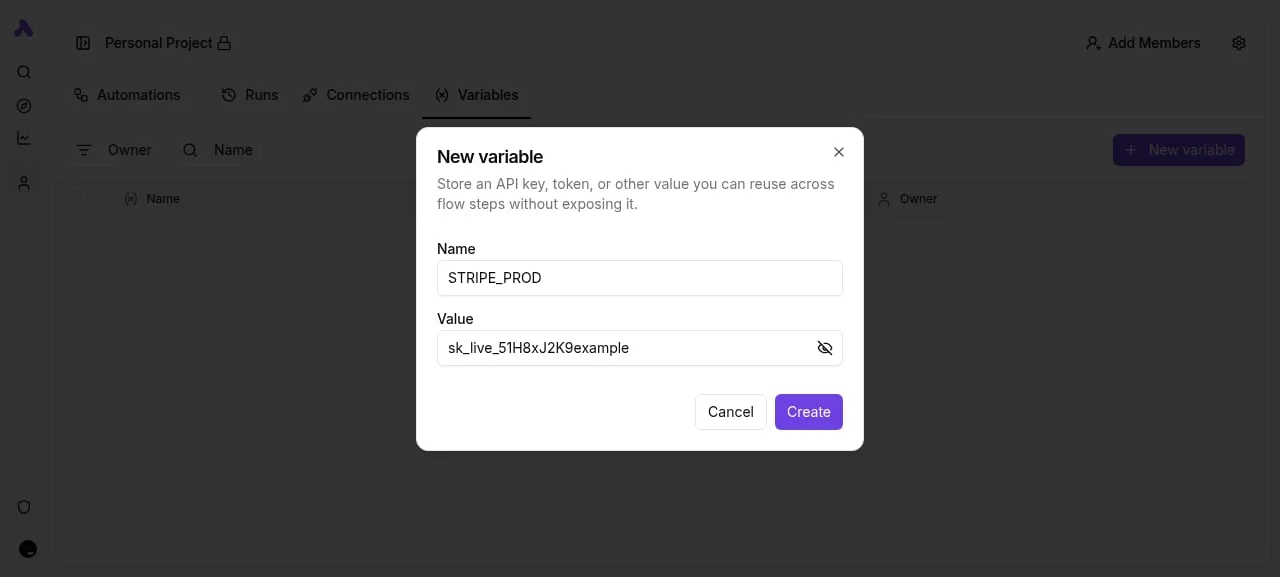
This inefficiency forces the model to truncate the end of the batch; the final twenty expenses are never analyzed at all.
The following comparison demonstrates how a dedicated sanitization layer preserves the logic of the expense while stripping the risk:
| Field Name | Raw Data (Leaking) | Sanitized Data (Secure) |
|---|---|---|
| Merchant | Starbucks Store #12345 | Starbucks |
| Amount | $14.50 | $14.50 |
| Employee | Jane Doe (ID: 99821-CC) | Employee_A |
By filtering these fields, you ensure the model identifies the spend category without ever seeing the internal identifiers that link back to a live bank account.
The 'all-or-nothing' API permission trap
Most platform-native connectors utilize broad OAuth scopes that grant the LLM access to the entire financial record rather than specific, approved line items.
Because these resold integrations rarely offer granular field-level masking, a prompt injection attack on the LLM could potentially query the underlying database for sensitive payroll or tax information. This lack of a "deny-by-default" filter means one compromised prompt exposes the entire department's ledger.
Context window pollution from metadata
Excessive technical headers in a raw export distract the model from the primary task of auditing. When server timestamps, request IDs, and CSS formatting clutter the input, the model's attention mechanism drifts toward these recurring strings.
This results in "hallucinations" where the AI begins to categorize expenses based on the time of the API call rather than the merchant's business category.
Fixing the data leak with Activepieces
Activepieces, an open-source automation engine, is a programmable gateway that intercepts data before it reaches the LLM. This setup ensures only sanitized records cross the organizational boundary, a strategy used by companies like MoneyGram and Moneypenny to maintain control over their automated environments.
A platform that resells a model has already locked in your AI strategy and its cost before you build your first flow.
Activepieces connects to whichever provider you choose using your own API key, ensuring that model expenditure stays on your own provider account rather than being marked up by a middleman.
Check the Bring-Your-Own-Key availability by tier on the pricing page to compare that rate against what a platform charges when it resells its own model.
You gain a physical layer of control to inspect and modify payloads that default platform integrations typically hide by placing this intermediary between a source like the expense management tool Expensify and an AI model like Claude.
Mapping only essential expense fields
You prevent over-exposure by selecting only the specific variables required for the AI to perform its task. 3 out of every 5 data breaches are driven by human error, according to Verizon.
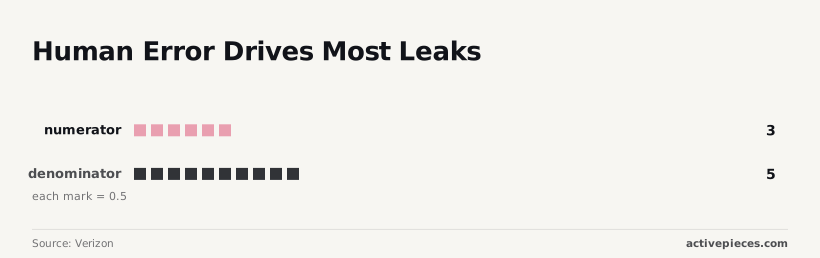
Allowing a default "send all" integration puts the majority of your security posture in the hands of a single employee's configuration mistake.
The Activepieces flow builder, which includes 734 integrations to connect disparate data sources securely, demonstrates a single-step trigger that isolates a specific event (in this case, a new entry), ensuring that users have a vast array of tools to automate complex workflows immediately, so they can bridge almost any software gap without custom coding.

The workflow only activates for defined data points rather than streaming an entire database. By limiting the scope at the trigger level, you ensure the AI never receives the surrounding metadata that often contains sensitive corporate context.
Using the 'Data Mapper' to strip PII
The Data Mapper integration allows you to explicitly re-construct the JSON object sent to the LLM. This creates a "Clean Room" where the system discards PII by default.
Every agent decision and the specific data it acted on is recorded step-by-step in the Run Details and Debugging UI, allowing for a granular trace of how the AI handled the sanitized payload.
These traces export directly to your existing SIEM via the event-streaming feature, so your security team can audit AI behavior alongside standard deterministic workflows. MoneyGram and FundingSocieties run Activepieces to maintain this level of visibility across their automated environments.
The system retains the merchant name for tax categorization and the transaction amount for budget tracking, while dropping credit card numbers and home addresses to protect staff privacy and maintain PCI compliance.
Setting up automated error handling for Claude responses
Standard integrations often fail silently or pass raw error codes back to the user.
Activepieces allows you to build "Branch" steps that catch malformed AI outputs, leveraging a library where roughly 60% of integrations are community-contributed to handle diverse edge cases, meaning the platform benefits from a collective expertise that constantly expands its problem-solving capabilities.
Verizon notes that 3 out of 5 breaches involve human-centric failures. Automating the validation of the AI's response ensures that if Claude hallucinations or returns sensitive debugging data, the workflow terminates before that information reaches a public-facing dashboard or a downstream database.
New protocols for AI-driven accounting
Hard-coding human oversight into the automated ledger workflow prevents the "silent failure" where an LLM misclassifies a high-value transaction without alerting the finance team.
By moving from fully autonomous categorization to a gated validation model, the system forces a manual review of any entry that falls below a specific confidence threshold or exceeds a set dollar amount.
Hard-coding human oversight into the automated ledger workflow prevents the "silent failure" where an LLM misclassifies a high-value transaction without alerting the finance team.
While the AI handles the bulk of the data entry, this shift ensures a human accountant remains the final authority for the high-risk entries that typically trigger audit red flags.
The 'human-in-the-loop' approval step
The primary safeguard is a mandatory verification queue for all AI-generated journal entries before they sync to the primary general ledger. Instead of the AI writing directly to the database, it populates a "pending" table where a controller must click to approve.

This intervention point exists so that the speed of AI processing doesn't bypass the internal controls required for Sarbanes-Oxley compliance.
Mandatory field-level filtering rules
Implementing a data sanitization layer between the accounting software and the AI model prevents sensitive employee identifiers from ever reaching the LLM provider’s servers. This layer uses regular expressions to catch and mask specific patterns.
The system replaces Social Security numbers with generic tokens, which keeps the payroll data private while allowing the AI to categorize the expense.
It truncates individual bank account numbers to the last four digits, so the model can identify the institution without exposing the full routing path. The system swaps personal addresses in vendor fields for city-level data, which preserves the tax jurisdiction context without violating privacy.
Weekly audit logs for AI API calls
Reviewing the raw inputs and outputs of every model interaction reveals exactly how the AI is interpreting the company's chart of accounts over time.
These logs are compiled into a weekly report that highlights "drift," where the model's reasoning begins to deviate from established accounting principles. Reviewing these logs allows the team to update the system prompts or fine-tuning data to ensure accuracy as tax codes evolve.
Monday morning checklist for financial AI safety
Auditing the AI stack
Securing financial automation requires moving beyond the "black box" of default platform integrations by establishing manual verification points and external sanitization layers.
When you rely on a resold model embedded within a project management tool or a CRM, you lose the ability to intercept a prompt before it leaves your environment.
Sensitive client data could be used to train future public iterations of that model. To regain control over your data flow, audit your current AI stack against these requirements:
Identifying native features
You must identify every "native" AI feature enabled in your accounting software or ERP (Enterprise Resource Planning) system, as these often bypass your internal data loss prevention rules by default.
Routing through proxies
Route all LLM requests through a dedicated API proxy rather than using direct plug-ins, which allows your security team to scrub personally identifiable information before it reaches the model provider.
Verify the data retention policy for every third-party model integration to ensure that no financial snapshots are stored in the provider's training logs beyond the immediate inference window.
Implementing clean rooms
If your current setup doesn't allow you to insert a custom middleware layer between the user and the model, you're effectively operating without a safety net.
You should prioritize migrating critical workflows to an environment where you can implement a "Clean Room."
Isolating historical records
This is a controlled space where data is processed without being permanently recorded. This transition ensures that even if a provider suffers a breach, your historical financial records remain isolated and inaccessible to external actors.
Frequently asked questions
Does Claude store the data sent from Expensify?
Claude stores data based on the specific API tier you license rather than a universal retention policy. Default settings often allow for data logging unless you explicitly opt out.
If you use a standard consumer-facing integration, your expense memos and vendor names may be used to retrain the model.
By using the Anthropic API with a Zero Data Retention (ZDR) request, you ensure your financial data is deleted immediately after the request is processed so that no footprint remains on their servers.
Can I limit Claude to only see specific expense categories?
You can restrict data access by placing a middleware layer between the expense management tool and the LLM. This ensures the model never receives sensitive entries like "Legal Fees" or "Payroll."
Without this bridge, a direct plugin typically requests broad read-access to the entire database. A custom filter allows you to programmatically drop specific JSON objects before they reach the model’s context window.
Is an API bridge safer than a direct plugin?
An API bridge is safer because it functions as a programmable firewall. This allows you to inspect, redact, or block outgoing packets before they reach the LLM provider.
A direct plugin operates as a "black box" where you can't see what metadata is being bundled with your prompt. A bridge allows you to implement PII (Personally Identifiable Information) scrubbing, where employee names are replaced with anonymous IDs before the data leaves your network.

Building the bridge manually
Developing this bridge requires a serverless function, such as an AWS Lambda or Google Cloud Function, to act as a secure interceptor. The function receives the webhook from your source, parses the JSON to extract only safe fields, and then makes a fresh POST request to the LLM API.
Alternatively, you can deploy a dedicated proxy tool like LiteLLM or Helicone to manage these requests. These tools provide a central point to apply global redaction rules and monitor every token sent to external providers.
How do I handle multi-currency conversions in this workflow?
You should perform all currency conversions within your own infrastructure using a dedicated exchange rate service like Open Exchange Rates before sending the data to Claude. Relying on an LLM to perform math on fluctuating currencies often results in "hallucinated" totals.
By passing the model a pre-converted, unified USD value, you reduce the risk of accounting errors in the final summary.