
Automated Data Processing: What It Is & How It Works
Automated data processing uses software to collect, clean, transform, and route data without manual work. See how it works and which tools help.

Feb 13, 202615 min read
Automated data processing is the use of software to collect, clean, transform, and route data through defined rules and triggers instead of by hand. It replaces manual exports, spreadsheet cleanup, and copy-paste work with pipelines that run continuously, cutting errors and shortening the gap between an event and a decision. Businesses rely on it for everything from real-time fraud alerts to nightly sales reports.
In this guide, you'll learn what automated data processing is, the benefits you can get, the different models and tools available, and which platforms help you build reliable automated data workflows.
TL;DR
- Data processing automation replaces manual data handling with systems that collect, clean, and move data automatically.
- It improves speed, accuracy, and data quality while reducing human error.
- You can use batch, real-time, or event-driven models depending on your needs.
- Tools like ETL, workflow platforms, and iPaaS connect and automate systems.
- Activepieces offers 735+ integrations, an MIT-licensed core, built-in AI, and flexible control for teams of any size.
This takes minutes, not a project: automate it in Activepieces free.
What Is Data Processing Automation?
Data processing automation means software takes over the work you used to do by hand.
It starts by getting raw data from different data sources like customer relationship management (CRM), apps, forms, or cloud services.
Then it runs data transformation rules. It removes duplicates, checks for errors, applies data validation, and reshapes the information so everything follows the same structure.
After that, prepared data is automatically delivered to a central storage area, like a data warehouse or a live dashboard.
Modern data automation tools are technologies that can be used to automate data processes. They connect systems and manage data workflows without constant manual intervention.
Some setups can manage both structured and unstructured data, so emails, PDFs, and tables all pass through the same logic.
In short, automated data processing covers the entire data lifecycle.
Key Benefits of Automating Data Processing
These are some of the benefits of data automation:
Faster Decision-Making
In a manual setup, there’s always a delay between an event and your awareness of it.
Sales can dip on Monday, but someone exports the data on Wednesday, cleans it on Thursday, and shares the report on Friday. By then, you’re reacting to old numbers.
Through automated data processing, real-time data pipelines collect updates the moment something happens, process the information, and update dashboards instantly.
For instance, automated data processing systems in finance can help you monitor transactions in real time for suspicious patterns, which means fraud gets flagged in seconds.
It can further help your marketing teams analyze data while campaigns are still live. You can make data-driven decisions based on current data.
Enhanced Data Accuracy
Manual data entry is flawed by nature. Humans are prone to accidental errors, especially during repetitive tasks. Even careful employees mistype numbers, skip rows, or paste values into the wrong column.
Your system may record dates as MM/DD/YY, while another uses MM-DD-YYYY. Automated data transformation forces everything into one format before it reaches reports.
By automating data validation, standardization, and deduplication processes, you can make sure that your data is consistent.
When systems can move information through application programming interfaces (APIs), your raw data arrives exactly as it was generated at the source.
Software can also flag extreme values, such as a $10,000 sale entered as $1,000,000, and detect duplicate records before they distort totals. These checks protect data integrity and strengthen data management in everyday data operations.
Improved Data Quality
Accuracy fixes errors, but quality looks at completeness and reliability.
Automated workflows can reject or flag entries that miss required fields. Some systems even fill gaps automatically, such as adding company details based on a domain name.
Companies that effectively leverage data automation solutions can reduce issues tied to manual data entry and keep information fresh.
Since automated data processing refreshes dashboards frequently, your data teams work with high-quality data. Better data quality management prevents broken reports and protects long-term analysis, too.
Reduced Operational Costs
Manual data handling costs more than you realize. Employees spend hours on repetitive data tasks that software can complete in seconds.
Businesses that adopt a data automation strategy can reduce processing time and free skilled staff to focus on planning, forecasting, and deeper analysis.
Computing resources handle large data analysis processes at a lower cost than employee time. Fewer mistakes also reduce expenses linked to human error, such as correcting invoices or fixing incorrect reports.
Research shows that companies that automate data tasks can reduce long-term operational expenses by 40%. That improvement in operational efficiency appears both in saved hours and in reduced payroll pressure without expanding headcount.
Types of Data Processing Automation
You can implement data automation, such as:
Batch Data Processing Automation
Instead of reacting to every event as it occurs, the system collects information over time and waits. That collection period could last an hour, a day, or even a full month, depending on the business need.
All those records sit in a temporary space until the scheduled run begins.
Once the clock hits a set time, like 2:00 AM, or when the file grows large enough, such as 1GB, the automation starts. It cleans entries, applies transformation rules, and pushes results to storage.
Processing data in bulk reduces compute load since it’s much easier on your servers to process 10,000 records in one go.
Real-Time Data Processing Automation
Real-time automation listens continuously to incoming signals. It listens to a source, such as:
- Website
- Mobile app
- Sensor
As soon as an event occurs, such as a click, swipe, or temperature change, the data enters the pipeline instantly.
Rather than storing everything for later, the platform processes it immediately. Since the pipeline reacts immediately, you can respond while the activity is still unfolding.
Marketing budgets adjust mid-campaign. Customer support tickets route to the right agent without delay.
Business processes that depend on current information benefit most from this structure.
Event-Driven Automation Systems
Event-driven systems focus on triggers. Nothing happens until a defined action takes place.
When an unrecognized IP address tries to log in to your server, that event can start the chain. The system freezes the account and sends a push notification to the admin’s phone.
Because tasks are activated on demand, computing power remains efficient. When 1,000 events occur at the same time, the platform can launch 1,000 small automated jobs simultaneously.
Each one runs independently, which prevents bottlenecks.
Types of Automated Data Processing Tools
Common types of data automation software include:
ETL and ELT Tools
When teams talk about classic analytics automation, they usually mean extract-transform-load (ETL) and extract-load-transform (ELT) tools.
Both models revolve around three actions: extracting data, cleaning and transforming it, and loading it into storage.
With ETL, the system performs data extraction from various sources, transforms the information in a staging area, and only then sends it to a warehouse. Cleaning happens before storage.
ELT flips that order. The system extracts data, loads it directly into a warehouse, and then performs transformation inside that environment. Modern cloud databases have enough computing power to reshape large datasets quickly.
These two remain necessary in data engineering, especially when building structured reporting layers.
Workflow Automation Platforms
Workflow automation platforms focus less on analytics storage and more on actions between tools. You define a trigger, set logic rules, and connect steps that run automatically.
These automated systems handle tasks that normally require manual intervention, such as routing a lead, creating a support ticket, or updating a CRM record.
Some platforms operate visually, while others allow code. Many can handle both structured data, such as database records, and unstructured data, like documents, images, or text.
iPaaS
An integration platform as a service (iPaaS) serves as a main hub for complex data flows within large organizations. Rather than connecting just two apps, it manages connections between dozens or even hundreds of systems.
You can think of it as a cloud-based suite designed to govern and automate the data flow between departments. Finance systems, marketing tools, HR software, and legacy databases all exchange information through one control layer.
Retail companies often rely on iPaaS to keep inventory synced between physical stores and online channels.
Automated Data Processing Software: Comparing the Options
Choosing the right category of automated data processing software depends on what you're moving and how fast you need it. Here's a quick comparison of the three main categories covered above:
| Tool Category | Best For | Typical Users | Handles Unstructured Data? |
|---|---|---|---|
| ETL / ELT tools | Building structured reporting layers and data warehouses | Data engineers, analytics teams | Limited — mainly structured records |
| Workflow automation platforms | Connecting apps and automating actions between them | Ops, sales, support, and technical teams | Yes — documents, images, and text alongside records |
| iPaaS | Governing data flow across many systems in a large organization | IT and platform teams at large enterprises | Varies by platform |
ETL/ELT tools remain the backbone of analytics pipelines, but they're built for moving data into a warehouse, not for triggering actions across business apps. Workflow automation platforms like Activepieces fill that gap: you get a visual builder for non-technical users, AI steps for handling unstructured content, and the ability to write custom logic in TypeScript when a flow needs more depth. iPaaS platforms sit above both, coordinating dozens of systems at once, which is why retailers and large enterprises often lean on them to keep inventory, finance, and CRM data in sync.
Most teams don't need to pick just one category. A common pattern is an ETL/ELT tool feeding a warehouse for analytics, while a workflow automation platform handles the day-to-day actions — routing leads, updating records, and triggering alerts — between the same systems.
You can follow the rest of this with the builder open. Start free, no card.
Why Activepieces Is the Most Advanced Platform for Data Processing Automation
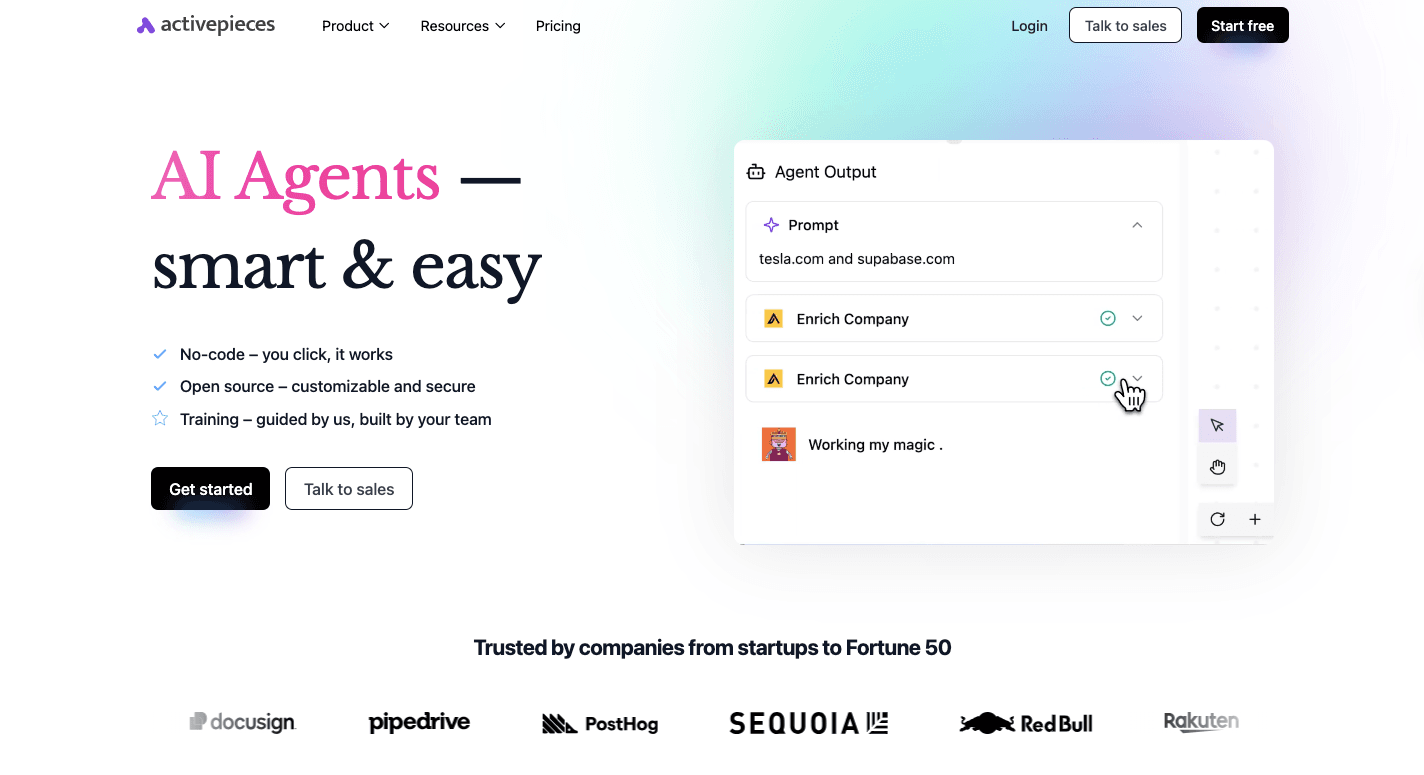
Let's talk about where most automation tools fall short. You usually have to choose between something simple that breaks as you scale or something advanced that demands serious technical expertise.
Activepieces is open-source automation software with a visual builder anyone on your team can use, while also giving you developer-level control when you need it.
Key features you get include:
MIT-Licensed Core With Full Control
Many platforms operate like black boxes. You can't see how they handle your logic, and you can't adjust internal behavior.
Activepieces runs on an MIT-licensed core, which means no fair-code restriction and no source-available asterisk, so you can inspect the code, audit workflows, and self-host it. That matters when you deal with sensitive customer data or third-party sources that require strict control. RBAC, SSO, SCIM, and audit logs are available whether you self-host or run on cloud, and Activepieces is SOC 2 Type II certified.
AI Automation
Activepieces lets you feed a messy document or support tickets into a workflow and use AI to extract structure instantly. It can route requests based on tone, intent, or content, and works with whichever model provider you choose, including your own API key so model spend stays on your own account.
That level of logic supports complex automated processes with minimal human intervention.
Copilot helps generate steps inside the builder, which lowers the learning curve. Even when you lack deep coding experience, you can still deploy serious automation.
735+ Integrations and Growing
Right now, Activepieces offers 735+ pre-built integrations called pieces, roughly 60% of them community-contributed. That number covers productivity apps, AI providers, finance tools, CRMs, and business intelligence platforms, and every one is also available to an AI agent as a callable tool.
Many competitors present themselves as enterprise-ready but offer fewer native connectors. Activepieces continues to expand through community contributions, which keep the ecosystem active and relevant.
When people compare the best data automation tools, integration depth often becomes the deciding factor. The broader the connector library, the fewer custom builds your team needs.
Stop patching tools together. Use Activepieces and plug into hundreds of apps instantly!
Examples of Data Automation Workflow in Activepieces
Here are some of the workflow automation templates available in Activepieces:
Automated Lead Processing
Manually reviewing appointment requests slows everything down. One person reads the form, another decides if it’s worth a call, and someone else forgets to reply.
An AI-powered qualification workflow allows every submission to be evaluated instantly, categorized based on intent, routed to the right path, and answered.
Here are the key elements of the flow and what each part does:
- Trigger: New Google Form submission - Starts the automation when a new response is submitted.
- Load sample data - Pulls recent entries so you can confirm the fields map correctly before activating the workflow.
- AI text classification - Analyzes the message and assigns a label such as “Sales,” “Inquiry,” or “General Question.”
- Defined categories - Controls how AI labels responses to keep routing consistent.
- Router with conditions - Applies logic to send each request down the correct branch.
- Sales branch actions - Logs the lead in Google Sheets, drafts an internal email using AI, and sends it to the salesperson.
- Non-sales branch actions - Drafts a response email for informational leads and sends it automatically.
Get the template here: Automate Lead Qualification Appointment Requests
AI-Based Support Ticket Recording
Support teams often spend time moving tickets between systems. A new Zendesk ticket comes in, someone opens it, copies the details, and pastes them into a database for reporting or tracking.
That routine creates delays and increases the risk of missing records.
An automated Zendesk-to-MySQL workflow lets every new ticket get captured and stored in your database the moment it appears.
Here are the key elements of the flow and what each part does:
- Trigger: New ticket in Zendesk view - Starts the automation whenever a new ticket appears in the selected Zendesk view.
- Template foundation - Provides a ready-built structure inside Activepieces so you don’t start from scratch.
- Zendesk connection - Authenticates your Zendesk account so the system can read ticket data.
- MySQL connection - Connects your database so new records can be written directly into a chosen table.
- Insert row action - Takes ticket fields such as subject, description, requester, and timestamps and writes them as a new row in MySQL.
Get the template here: Zendesk Tickets to MySQL
Simplify Complex Data Automation Processes With Activepieces
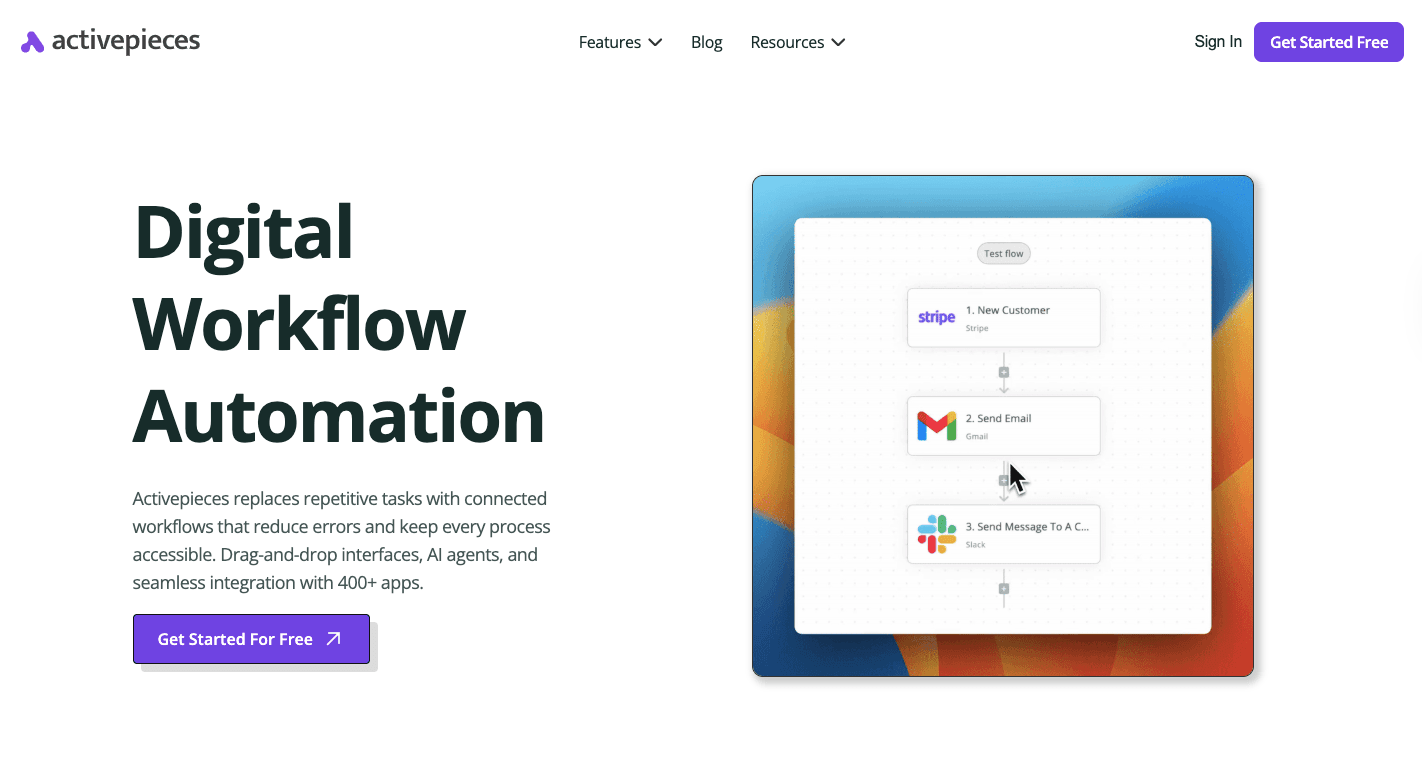
You have data from multiple sources like your CRM, marketing tools, finance apps, and AI services. Others export files, and someone else uploads numbers into a dashboard. That cycle eats time and creates room for mistakes.
Activepieces replaces manual effort with connected flows that run within a single system. You link tools once, define the logic, and let automated processes move records where they need to go.
The interface stays approachable, yet it doesn’t limit depth. Non-technical users can build flows visually. Developers can write custom pieces in TypeScript when complex logic demands more control.
As everything runs together, accurate data flows consistently without constant supervision.
FAQs About Data Processing Automation
What is automation in data processing?
Automation in data processing means software handles the collection, cleaning, transformation, and movement of data without constant manual input.
Instead of employees exporting files and fixing spreadsheets, systems run the data automation work automatically based on defined rules and triggers.
What does automated data processing do?
Automated data processing collects information from systems, applies logic to clean and standardize it, and stores or routes it where needed. It reduces manual review, improves consistency, and prepares data for reporting or further analysis.
Many data scientists rely on these systems so they can focus on modeling.
What is an example of automated data processing?
A simple example is a sales form that automatically sends submissions into a CRM, classifies the request using AI, and logs it in a database without human review. Another example is a bank system that reviews transactions in real time and flags unusual patterns.
What are the four types of automation?
Automation can be categorized into several types, including robotic process automation (RPA) for repetitive tasks, data integration for consolidating data from multiple sources, and machine learning (ML) for automating data analysis.
Batch and real-time processing models are also commonly used, depending on speed requirements.
How Do You Automate Data Processing?
If you're starting from scratch, automating data processing usually follows the same five steps regardless of which tool you pick:
- Identify the data sources. List every app, form, database, or file where the data currently lives, including both structured records and unstructured documents.
- Define the trigger. Decide what starts the automation — a new form submission, a scheduled time, a file landing in storage, or an event like a failed login.
- Set the transformation rules. Decide how data gets cleaned, validated, deduplicated, and reshaped so it lands in a consistent format every time.
- Choose the destination. Route the processed data to a warehouse, database, dashboard, or another app, depending on who needs to use it next.
- Test with sample data, then monitor. Run the flow against real records before turning it on fully, and keep an eye on error logs as volume grows.
In a platform like Activepieces, this looks like picking a trigger piece (such as a new Google Form response or a new database row), adding action pieces to classify, clean, or transform the data — including AI steps for unstructured content — and connecting a final action that writes the result to a CRM, spreadsheet, or database. You can build this visually without code, or drop into TypeScript when a step needs custom logic.
The same five steps apply whether you're automating a single two-app connection or a multi-stage pipeline feeding a data warehouse; only the tools and the number of steps in between change.
Build it
Set this up in minutes.
No code required. Connect your accounts, and Activepieces runs it from there.
Start free Talk to sales