
GitHub Copilot Fusion Explained for AI Coding Teams

Nov 1, 202611 min read
Copilot Fusion is GitHub's feature for sending coding requests to different AI models, and GitHub, which Microsoft owns, is the company that built it. Everything below is held to what GitHub's own pages said on 31 October 2026, not to what others reported about them.
When a support lead sends a password reset to the junior queue and a billing dispute to a senior agent, that is routing. A router does the same with models, sending easy requests to a cheap one and hard ones to a stronger one.

Either way, a wrong call costs something. A hard request sent to a weak model gives a bad answer with confidence, and an easy one sent to a strong model burns budget.
Teams that wire this into wider workflows, say through Activepieces, still need the vendor to state the router's rules plainly, because a larger set of integrations makes documentation more critical, not less.
Only the first row of the table below is GitHub speaking, and the third row is a list of gaps I won't fill with guesses. Together the rows show the three kinds of evidence used here.
GitHub Copilot Fusion in plain terms
| Row | What it covers | Source |
|---|---|---|
| What GitHub published | The announcement itself, with the date GitHub put on it | GitHub changelog |
| What this article checked | GitHub's pages as they read on 31 October 2026 | GitHub Copilot docs |
| What's unknown | Anything the pages above don't state: access, price and usage limits unless GitHub has written them down | GitHub Copilot plans |
Prices and plan limits checked against activepieces.com and docs.claude.com and claude.com and openai.com and gemini.google on October 31, 2026.
A claim counts only if one of those pages backs it, and each later section follows from that.
Everything below works on Activepieces' free plan. Start without code or a credit card.
What Copilot Fusion does to a request
Take one request and decide which model answers it: that is Fusion's job, and any detail beyond that counts only if GitHub states it. Treat everything else as unstated until a GitHub page says otherwise.
Which models it chooses between
When the pick is wrong, it costs more than a slow one does. A cheap model on a hard refactor sends the developer back to redo the work, and an expensive model on a trivial rename burns budget for nothing.
According to Docs, the sketch below shows the general shape of routing, using Claude Haiku 5.5, Claude Opus 5.5 and a GPT-6 model as stand-ins. Read it as the decision Fusion has to make, not as GitHub's list.
The sentence it earns is simple: the question mark is the step you can't adopt blind.
Check GitHub's own model list for Fusion. This article doesn't cite it, so the set of models is unstated.
Whether Fusion works in the editor, in chat, in the agent or in the command line, the sources here don't say. Each surface matters separately, because a choice made in a one-line completion carries different risk from one made inside a long agent run.

Whether Fusion shows which model it picked, or whether you can overrule it, GitHub's pages don't say. That's the first thing to confirm.
If a user can't see the choice, nobody can trace a bad answer to the model that gave it, or say whether to escalate or retry.
Copilot Fusion pricing and access
Whether your account can use it depends on your plan and on a policy your admin controls. Check both on GitHub's own pages before you rely on either.
When a user can't see Fusion, they will file a ticket asking why, so eligibility is the first thing to confirm.
Read the plan list on GitHub's docs and changelog, and note the date on the page you read. A secondhand summary may describe a plan list that has since changed.
Check whether Fusion needs a preview or opt-in step, and whether an organisation policy toggle sits above the individual setting. If the policy is off, a user's own setting changes nothing. Ask the admin before you tell anyone it's broken.
Pricing and usage allowances
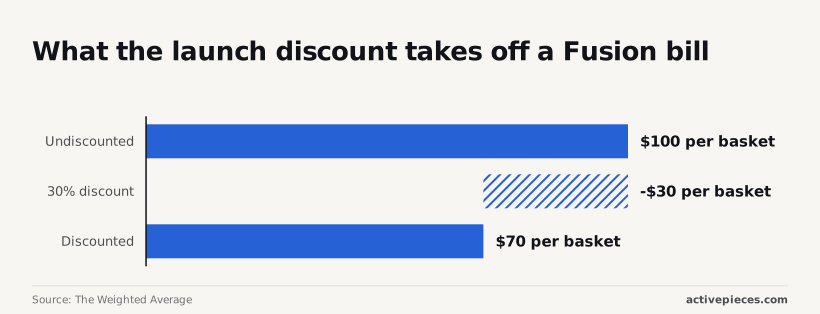
To see the discount, take an illustrative basket. The Weighted Average puts an undiscounted Fusion basket at $100.

That way they aren't caught off-guard when renewal costs jump.
Compare these figures with the pricing page itself, and record the date you checked.
Copilot Fusion strengths and limitations
We haven't run Fusion ourselves.
What GitHub says it does well
About half the average API cost per task is the saving GitHub claims.
On quality, Artificial Analysis scores Fusion Max 60 and Claude Code with Opus 5.5 Max 62 on its coding index.
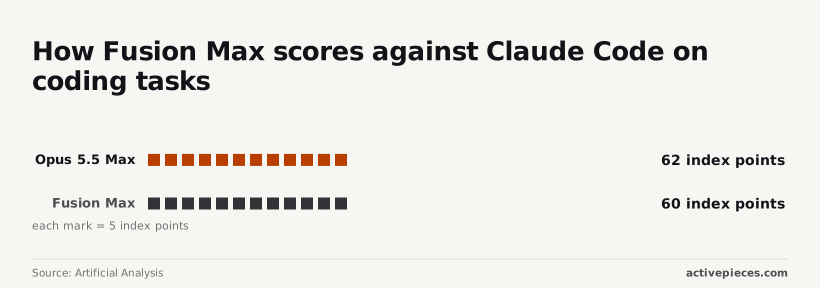
The chart sits here.
At $5.59 per task for Fusion Max, the question is whether two index points are worth the extra spend on your tickets.
Read GitHub's list of unsupported surfaces and its data and privacy terms before anyone routes private code through it. Note the date you read them.
We haven't run Fusion, so these are questions, not findings:
- When the router picks a cheaper model for a hard task, who sees the failure?
- Does your repository's data go to more than one model provider?
- Can you pin one model when a task matters?
Easier to see it running than to read about it: set it up free, no card.
Copilot Fusion compared with established options
Whether you or the router picks the model is the question that matters most, and Fusion's published material, as we read it, doesn't say. GitHub makes Fusion, as it makes Copilot, its AI coding assistant.
A wrong pick costs you: a cheap model on a hard bug reads like a confident wrong answer.
When routing is in play, software, not you, decides which model answers each request. Cursor's auto mode does this inside the editor Cursor makes.
Claude Code is Anthropic's terminal coding tool, where you choose the model. OpenRouter is a hosted service that forwards requests to many providers and can also pick for you.
The comparison uses only vendor documentation, with the check date beside each cell. Where the vendor is silent, the cell says so, and the silence is the finding.
Read the table for one thing: Fusion's cells are the emptiest, so nothing in it can yet be treated as a reason to adopt.
| Option | Who chooses the model | Choice visible | Billing | Where it runs |
|---|---|---|---|---|
| Fusion | Not stated, 2026-10-31 | Not stated, 2026-10-31 | Not stated, 2026-10-31 | Not stated, 2026-10-31 |
| Copilot manual picker | You | Yes | Not stated, 2026-10-31 | Not stated, 2026-10-31 |
| Cursor auto | Cursor | Not stated, 2026-10-31 | Not stated, 2026-10-31 | Not stated, 2026-10-31 |
| Claude Code | You | Yes | Not stated, 2026-10-31 | Your terminal |
| OpenRouter | You, or its auto option | Not stated, 2026-10-31 | Not stated, 2026-10-31 | Hosted service |
Put each blank to GitHub as a question before any team routes real tickets through Fusion.
Activepieces support that already touches Copilot Fusion
This article can't confirm any Copilot Fusion step in Activepieces, so there's no dated release or link to cite.
Activepieces is an MIT-licensed AI automation platform that connects 746 integrations, counted from the community pieces directory in its monorepo, and it is made by the Activepieces team, not by GitHub.
The LICENSE file puts the core under MIT, with the packages/ee/ directories under a separate commercial licence, and the GitHub piece page lists what that integration does today. Nothing it ships speaks for GitHub's access, price or limits.
A router that picks your model has made part of your AI decision for you, and the same is true of any platform that resells you its own model.
On the pricing page, an AI step on your own key is 1 credit and the model cost goes to your provider bill, while on the managed models the same step is 2 credits for a fast model, 10 for a smart one and 20 for a frontier one.
What AI model routing means
Say a routine password-reset ticket goes to a cheap model and a furious refund demand to a stronger one: that is routing, a system picking which model handles each request.
A wrong route costs more than a slow one. An angry customer who gets a cheap model's flat reply is a bigger problem than a pricey model answering an easy ticket.
That's why the blanks in GitHub's own statements matter before anything is wired in.
An angry customer who gets a cheap model's flat reply is a bigger problem than a pricey model answering an easy ticket.
Sources and evidence for Copilot Fusion claims
It relies on what can be pointed at. Look at the test flow below: it has an "Every Hour" Schedule trigger selected and an integration selector listing Google Sheets, Microsoft Excel 365, AITable and Retable with actions like Insert Row and Find Rows.
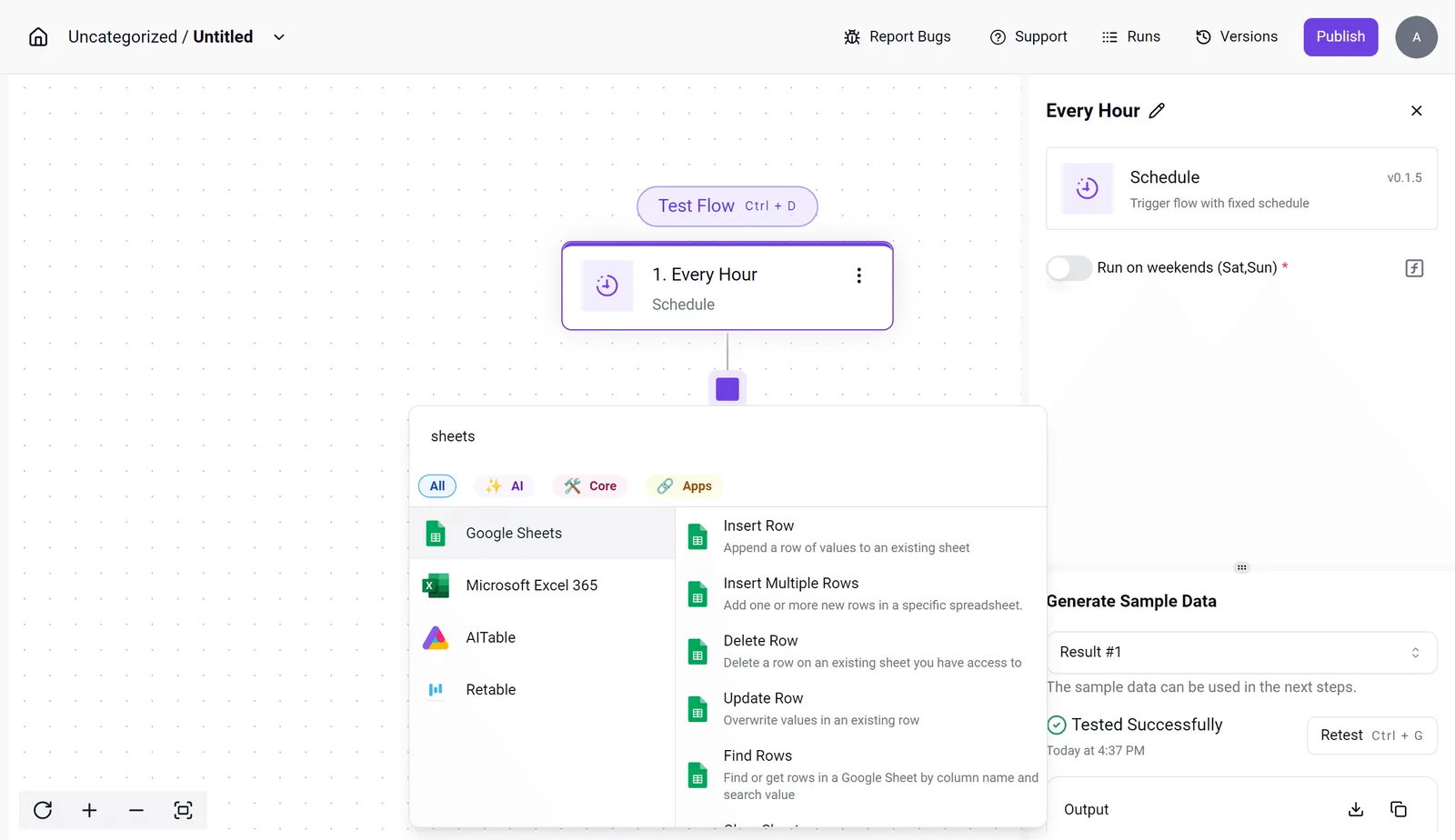
It also shows a "Generate Sample Data" test that passed. So the builder can run a timed job and write rows to a spreadsheet, which is useful for logging what a router decided on each ticket.
It doesn't show a Copilot step, and it proves nothing about Fusion. A reader who wants Copilot-related steps in a workflow can search the 746 integrations in the community directory linked above, roughly 60% of them community-contributed, or the integration selector, for one.
Until a dated GitHub or Activepieces statement says otherwise, treat any such step as unconfirmed.
Monday verification steps for Copilot Fusion
A reader who wants Copilot-related steps in a workflow can search the 746 integrations in the community directory linked above, roughly 60% of them community-contributed, or the integration selector, for one.
Skipping ahead costs more than it saves: a team that enables a feature before reading the limits finds out about them from a blocked developer.
- Re-read GitHub's announcement and pricing page for any change since 31 October 2026.
- Confirm your plan and the admin policy that governs it.
- Trial it on one non-critical repository.
- Log usage against the allowance.
- Set a review date.
Each step stops you from acting on a stale answer from the one before, which is why the order matters. The three below are where people most often cut corners.
Read GitHub's own announcement and pricing page, and note the date on each. If a page has changed since 31 October, your earlier notes are out of date.
Then check your plan and your organisation's admin policy, because an admin setting can switch a feature off even when the plan includes it.
Pick one repository where a bad suggestion costs an afternoon, not a release. Record each use against the stated allowance as you go. Without that record, you can't tell whether the routing saved effort or only moved it.
Put a date in the calendar before the trial starts. Access, price and limits are statements that can change, so re-read the same two pages on that date and decide again.
Frequently asked questions
Cost and the rule for unconfirmed answers
If GitHub's own pages don't say it, it counts as unconfirmed, the same rule as in the re-read.
Is GitHub Copilot Fusion free? Unconfirmed. I have no GitHub statement that makes it free, so don't assume it. If you assume free and it isn't, a team can run up usage nobody budgeted. Read GitHub's pricing page and note its date.
How Fusion relates to Auto model selection
Is GitHub Copilot Fusion the same as Copilot's Auto model selection? Not established.
Auto model selection is its own Copilot feature, and I found no GitHub statement saying Fusion is the same thing. Treat them as separate until GitHub's documentation says otherwise. Otherwise you may test one feature and report on the other.
Choosing the model
Can I choose which model Copilot Fusion uses? Unconfirmed.
Routing implies the system picks the model, but whether you can override that choice is a limit GitHub has to state. Until it does, don't promise your team a pinned model, because the first person who needs one will be the one writing in.
Plans and availability
Does Copilot Fusion work with Copilot Business and Enterprise? Unconfirmed.
Plan availability and administrator policies are exactly what GitHub's plan documentation settles. Check it before rollout. A developer who can't switch the feature on because an admin policy blocks it becomes a support ticket you could have avoided.
Is GitHub Copilot Fusion generally available yet? I have no GitHub announcement of general availability that I can confirm. Look at GitHub's changelog for a dated entry. Anything labeled preview can change its access, price and limits without much notice.