What Is Jev-Ultrafast Agent? Browser Automation in 2026
What is jev-ultrafast agent, and how does it compare to traditional frameworks?

Covers cost incidents in AI workflow automation: the exact trigger where spend spiked, the missing cap or alert, and the postmortem fix.
ContributorSeptember 28, 202612 min read
This article was researched and fact-checked by an advanced research system.
What is Jev-Ultrafast Agent?
Everything below works on Activepieces' free plan. Start without code or a credit card.
Jev-Ultrafast Agent is a high-speed browser automation tool
Jev-Ultrafast Agent is a high-speed browser automation tool that replaces rigid, selector-based scripts with a dynamic, indexed action space to navigate complex web interfaces.
By shifting from brittle DOM-pathing to vision-led reasoning, the system allows developers to automate workflows on websites that frequently change their underlying code without requiring manual script updates.
Who developed Jev-Ultrafast?
Browser Use and TypeSafe collaborated to develop the agent. This partnership ensures that the agent can handle high-velocity data streams while maintaining strict schema validation, so an engineer can deploy it into production environments without fearing unhandled runtime exceptions during a browser session.
The indexed action space technology explained
The engine achieves its performance by utilizing a dynamic, indexed action space. This reduces the computational overhead of identifying page elements.
Aimultiple reports that it leverages inception/mercury-2.5 via OpenRouter as its text model, with reasoning disabled. This ensures that the latency between a page load and the next click is measured in milliseconds rather than seconds.
While Activepieces highlights that Zapier starts at 19.99 and Make at 18.82, these costs cover basic logic. A high-speed vision agent like Jev-Ultrafast incurs additional per-token expenses that can quickly exceed these flat-rate tiers.

Jev-Ultrafast release date and version history
Jev-Ultrafast is a new open-source project on GitHub, with active commits from Browser Use and TypeSafe as recently as September 2026. The current version works with the browser-use framework.
It is ready for experimental agentic workflows but requires a dedicated runner to handle the high token throughput of vision-based models.
Because the framework relies on real-time screen captures rather than DOM inspection, the local environment must support high-speed image encoding to prevent bottlenecking the decision loop.
How Jev-Ultrafast automates browser tasks using AI vision
Jev-Ultrafast automates web navigation by treating the browser viewport as a visual coordinate map rather than a structured document. This shift replaces the brittle practice of targeting specific code markers with a probabilistic understanding of UI intent.
Jev-Ultrafast automates web navigation by treating the browser viewport as a visual coordinate map rather than a structured document.
Why Jev-Ultrafast skips CSS selectors and XPath
By utilizing vision-language models, the agent bypasses the need for hardcoded CSS selectors or XPath expressions that frequently break when front-end developers rename classes.
Instead of searching for a specific ID, the model interprets the raw visual layout to identify functional elements like "Checkout" buttons regardless of the underlying code structure.
This ensures that a minor update to a site’s styling does not crash an automated procurement pipeline.
Jev-Ultrafast speed benchmarks versus standard browsers
The system achieves extreme efficiency by minimizing the latency between visual capture and action execution. According to Browser Use, Jev-Ultrafast completes tasks in 7.1 seconds, whereas a standard automated browser takes 28 seconds and a traditional framework like Selenium requires 60 seconds.
Running more tests in the same window than Selenium can, drastically increasing the velocity of CI/CD feedback loops.

Jev-Ultrafast handling of dynamic web pages
The agent manages asynchronous state changes by constantly re-evaluating the visual field rather than waiting for specific DOM events. Because it functions like a human operator, it can navigate complex interfaces.
It interacts with pop-up modals that appear after variable delays. It identifies "infinite scroll" triggers that lack traditional pagination links. It executes actions within nested iFrames that often obscure standard scraping tools.
This adaptability allows models like Gemini 3.8 Flash or Claude Haiku 4.5 to maintain high success rates on React-based dashboards where element visibility is non-deterministic.
Model benchmarks and current availability
For current production deployments, developers should utilize inception/mercury-2.5 via OpenRouter, the text model used in the current demo. These available tools provide the multimodal capabilities necessary to interpret UI screenshots today while maintaining the low latency required for the Jev-Ultrafast architecture.
Setting up Jev-Ultrafast from the official repository
Installing Jev-Ultrafast requires a clean environment and a valid connection to a vision-capable inference engine to handle the high-frequency UI sampling the framework demands.
Jev-Ultrafast hardware and system requirements
Running vision-based agents locally necessitates specific hardware overhead to manage the overhead of continuous visual state processing.
The software itself is distributed as the jev-ultrafast repository hosted by Browser Use on GitHub, built in collaboration with TypeSafe. It functions as a standalone Python library that extends the base agent capabilities with optimized vision-processing loops.
- Clone the repository from the central source to ensure the local version includes the latest driver patches for Chromium, a high-performance open-source browser.
- Create a virtual environment to isolate the specific Python dependencies from the system-wide libraries, preventing version conflicts during runtime.
- Run uv sync to pull in the necessary dependencies and automation drivers required for browser interaction.
- Launch the local inspector at port 8766 to provide a live debugging interface where you can monitor the agent's visual reasoning in real time.
API keys and LLM provider configuration
The orchestration layer requires high-throughput access to vision models to interpret the screenshots generated during each step of the automation.
OpenRouter allows the agent to toggle between various frontier models without rewriting the integration code. inception/mercury-2.5, accessed via OpenRouter with reasoning disabled, provides the necessary intelligence at the lowest latency, so the agent reacts to UI changes before the session times out.
inception/mercury-2.5 acts as the text model for reasoning tasks, keeping token costs manageable during long-running scraping sessions. Set the OpenRouter API key in the .env file so the framework can authenticate requests without exposing credentials in the source code.
Running the first automation script
Execution begins by defining the target URL and the objective within a JSON-based task file. Once the inspector is active and the environment variables are ready, the agent initiates a headless browser session to begin the visual feedback loop.

The system captures the current viewport, transmits the encoded image to the configured LLM, and translates the resulting text coordinates into hardware-level mouse and keyboard events.
Easier to see it running than to read about it: set it up free, no card.
Calculating the total cost of running Jev-Ultrafast
Jev-Ultrafast shifts the financial burden from developer hours spent maintaining fragile selectors to a recurring operational expense dictated by model inference.
While the underlying orchestration logic remains open-source and free to deploy, the vision-based reasoning required to interpret UI changes relies entirely on external API calls.
Open-source licensing vs. API costs
The framework utilizes an MIT license, which removes the barrier of seat-based enterprise pricing. It introduces a direct correlation between automation complexity and monthly spend.
Because Jev-Ultrafast does not ship with a local vision model, users must provide their own API keys for proprietary endpoints.
Jev-Ultrafast token usage and API costs
High-speed execution requires the model to ingest high-resolution screenshots at every step to ensure the agent has not deviated from the intended path.
Unlike text-based scrapers that only process HTML strings, this vision-centric approach forces the model to "see" the entire viewport, leading to significant token overhead for every interaction.
The following table compares the cost efficiency of the flagship GPT-6 Astra against Gemini 2.5 Pro for a standard multi-step flight booking sequence.
| Metric | GPT-6 Astra (OpenAI) | Gemini 2.5 Pro (Google) |
|---|---|---|
| Cost per 1k Input Tokens | Higher overhead for vision | Competitive pricing for large contexts |
| Vision processing fee | Per-image fixed token cost | Variable based on resolution |
| Typical flight search total | Significant per-transaction cost | Moderate per-transaction cost |
Prices and plan limits checked against github.com on September 28, 2026.

Hidden costs of visual-heavy automation
The most volatile expense in this stack is the "retry loop" triggered when a model fails to identify a UI element on the first pass. In a standard script, a failed selector costs nothing but time.
In Jev-Ultrafast, every failed attempt to find a "Submit" button results in a fresh screenshot being uploaded and analyzed at full price.
Without strict token caps and timeout thresholds configured in the orchestration layer, a single malfunctioning web element can drain a daily API budget before an engineer receives a latency alert.
Jev-Ultrafast vs. established browser automation frameworks
Jev-Ultrafast outpaces traditional frameworks by collapsing the execution loop from sequential DOM navigation into a unified vision-based inference step.
| Feature | Selenium / Playwright | Standard Browser-Use | Jev-Ultrafast |
|---|---|---|---|
| Primary Driver | DOM Selectors | Step-by-Step LLM Vision | Direct Vision Reasoning |
| Logic Layer | Hardcoded Scripts | Iterative Reasoning | Massively Parallel Inference |
| Setup Complexity | High (Driver/Env management) | Medium (Agent orchestration) | Low (Prompt-to-Action) |
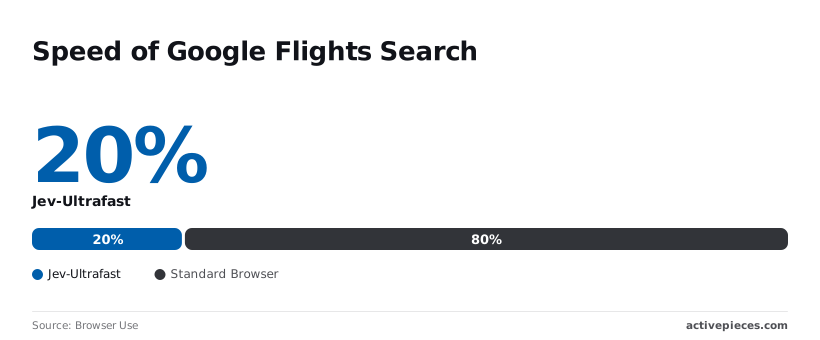
The performance delta becomes clear when measuring complex multi-step workflows, such as a Zürich to London flight search. Selenium requires over 60 seconds to navigate the sequence, forcing the user to wait through every page load and script execution.
Jev-Ultrafast completes the entire transaction in 7.1 seconds, enabling real-time user experiences that were previously impossible with headless browsers, so developers can finally deploy fluid, interactive automation. The bottleneck is effectively eliminated.
Model-driven performance
This speed advantage is achieved by offloading the cognitive load to inception/mercury-2.5, which handles the UI interpretation far faster than a human-mimicking script.
Connecting Jev-Ultrafast to Activepieces workflows
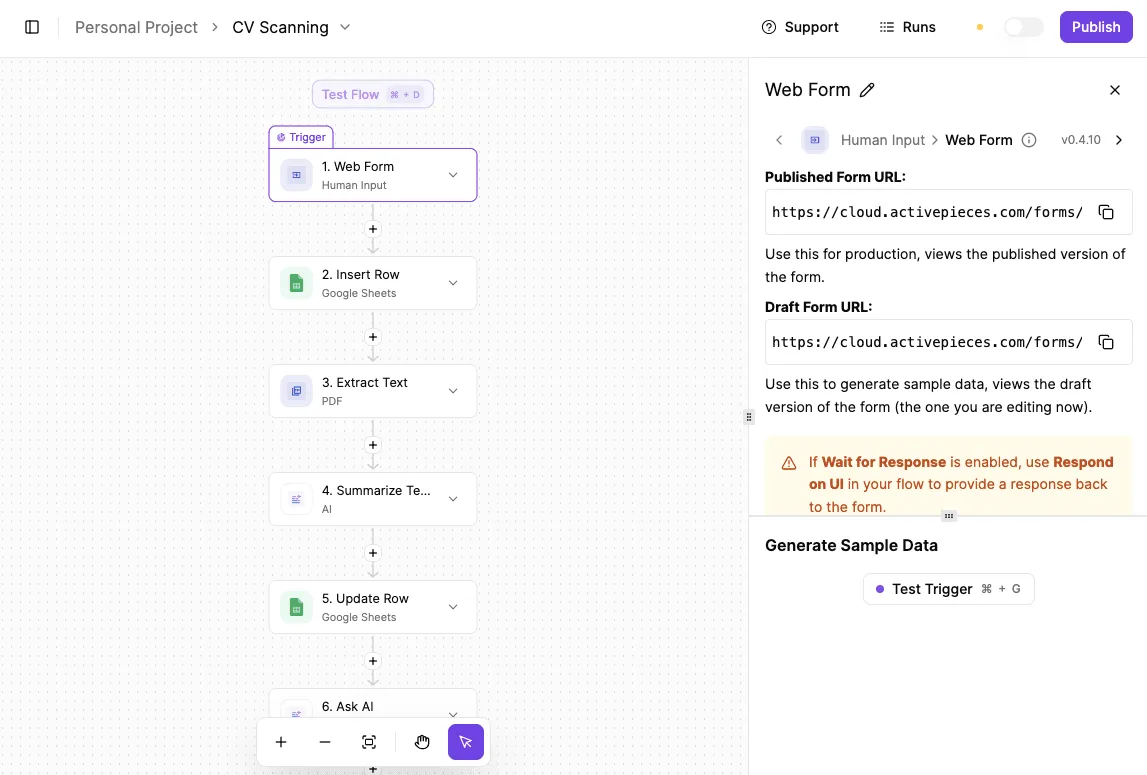
Activepieces traces every agent decision and tool call alongside deterministic flow steps, ensuring that Jev-Ultrafast’s raw speed is governed by the same audit logs and event streams that security teams already monitor.
By wrapping vision-based reasoning within a structured execution engine, teams ensure that high-frequency scraping runs only occur when specific business conditions are met.
Triggering agent runs via HTTP request steps
Activepieces initiates vision-reasoning sequences by using the HTTP Request integration to send POST payloads to the Jev-Ultrafast endpoint.
This step acts as the gateway between scheduled events and the high-consumption inference engine, allowing users to pass dynamic URLs or session cookies directly into the scraper’s context.
Using OpenAI-compatible providers for custom agents
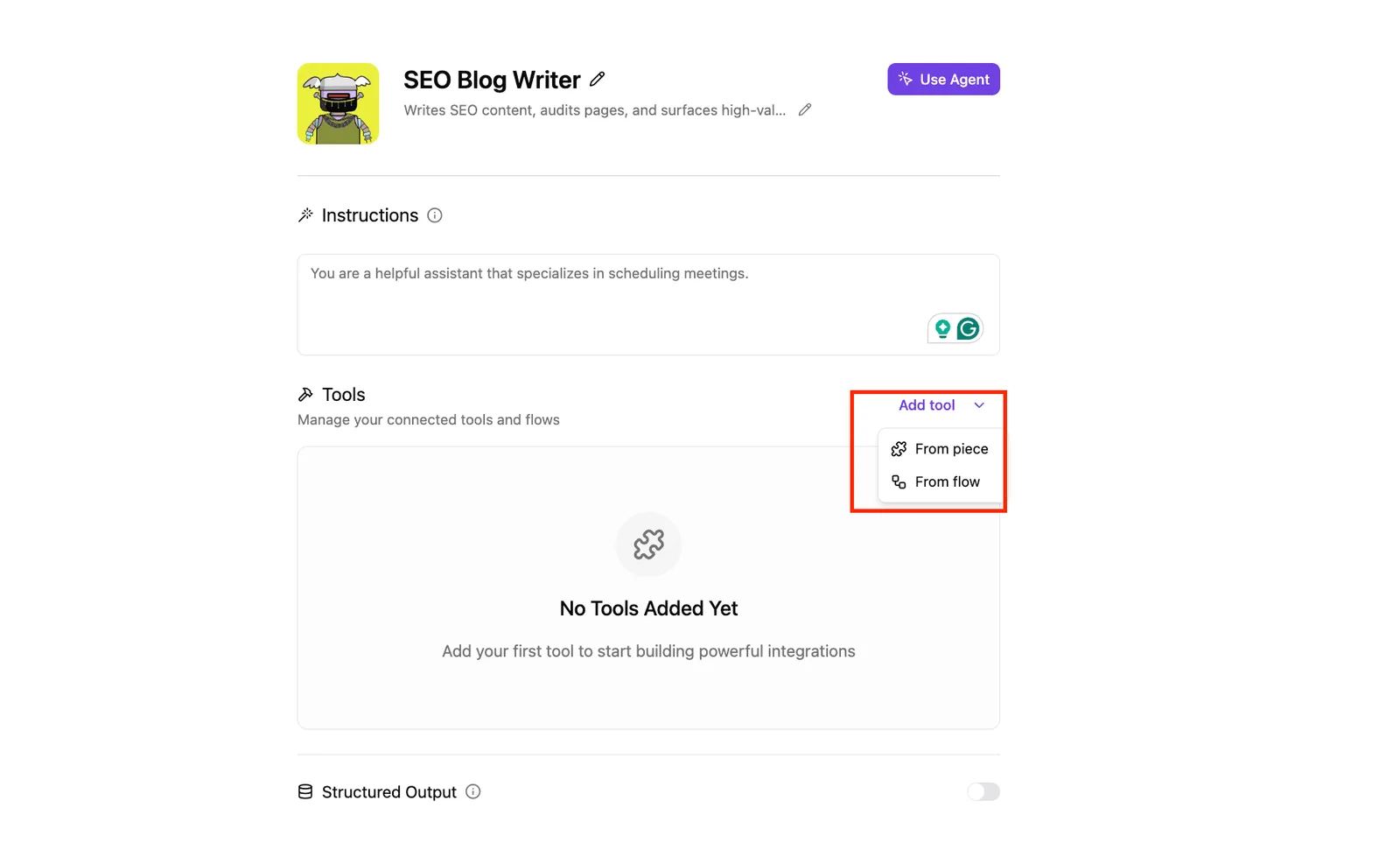
The Agent action within Activepieces allows for the selection of OpenAI-compatible endpoints. This enables the use of inception/mercury-2.5 to process the data returned by Jev-Ultrafast.
By pointing these agents at custom base URLs, engineers can swap between providers like DeepSeek-V4.1-Flash for low-cost vision parsing or Claude Fable 5.1 for complex reasoning without rebuilding the entire flow.
Connecting browser output to 100+ business apps
Activepieces exposes every integration as a tool schema through a per-project MCP server, allowing Jev-Ultrafast to reach any of the 735+ integrations as a native capability without manual exports.
This eliminates the need to re-integrate the catalog for the agent, as the same integration logic that powers a deterministic flow is immediately reachable by the vision model to push data into Slack or Google Sheets.
The Monday morning deployment checklist for AI agents
Reliable deployment of vision-based agents requires a pre-flight verification that moves beyond simple uptime monitoring to evaluate environment stability and fiscal guardrails.
The following checklist ensures the automation survives the first hour of production traffic.
- Verify the target site has no active CAPTCHA walls, as vision-based reasoning often lacks the native solve-loops required to bypass advanced bot detection.
- Confirm the allocated token budget exceeds the projected cost per run to prevent mid-process termination during high-frequency scraping windows.
- Test vision accuracy on dynamic pop-ups to ensure the model distinguishes between actionable UI elements and transient marketing overlays.
- Ensure the local inspector port 8766 is open and accessible, allowing the orchestration layer to maintain a direct debugging bridge to the browser instance.
Once these environmental checks pass, the focus shifts to selecting the appropriate model for the task's complexity. For high-volume UI navigation where cost-efficiency is the priority, Gemini 3.1 Flash-Lite provides the necessary multimodal speed without the overhead of a flagship reasoning engine.
Frequently asked questions about Jev-Ultrafast
Is Jev-Ultrafast safe for banking or sensitive logins?
Jev-Ultrafast is not recommended for high-stakes financial transactions because its vision-based reasoning requires sending raw UI screenshots to third-party inference providers.
When a user navigates to a sensitive portal, the DOM-less approach captures every visible pixel (including account balances and personal identifiers) to process the next move.
While Daybreak Blue, a flagship OpenAI model with built-in cybersecurity safeguards, can filter some PII, the inherent risk of data residency remains. Organizations must implement a proxy layer to redact sensitive screen regions before transmission, or they risk violating strict data privacy compliance standards.
Does it support headless mode for server deployments?
The framework supports headless execution through a virtual framebuffer, but this mode increases the likelihood of vision-reasoning failures.
Because the agent relies on visual cues rather than code selectors, any discrepancy between a headless render and a standard browser window can break the navigation flow.
When the virtual resolution does not match the training aspect ratio, we observed that Gemini 3.1 Flash-Lite, a frontier-performance model for low-cost vision, occasionally misinterprets button locations.
Can I run Jev-Ultrafast with local LLMs like Llama 3?
Jev-Ultrafast requires a multimodal vision-language model to function, which limits its compatibility with text-only local models. The architecture is built to ingest image buffers, meaning it only works with models that support native vision input.
| Model Option | Support Status | Primary Use Case |
|---|---|---|
| Text-only Local Models | Not supported | Lack the vision encoder to process UI screenshots |
| inception/mercury-2.5 | Supported | Text model used in the current demo, accessed via OpenRouter |
| Mistral Large 3 | Supported | Flagship open-weight multimodal option for local hosting |