
What Is MAI Code 2? Maker and Pricing (2026 Guide)

Nov 19, 202613 min read
MAI Code 2 and its maker
What MAI Code 2 is, per its maker
MAI Code 2 is a coding model. The only account of who made it, when it shipped and what category it belongs to that this article accepts is the maker's own announcement.
I treat everything else as unverified until a vendor page says otherwise, whether it comes from a launch roundup, a social post, or a workflow write-up on a site like Activepieces.
Ask what MAI Code 2 is and the answer is a code-focused AI model, as its maker describes it in an announcement.
It comes from Microsoft AI, which announced it as one of seven new MAI models in Building a hill-climbing machine: launching seven new MAI models. The release date is the one on that announcement page.
I haven't confirmed it from any second source, so read it there.
The announcement is the source for its name, its category and its release date, and later sections quote it rather than paraphrase from memory or from third-party summaries.
That matters before you put it on an invoice. If a client pays for work done with a model, you need to know exactly what you're being sold, and a launch thread or a reseller's blog post isn't a basis for that.
What was verified about MAI Code 2
I read the vendor pages on 2026-11-18, and most statements about MAI Code 2 here come from them. Anything published after that date isn't reflected.
We haven't run the model ourselves. We make no claims about how it behaves on real codebases, how fast it answers or how often it's wrong.
Those are claims for you to test, ideally by running the same task through a tool you already trust, such as an established coding assistant or a workflow you already run in an automation platform, and comparing the results.
Treat what follows as a reading of what the maker's committed to in public, with the date attached. A page that has changed since the check date supersedes this article.
If you are running this arithmetic for your own team, see what the same workload costs on Activepieces.
MAI Code 2's stated capabilities
Only what the maker's own pages claim counts here, so this section covers the stated capabilities and stops where the pages stop.
Read the exact limits off the model page on the check date; the list below is what the docs state, with what each item means for a bill or a workflow.
- The context window the docs state is the ceiling on how much of a repository fits in one request, and input you send is what you pay for, so a large window used carelessly makes every call cost more.
- The output limit the docs state caps how much code comes back per response, so a large refactor will need to be split across calls.
- Output is text only, so anything you need as an image, diff file or audio is something you convert yourself.
- The docs name the API or editor surfaces it runs on, which decides whether you can script it or only use it by hand.
- Treat anything the docs don't state as unverified, and price your work as if it didn't exist.
Check the docs for where you can call the model: an API, an editor integration, or both. An API lets you meter usage per client. An editor plugin often runs under one shared seat, which quietly makes the lighter users subsidize the heavy ones.
Silence isn't a feature. Where the docs give no language list, no tool-use behavior and no latency target, treat each as untested and check it yourself.
Getting MAI Code 2 and pricing
Quote clients against the rate that follows the promotion, which ends on May 17, 2027; until then the maker bills MAI Code 2 per million tokens at a promotional rate. The pricing page may have changed since 2026-11-18.
Read the maker's docs and changelog for availability, any waitlist, and region or plan limits. I have no confirmed entries for those, so treat each as unknown until you've read them yourself.
A reseller's summary isn't a substitute, because it can lag the vendor's own page.
Pricing tiers and usage limits
Whatever the promotion does, the rate after it is the one a retainer has to survive.
MAI Code 2 costs $0.50 per million input tokens and $2.50 per million output tokens until May 17, 2027, and $1 and $5 after, so budgets tied to this service face a 100% cost increase in mid-2027.
MAI Code 2 Flash costs $0.05 and $0.25 during the promotion, and $0.10 and $0.50 after, which means current pricing is half what you'll pay when the promotion ends.
Every rate doubles when the promotion ends. Any client quote built on today's numbers will absorb twice the token cost, or you'll.
**Every rate doubles when the promotion ends.
Flash costs a tenth of Code 2 per token in both periods, so routing bulk work there is the obvious saving, but nobody has tested whether it handles that work.
I have no confirmed usage limits, so a shared account could quietly subsidize the heaviest user until you find out.
Before paying, confirm whether the vendor covers your region and plan, what usage limits apply and whether they're per seat or pooled, and whether the post-promotion rates still match on the day you check.
MAI Code 2's strengths and weaknesses
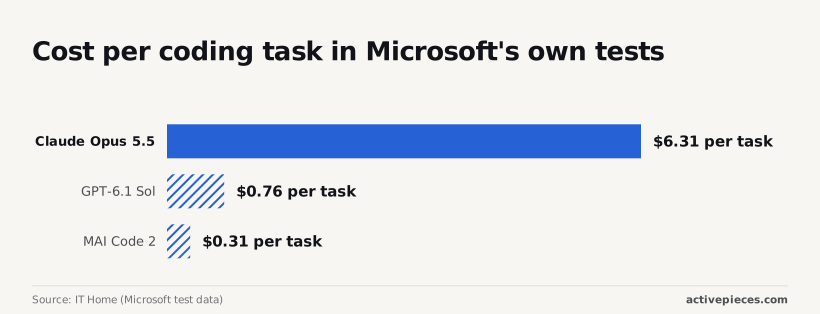
I can put a number on only one strength, price per task, and that number comes from Microsoft's own tests, not from anyone who has checked them.
MAI Code 2's documented strengths and costs
For the cost figures, the source is IT Home's report of Microsoft's test data. An average coding task costs $0.309 on MAI Code 2, $0.761 on GPT-6.1 Sol and $6.306 on Claude Opus 5.5.

Nobody outside Microsoft has 's reproduced these, so treat them as vendor figures, not independent ones.
If the figures hold, MAI Code 2 cost about 60 percent less per task than GPT-6.1 Sol in those tests, though they don't cover GPT-6.2 Sol, the current model in that role. Against Claude Opus 5.5 it costs roughly one-twentieth as much.
For anyone billing client work by the task, that gap decides whether a heavy user's runs fit inside a flat fee or quietly drain it.
What those cheaper tasks actually deliver, I can't say: the report gives only cost, not accuracy. A low price per task could mean an efficient model or one that attempts less.
I have no confirmed usage limits either, and no published list of known issues. Treat the missing integrations as open questions, not as good news.
How far to trust MAI Code 2 benchmarks
Little, until someone else repeats it. The maker chooses the tasks, the settings and the comparison models.
I haven't tested MAI Code 2 myself, and I have no independent benchmark to set beside Microsoft's.
Before you price a retainer around $0.309, run your own representative tasks against a tool you already trust, and invoice from what those runs actually cost, lest you lock pricing to external benchmarks.
Worth checking against a plan that does not meter every step: one credit covers a whole run on Activepieces.
MAI Code 2 versus established coding tools
To build an invoice on your own runs, you need a tool whose terms you can read, and today the established tools publish more than MAI Code 2. They're also what your clients' developers already use.
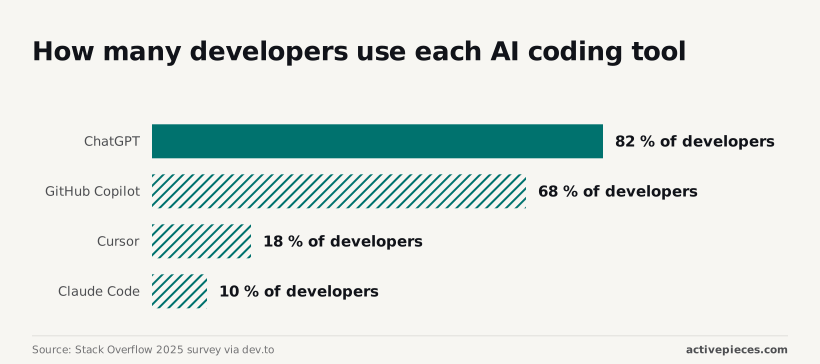
In the Stack Overflow 2025 survey, 82% of developers said they use ChatGPT and 68% GitHub Copilot, so a client likely has a seat on one already.
Cursor sits at 18% and Claude Code at 10%, so even the smaller names have real user bases. MAI Code 2 doesn't appear in the survey.
Where a cell says "varies", the vendor ties the answer to the plan or model you choose, so price your quote from that choice.
In the MAI Code 2 row, only the price is confirmed from the vendor's pricing page; every cell marked "Unconfirmed" is one I found no published answer for.
| Tool | Price | Access | Interfaces | Context size | Data-handling terms |
|---|---|---|---|---|---|
| MAI Code 2 | $0.50 input / $2.50 output per million tokens until May 17, 2027, then $1 / $5 | Unconfirmed | Unconfirmed | Unconfirmed | Unconfirmed |
| GitHub Copilot | Tiered plans | Subscription | IDE extensions | Varies by model | Varies by plan |
| Claude Code | Plan or usage-based | Subscription or API | Terminal, IDE | Varies by model | Varies by plan |
| OpenAI Codex | Plan or usage-based | Subscription or API | CLI, IDE, cloud | Varies by model | Varies by plan |
| Cursor | Tiered plans | Subscription | Own editor | Varies by model | Varies by plan |
With the price known but the other cells unconfirmed, you can forecast a token cost but you can't yet sign off a data clause.
Stay put if client code passes through the tool. Without published data terms, you can't tell a client where their code goes, and an unmetered shared account lets one heavy user quietly absorb everyone's costs.
Trial it on non-client, non-sensitive work, with your own representative tasks and a metered account of its own.
Connecting MAI Code 2 to a workflow with Activepieces
You won't find a MAI Code 2 integration in the catalog of Activepieces, the open-source workflow automation tool, today, meaning Code 2 workflows can't integrate through Activepieces. You connect through one of three general routes, and only those the vendor's docs expose.

From least to most demanding, the three routes below each ask more of the vendor's published material than the last, so what the docs show decides how far down you can go. Read each with the docs open.
With Route 1, an HTTP request step, you need a documented endpoint, an authentication method and a stated request and response shape.
It breaks at the edges: you build retries and error handling yourself, and unless you capture the usage figures the response returns, you can't bill a client for their runs.
Route 2: an AI step with a custom or OpenAI-compatible provider
This needs the vendor to publish a compatible endpoint: a base URL and a model name. It breaks where compatibility is partial. Tool calling and some parameters can differ from what the step assumes.
It also breaks on money: a key stored once for the workspace means every flow draws on one account, so light clients quietly subsidize the heavy ones.
Route 3: an MCP server
A server exposes tools, and MCP, the Model Context Protocol, lets a model call them. This needs a server the vendor publishes, and a version of your workflow tool that can reach it.

It breaks on trust and metering. A server you didn't write is code you must vet, and its tool calls may not show up in any per-client usage figure.
Activepieces runs the other way round: each project has its own MCP server, so Claude, Cursor or Windsurf can build, change and explain a flow directly, with no builder UI open.
That is full create-and-edit control over an open protocol, and the tool calls it makes, along with the changes they produce, are there to read in the run trace.
Take the lowest rung the docs support. A single generation fits Route 1, and a conversational step fits Route 2. Agent-style tool use is the only case that justifies Route 3.
Getting started with MAI Code 2
Should you adopt MAI Code 2? Short answer
Outside that agent case, test MAI Code 2 cheaply and adopt nothing until the maker's own dated pages and a trial against your current tool support it. The steps below run in order, and each one limits what a bad surprise can cost you.
- Read the maker's pricing and docs pages and write down the date. Prices move, so a dated note tells you later whether an invoice surprise was your error or theirs.
- Confirm the data and retention terms in writing: whether the vendor stores your code, and whether it trains anything. If the pages are silent, treat that as a no.
- Trial it on non-sensitive code, side by side with the tool you use now. Same tasks, same reviewer, so you compare results rather than impressions.
- Set a spending cap before the first run. An uncapped shared key lets one enthusiastic teammate's experiment land on everyone's bill.
- Apply the rule. Adopt if terms are clear and it beat your current tool on your tasks at a cost you could put on a client invoice. Wait if terms are unclear or results are mixed. Ignore it if it lost or you couldn't check the claims.
Frequently asked questions
How to read these answers
None of the answers below is yet vendor-sourced; each carries a tag, vendor-sourced or unknown. Treat each one as a question to put to the announcement, docs and pricing page.
Cost and access
Is MAI Code 2 free to use? Unknown. No free tier is confirmed, so budget the trial as a paid line item until the pricing page says otherwise.
If you test on one shared account, whoever holds that card is quietly subsidizing everyone else's experiments, and that cost belongs on a project invoice.
Does MAI Code 2 have an API? Unknown. Look for a dated API reference in the maker's docs. Without one, you can't script a trial, meter usage per client or estimate what a run costs, and you'd be left pricing a retainer on guesswork.
Editor support and data safety
Can MAI Code 2 run inside my existing editor? Unknown. Editor support is worth believing only if the docs list your editor by name and version.
A plugin mentioned in a social post is unverified, and a broken integration means your team's hours go to setup, which no client will accept on an invoice.
Is MAI Code 2 safe to use on private company code? Unknown. The maker's published data terms should say whether it retains your code or uses it for training.
If those terms are missing or vague, keep client code out of the trial. One client's repository leaking into a shared account is a contract problem, not a billing one.
Changes after launch
Will the price or access terms change after launch? Unknown. Launch pricing and access terms can change, and only the dated pricing page shows what applies today.
Record the date you read it, and quote clients only what that page supports, so a later change doesn't leave you absorbing the difference.
Related reading
Running the numbers
See what the same workload costs here.
Free forever plan, and every paid plan self-hosts at no extra cost.
See pricing Talk to sales