
Zapier Alternatives with AI Agents: Best Tools Compared

Oct 12, 202614 min read
As the landscape of workflow automation evolves, businesses are increasingly seeking the best Zapier alternatives with AI agents in 2026 to streamline their operations.
While traditional platforms offer robust connectivity, the rise of autonomous agents has shifted the focus toward tools that can reason and execute complex tasks independently.
Many organizations are evaluating options like Make for its visual complexity or exploring how Activepieces fits into their open-source strategy, alongside newer AI-native entrants that prioritize natural language processing.
This ranked comparison examines the top contenders based on their agentic capabilities, ease of integration, and overall scalability for modern digital ecosystems.
Selection Criteria for AI Automation Platforms
Selecting an AI automation platform requires balancing the high operational costs of agentic reasoning against the technical requirements for secure tool-use and data sovereignty.
These benchmarks illustrate how platforms must evolve to handle the increased reasoning density and context requirements of next-generation intelligence.
As workflows shift from static triggers to long-horizon tasks using models like Claude Opus 5.5, the underlying infrastructure must support frequent model calls without prohibitive overhead.
Zapier task-based pricing at high volume
When platforms charge premiums for every individual execution, high-volume automation becomes a significant line item. According to Decryptd, running 100,000 tasks on Zapier costs 1,199 USD, which forces teams to limit the frequency of their data syncs to avoid budget overruns.
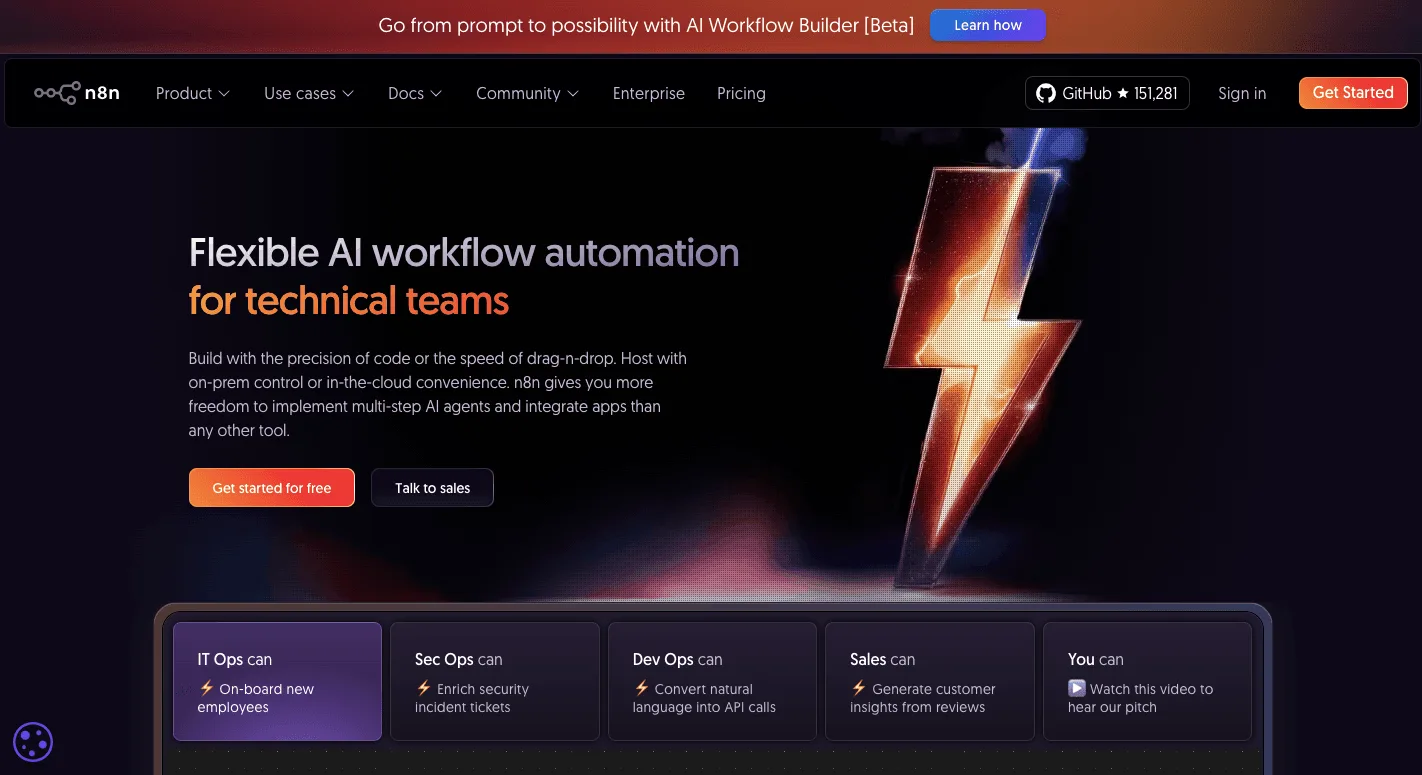

This means you can run forty times the volume of a Zapier-based workflow for the same total expenditure.
| Platform | 100,000 Tasks Cost (USD) |
|---|---|
| Zapier | 1,199 |
| Make | 106 |
| n8n (Self-hosted) | 60 |
| Activepieces | 25 |
Prices and plan limits checked against docs.claude.com and claude.com and openai.com and gemini.google on October 11, 2026.
Agent autonomy and reasoning
To handle non-linear business processes, autonomous agents require models capable of multi-step planning and self-correction. For demanding reasoning and long-horizon agentic work, Claude Fable 5.1 has the logic to navigate complex decision trees.
Developers often route high-volume, latency-sensitive tasks like classification to Claude Haiku 5.5 to manage these costs. This lowers the cost per token while maintaining enough intelligence to categorize incoming webhooks.
Self-hosting for data privacy and compliance
To satisfy audit windows and procurement cycles, organizations with strict compliance requirements must control where their data resides.
Activepieces exposes every integration as a tool schema on a per-project MCP server, so a integration registered once functions as both a flow step and an agent tool reachable from Claude, ChatGPT, or Cursor.
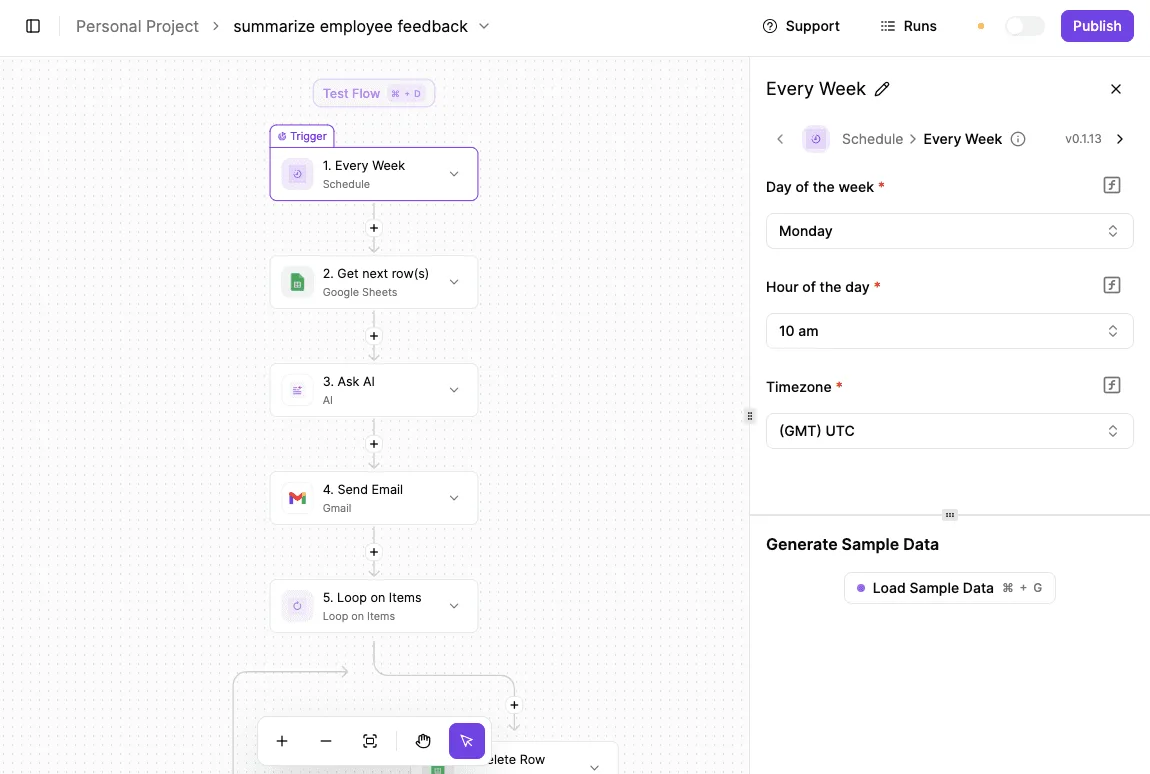
This eliminates the need to wire up a catalog twice or perform a second migration when moving from structured flows to autonomous agents.
Check the Integrations Framework and MCP Server documentation in the MIT-licensed core to see how the same action exposed in a flow is surfaced as an MCP tool.
| Platform | Starting Price (Monthly) | Agent Autonomy | Data Privacy | MCP Support |
|---|---|---|---|---|
| Zapier | $19.99 | Medium | Cloud | No |
| Make | $9.00 | Medium | Cloud | No |
| n8n | $20.00 | High | Self-Host | Yes |
| Activepieces | $0.00 | High | Self-Host | Yes |
These structural differences dictate whether a platform can act as a secure bridge for internal tools.
MCP support and tool-use capabilities
The Model Context Protocol (MCP) allows agents to securely query databases and local files without custom API development for every new resource.
Standardizing the agent connection
The Model Context Protocol functions as an open standard that enables AI models to connect to data sources and software tools without writing unique code for every integration.
It acts as a universal translator between the reasoning engine of the AI and the technical interfaces of your business applications. By using this protocol, an agent can discover what actions it can perform and what data it can access through a single, unified gateway.
This architecture is load-bearing for modern agents because it removes the friction of manual tool mapping. Instead of a developer building a specific bridge for every database, the MCP server provides a schema that any compatible model can read and execute immediately.
This allows for a plug-and-play ecosystem where agents gain new capabilities as soon as a new resource is added to the server.
According to Docs, using a flagship model like Grok 4.7 requires a platform that can translate natural language prompts into structured tool calls across your stack. You must manually map every possible output without native MCP support.
This increases the maintenance burden as your AI workflows evolve.
The fastest way to settle a shortlist is to try one. Activepieces is free to try, no credit card.
1. Activepieces for private automation
Self-hosted deployment and security control
By deploying the platform on your own infrastructure, you maintain total control over the execution environment and eliminate the security risks of sending sensitive internal data to third-party cloud servers.
This ensures that proprietary data used to ground models like Claude Opus 5.5 never leaves your firewall.
Activepieces provides SSO, SCIM, custom RBAC, audit logs, and release management in the air-gapped build exactly as they run in the managed cloud. Regulated and public-sector organizations like MoneyGram and FundingSocieties run this edition in production to maintain governance over their automation environments.
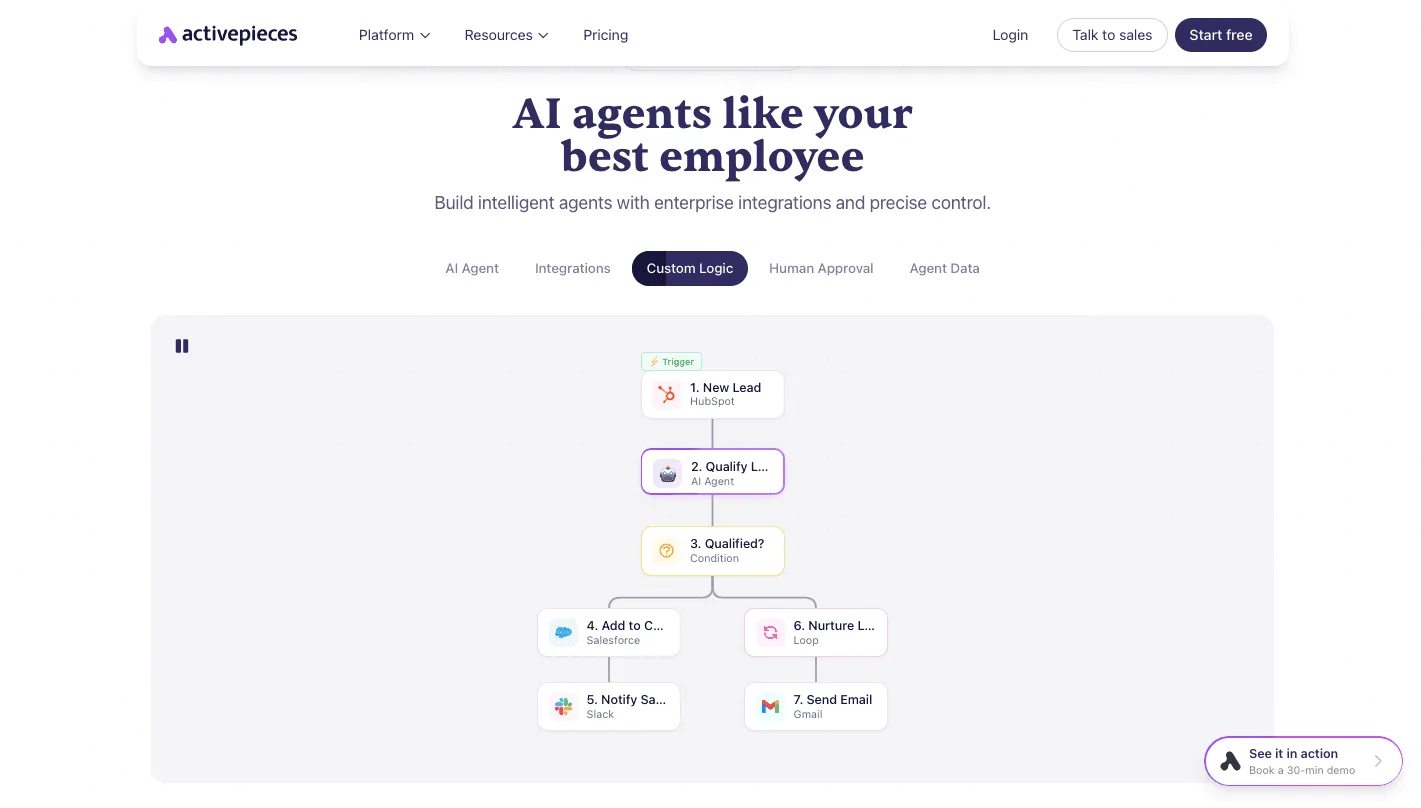
Compare the enterprise feature list in the self-hosted docs against the SOC 2 Type II managed cloud to see the identical feature set.
Data throughput for AI workflows
By supporting significantly larger data transfers than standard automation tools, the platform addresses the specific bottleneck of data-heavy AI workflows.
This capacity moves massive context windows or large document batches to models such as Gemini 3.8 Flash for long-horizon agentic coding without hitting the "payload too large" errors that frequently stall high-volume pipelines.
Community and Ecosystem
With 24,986 GitHub stars, Activepieces indicates a stable, peer-reviewed codebase that reduces the risk of abandoned software in your stack.
The platform has 739 community integrations, offering a vast ecosystem of tools to connect your existing software stack, which means you can likely automate workflows without building custom middleware.
These allow niche internal tools to connect without custom API wrappers. With a 60% community contribution ratio, the platform evolves at the pace of the open-source community rather than following a single vendor's roadmap.

Payload size limits for AI agents
Because the platform has a 50MB payload limit for large data transfers, you can pass entire technical manuals or codebases to an agent in a single execution.
Furthermore, because Activepieces supports the Model Context Protocol (MCP), these integrations aren't static triggers but dynamic tools that your agents can discover and use as needed.
Agentic Flexibility
You can deploy Gemini Deep Research Max against your own private databases thanks to this shift from rigid "if-this-then-that" logic to a flexible tool-use framework. You maintain a strict audit trail of every action the agent takes.
By unifying the architecture of workflow actions and agentic tools, the platform ensures that every integration developed for automation is immediately available to AI models.
Activepieces is the better choice for organizations that require a secure, self-hosted environment where the same connectors powering internal flows serve as the foundation for their AI agents.
This architectural alignment allows teams to scale their agentic capabilities without the overhead of maintaining separate toolsets for different execution modes.
2. n8n for Developer-Centric Agents
n8n is a specialized environment for technical teams to build sophisticated agents using a native LangChain integration that maps complex AI logic to a visual node-based interface.
This architecture allows developers to drag-and-drop functional components (such as memory buffers or vector store retrievers) directly into a workflow. The underlying code structure remains visible and editable.
The platform’s flexibility is most evident in its self-hosting model, which eliminates the per-execution fees that often stall high-volume AI projects.
According to infrastructure data from Deepyze, running a basic instance on a personal VPS costs approximately 8 USD per month, allowing an individual developer to experiment with unlimited triggers without a subscription cap.
Costs rise to 25 USD for a small business setup in production environments requiring higher reliability. Furthermore, a dedicated queue configuration for high-concurrency tasks costs 60 USD.
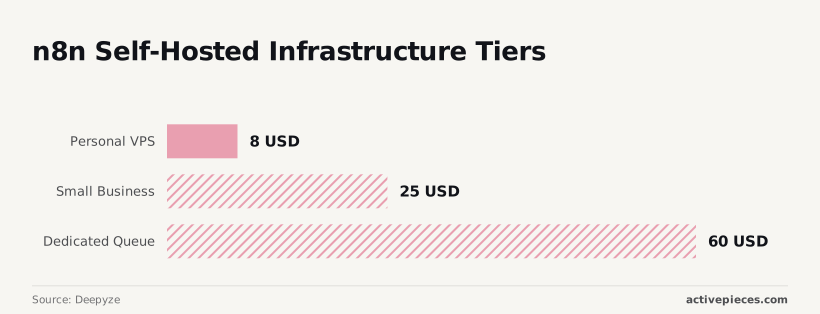
These predictable hardware costs mean that as your agentic volume scales, your overhead remains flat rather than increasing with every API call.
The workflow builder orchestrates advanced reasoning models, such as Claude Fable 5.1 for long-horizon agentic work, alongside faster models like Claude Haiku 5.5 for high-volume classification and routing.
Before the agent generates the final output, this visual representation of the agent’s internal state allows for granular debugging of the "thought" process.
By inspecting the execution logs in the right-hand panel, a developer can verify exactly how the memory sub-node influenced the response. This prevents the "black box" behavior common in simpler automation tools. When moving from basic chat triggers to autonomous systems that interact with sensitive internal data, this level of control is essential.
Reading a table only gets you so far. Build the same workflow in Activepieces and compare it yourself.
3. Make for complex visual logic
Make is a visual canvas designed for users who must map high-volume data transformations and complex, multi-branching AI logic within a single workflow.
The platform operates on a spatial grid where every module represents a discrete function. This allows for control over how data from a source, such as a PostgreSQL database, is filtered and routed before reaching an LLM.

To prevent the workflow from hitting timeout limits on large datasets, the built-in iterator and aggregator modules allow a single execution to break a large payload, like a 500-row CSV file, into individual items for parallel processing.
The router tool creates multiple conditional paths, so a single prompt result from Gemini 3.8 Flash can be simultaneously sent to a Slack channel for notification and a vector store for long-term memory.
To prevent a transient API failure in a service like GitHub from terminating the entire agentic sequence, users can attach specific "Ignore," "Resume," or "Rollback" instructions to individual modules.
When building autonomous agents that require long-horizon reasoning, the visual nature of the platform assists in debugging state changes. A developer using Claude Fable 5.1 for multi-step research can visually trace the flow of variables through each stage of the sequence. This visibility is necessary when managing the high degree of entropy inherent in agentic tool-use.

| Feature | Capability |
|---|---|
| Logic mapping | Drag-and-drop canvas for multi-path branching and loops. |
| Data manipulation | Native functions for regex, math, and array transformation without custom code. |
| Execution control | Real-time visual playback of data moving through each step for debugging. |
While the interface simplifies the construction of complex logic, the reliance on a hosted cloud environment means that all data processed by an agent must transit through their infrastructure.
For teams bound by strict data residency requirements or those running high-frequency tasks that exceed standard rate limits, the lack of a self-hosted binary remains a primary constraint.
4. Pipedream for Event-Driven AI
Pipedream is a managed cloud platform designed for technical teams that need to deploy autonomous agents within a high-security environment without managing their own infrastructure.
By providing a serverless runtime, it allows developers to write custom Node.js or Python code that interacts with AI models like Claude Haiku 5.5 for rapid classification or GPT-6 Astra for complex reasoning tasks.
However, the platform imposes specific technical constraints on the volume of data that can be ingested in a single trigger.
As AI agents move from processing simple text strings to handling large JSON objects or encoded files, the maximum size of an incoming webhook becomes a critical bottleneck for system stability.
| Platform | Maximum Webhook Payload Limit |
|---|---|
| Activepieces | 50 MB |
| Workato | 10 MB |
| Pipedream | 6 MB |
| Make | 5 MB |
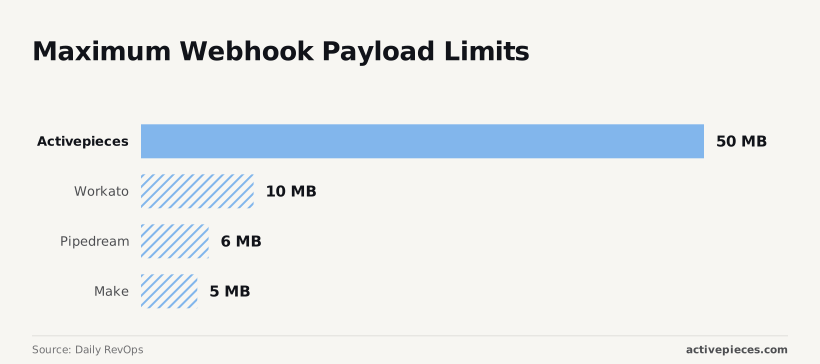
The data above illustrates the ceiling for direct event ingestion across major providers as of late 2024.
Pipedream limits incoming payloads to 6 MB. This means an agent attempting to process a high-resolution image or a large PDF document via a direct POST request will fail before the code even executes.
Workato has a 10 MB limit, which gives slightly more headroom for enterprise message streams.
Make restricts users to 5 MB, necessitating external storage workarounds for even moderate data transfers, which creates significant friction in automated pipelines, so developers must dedicate extra time to managing file-handling logic instead of building core features. Activepieces includes secret manager integration and log streaming in its air-gapped build to ensure that high-volume agentic data remains under central governance, allowing teams to monitor complex information flows without third-party dependencies.
When these limits are exceeded, the platform returns a 413 Request Entity Too Large error. To avoid this, developers must implement a three-step "claim check" pattern:
- Upload the large file to an external bucket like Amazon S3.
- Send only the file URL to the automation platform.
- Use a code step to download and process the data locally.
While this adds architectural complexity, Pipedream's support for the Model Context Protocol (MCP) helps mitigate the friction of connecting these disparate data sources to agents.
Migration Strategy for AI-First Workflows
A successful transition to agentic automation requires shifting from linear task-counting to a resource-allocation model that prioritizes high-reasoning workloads. This shift ensures that expensive frontier models, such as Claude Fable 5.1, are only invoked for complex decision-making while simpler routing remains on cost-efficient infrastructure.
A successful transition to agentic automation requires shifting from linear task-counting to a resource-allocation model that prioritizes high-reasoning workloads.
Auditing current Zapier overhead
The audit process identifies workflows where the volume of multi-step logic creates a price ceiling on scaling. Every task execution in a legacy environment incurs a flat fee regardless of whether it's a simple data pass-through or a complex transformation.
As agents begin to iterate, this leads to ballooning operational costs. By isolating Zaps that trigger frequently but perform low-level logic, a team can pinpoint exactly where moving to a self-hosted or pay-as-you-go alternative will yield the highest immediate margin.
Selecting a pilot agent project
A pilot project should focus on a contained, high-frequency process that requires the advanced reasoning capabilities of a model like Gemini 3.8 Flash.
Selecting a workflow with a clear success metric, such as customer support ticket categorization or automated lead enrichment, gives a controlled environment to measure the latency and accuracy of the new agentic stack.
This isolated test prevents a full-scale migration failure by revealing how the new platform handles API rate limits and token consumption before critical business systems are moved.
Mapping triggers to MCP-compatible tools
Mapping requires aligning existing triggers with tools that support the Model Context Protocol (MCP) to ensure the agent has a standardized way to query external databases.
When a trigger from a service like Salesforce or GitHub is mapped, the agent must be able to fetch the surrounding context without manual intervention. The following sequence ensures data integrity during the transition:
- Audit Zaps for high-volume logic
- Map existing triggers to MCP-compatible tools
- Deploy a pilot agent on the new platform
- Stress-test data
By forcing the new architecture to acknowledge every dependency present in the original workflow, this structured approach prevents data silos.
Testing agentic reasoning loops
Final validation involves running the migrated workflow through recursive loops where a model like GPT-6 Astra must correct its own errors based on environmental feedback.
Unlike static automations, agentic loops can fail silently if the reasoning step lacks the proper context or if the tool-calling permissions are too restrictive. Stress-testing these loops under heavy load ensures the system remains stable when the agent encounters unexpected API responses or ambiguous data inputs.
Related reading
References
Still comparing
The fastest way to settle it is to build something.
Open source under MIT, so you can self-host the same thing later.
Start free Talk to sales