9 Best Shopify Alternatives in 2026: Compare Fees & Features

Sep 30, 202614 min read
Choosing the right e-commerce platform in 2026 requires a careful balance between user-friendly design interfaces and the technical flexibility needed to scale operations.
While Shopify remains a dominant force for beginners, many growing brands are migrating to alternatives that offer deeper customization of the checkout experience and more transparent pricing structures.
As businesses expand, they often find that success depends on how seamlessly they can connect their storefront to external marketing tools, perhaps by using Activepieces to automate their internal workflows, ensuring that data flows freely between inventory management and customer support systems.
Ultimately, the best choice depends on whether your priority lies in rapid deployment or in maintaining total control over your store's underlying architecture and long-term overhead costs.
Why merchants are moving away from Shopify
When the "App Tax" begins to climb and rigid architectural constraints outweigh the convenience of a managed ecosystem, merchants start migrating.
While the platform simplifies the initial launch, the cumulative cost of third-party subscriptions and the inability to customize core checkout logic drive high-growth retailers toward more flexible alternatives.
The escalating cost of the Shopify App ecosystem
A base subscription is only a fraction of the total cost of ownership. Essential features like advanced reporting or loyalty programs require third-party apps that charge recurring fees.
| Tier | Monthly Base Cost | Target Business Stage |
|---|---|---|
| Starter | $5 | Social selling and lightweight storefronts |
| Basic | $39 | Solo entrepreneurs needing basic reporting |
| Shopify | $105 | Growing teams requiring professional reports |
| Advanced | $399 | Scaled brands needing custom report builders |
| Plus | $2,300 | High-volume enterprise with dedicated support |

476% is the increase in fixed costs when jumping from the $399 Advanced tier to the $2,300 Plus tier, according to Smart Cloud Suites.
This upgrade is required just to access lower transaction fees and API rate limits, which means businesses must process significant volume to justify the expense.
For a brand doing $2M in annual GMV, this jump often forces a choice between margin erosion or platform migration. Even the $5 Starter and $105 Shopify tiers quickly become expensive once you add $200 in monthly app fees for basic SEO and inventory tools.
The advertised entry price is rarely what a merchant actually pays.
Platform lock-in and liquid template limitations
Developers are prevented from using modern frontend frameworks like Next.js without moving to a complex headless configuration because Shopify relies on Liquid, a proprietary ruby-based template language.
The advertised entry price is rarely what a merchant actually pays.
This creates a technical ceiling where site speed is capped by the number of scripts loaded by external apps.
Activepieces moves this backend logic to a self-hostable environment, allowing teams to execute complex workflows without injecting heavy scripts into the Document Object Model (DOM). By running automations externally, merchants maintain a clean frontend while leveraging an MIT-licensed core to handle the heavy lifting.
Internationalization and multi-store management
When managing multiple regions on Shopify, you often require separate store instances for each country. This setup fragments inventory and customer data. Adobe Commerce is a single multi-site dashboard where a manager can update global pricing in one click.

BigCommerce has native multi-storefront capabilities, so a brand can run a B2B and B2C site from one backend.
WooCommerce allows full database access for building custom sync engines for localized tax compliance. These alternatives allow merchants to centralize operations without paying for a new $2,300 Plus license for every additional international market, protecting the bottom line during global expansion.
The fastest way to settle a shortlist is to try one. Activepieces is free to try, no credit card.
Compare the top four alternatives
Whether they require total ownership of their underlying code or a managed service that scales without manual server tuning determines which alternative platform a merchant selects.
| Platform | Entry Price | Core Strength | Scaling Limit | Ideal User |
|---|---|---|---|---|
| BigCommerce | Monthly Subscription | Multi-storefront management | Complexity of API rate limits | Mid-market multi-channel brands |
| WooCommerce | Free (Self-hosted) | Full database ownership | Database bloat at high volume | Small businesses needing ownership |
| Adobe Commerce | Annual Licensing | Deep B2B architecture | High infrastructure overhead | Enterprise with dedicated DevOps |
| Wix | Monthly Subscription | Visual design flexibility | Rigid checkout customization | Boutique brands and creators |
| Activepieces | — | AI automation platform | — | Enterprise |
Choosing among these options requires balancing the immediate cost of entry against the long-level technical debt of a closed ecosystem. Moving to a self-hosted solution like WooCommerce eliminates monthly software fees but shifts that expenditure toward security maintenance and server optimization.

Beyond the core platform, modern merchants are increasingly using high-reasoning models like Gemini 3.8 Flash to generate product descriptions or GPT-6 Sol to audit complex custom checkout scripts.
1. Activepieces: Automating the store without the app tax
Activepieces runs a merchant's chosen AI models and automations across their existing apps under an MIT-licensed core, allowing brands to bypass proprietary app stores by building custom logic that connects their commerce core to third-party services.
By self-hosting this middleware, a brand owns its business logic entirely. A platform update won't break a critical fulfillment sequence.
Replacing monthly app subscriptions with custom workflows
Activepieces addresses this by charging per flow run rather than per step, ensuring that complex multi-stage logic costs the same as a simple trigger.
The published pricing page shows 1 credit per flow run regardless of step count, which removes the penalty for building granular, reliable workflows that would otherwise consume multiple tasks on Zapier or modules on Make.

Syncing inventory across multiple alternative platforms spinning up
When moving away from Shopify's ecosystem, the primary challenge is maintaining a single source of truth across diverse sales channels.
According to data from the Project Cost Estimator, the annual store cost at $1M GMV reaches $9,788 for Shopify and $10,788 for BigCommerce, meaning that platform choice alone dictates a five-figure baseline expense for mid-sized operations.

Any inefficiency in inventory syncing results in costly overselling. Activepieces uses Claude Sonnet 5.5 to map disparate data schemas between platforms. Stock levels update in milliseconds without a dedicated middleware subscription.
Connecting your store to CRM and ERP systems without a developer
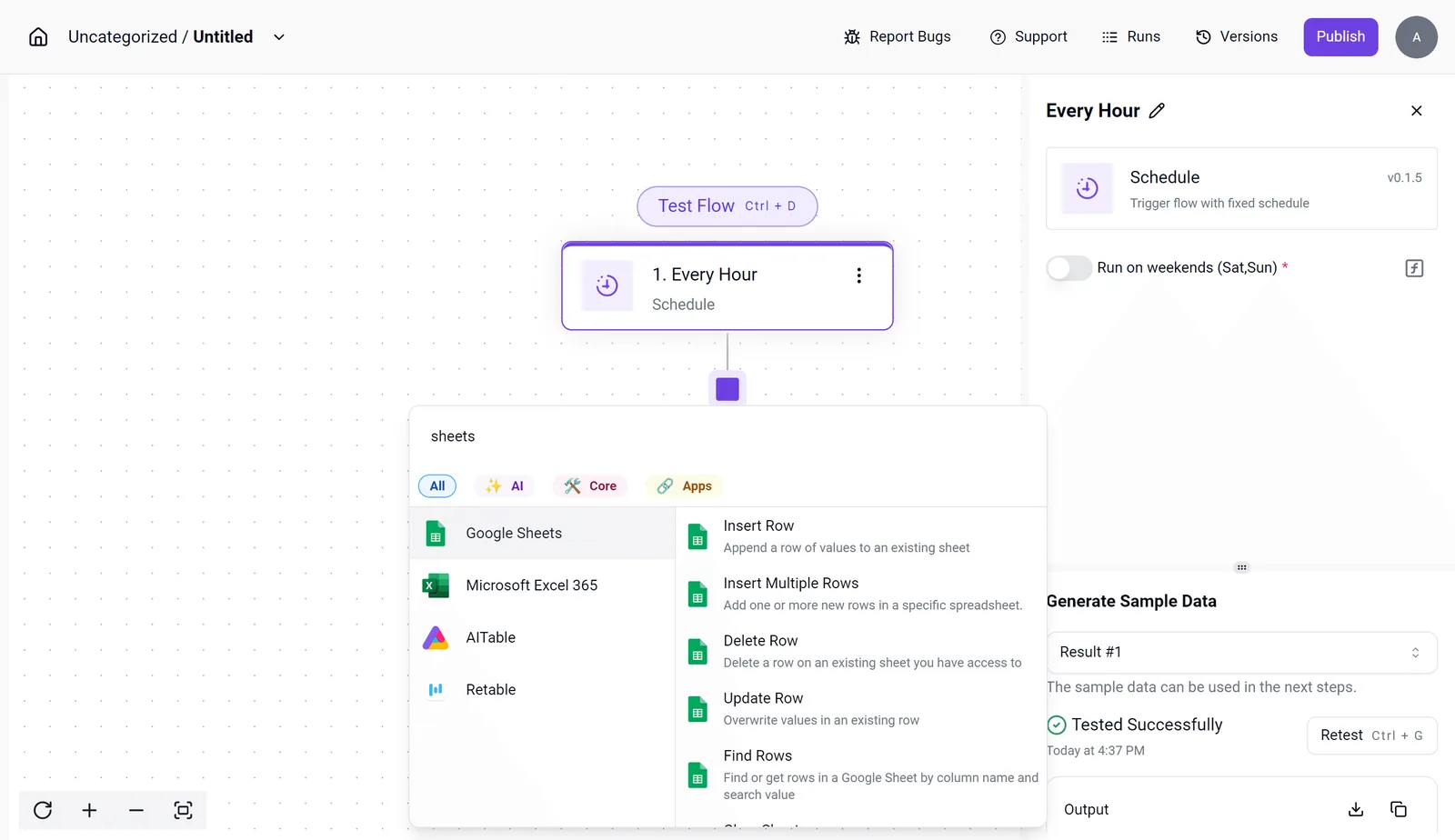
Activepieces provides a visual builder where non-technical managers can connect their store to legacy systems without expensive custom API work.
If a specific connector is missing from the 735 integrations currently in the open-source monorepo, merchants can generate it using AI and add it to their own instance immediately.
This community-driven approach, where roughly 60% of integrations are contributed by users, ensures that niche ERPs never become a roadblock.
Teams can launch personalized retention campaigns based on real-time purchase history without waiting for a sprint cycle. MoneyGram and FundingSocieties run Activepieces in production to maintain these complex data flows without the overhead of proprietary connectors.
By decoupling operational costs from the complexity of the workflow, this platform eliminates the financial penalty typically associated with building robust, multi-step business logic.
Activepieces is the better choice for high-volume merchants who require sophisticated, multi-stage automations without the escalating per-task or per-module fees found in competing services. Its flat-rate credit consumption per flow run ensures that reliability and depth do not come at a premium.
Reading a table only gets you so far. Build the same workflow in Activepieces and compare it yourself.
2. BigCommerce: Scaling without the transaction fee penalties
BigCommerce is a specialized mid-market alternative that prioritizes complex catalog structures and native wholesale functionality over the third-party app ecosystem.
Native B2B features vs Shopify Plus
Standardizing B2B operations on BigCommerce removes the need for high-cost middleware. Customer-specific price lists and corporate account hierarchies are out-of-the-box settings. This native approach means a merchant can define unique purchasing rules for different buying groups without relying on external scripts.
Multi-storefront management from a single dashboard
Managing multiple international brands or sub-labels is consolidated into a single administrative interface. This unified view allows a single inventory pool to be mapped across various localized domains.
A stock update in the warehouse reflects instantly across all regional sites. For lean operations, this reduces the headcount required to manage global expansion by centralizing product data and order fulfillment workflows.
The 'revenue ceiling' pricing model explained
BigCommerce utilizes a tiered subscription model based on annual sales volume.
It doesn't charge a percentage-based transaction fee on every order. This structure provides predictable overhead for high-volume merchants, as the cost of the platform is fixed until the business crosses into a higher predefined revenue bracket.
3. WooCommerce: Total ownership for the WordPress ecosystem
WooCommerce is a path to complete digital sovereignty by eliminating the recurring subscription costs and per-transaction commissions found on proprietary platforms.
Zero platform fees and the cost of self-hosting
By operating as a free plugin for WordPress, WooCommerce allows merchants to retain their entire margin rather than sharing a percentage of gross revenue with a provider. However, this shift means the merchant is responsible for sourcing managed hosting.
Customization limits: if you can code it, you can have it
The open-source nature of the platform ensures that there are no "black box" features or restricted API endpoints preventing specific business logic from being implemented.
Because the entire codebase is accessible, a developer can modify the core checkout flow or build bespoke product configurators that would be blocked by the rigid schemas of SaaS competitors.
Security responsibilities for the self-hosted merchant
Owning the entire stack places the burden of data protection and PCI compliance directly on the merchant’s shoulders.
Without the protective umbrella of a SaaS provider, store owners must manage their own SSL certificates, firewall configurations, and regular patch cycles.
4. Adobe Commerce: Complex catalogs and enterprise flexibility
Adobe Commerce provides the architectural depth required for large-scale merchants whose product data structures exceed the rigid flat-file limitations of simpler SaaS platforms.
Handling 100,000+ SKUs and complex attributes
Adobe Commerce utilizes an EAV (Entity-Attribute-Value) database model, allowing merchants to define limitless custom attributes for every item without degrading system performance.
According to [Thestackarchitects](https://thestackarchitects.
This hierarchy ensures that a wholesale buyer in Berlin sees different specifications and bulk pricing than a retail customer in New York, all managed from a single administrative interface.
The total cost of ownership for Adobe Managed Services
Choosing Adobe Commerce Cloud moves the burden of infrastructure maintenance to Adobe, but it introduces a higher entry point in licensing and specialized labor. Beyond the annual contract fee, merchants must budget for certified developers to manage the PHP-based codebase.
Integrating with the Adobe Creative Cloud suite
The platform is a native connection to the Adobe Creative Cloud, bridging the gap between asset creation and storefront deployment. By using Adobe Experience Manager (AEM) for content delivery, marketing teams can push high-fidelity assets directly from design tools to the commerce engine.
Why shopify remains the market leader
Despite the technical and financial friction, Shopify maintains its dominance because it offers the most reliable "all-in-one" experience for the majority of retailers. The platform provides a level of operational stability that self-hosted alternatives struggle to match without a dedicated engineering team.
Speed to market and operational simplicity
For a new brand, the ability to go from a concept to a live, processing storefront in a single afternoon is a significant competitive advantage. The platform handles server maintenance, security patches, and payment gateway integration automatically.
The strength of the shopify fulfillment network
The integrated logistics and fulfillment ecosystem provides small to mid-sized brands with the shipping power of a much larger enterprise. By leveraging Shopify’s negotiated rates and warehouse network, merchants can offer competitive shipping times that rival major marketplaces.
A unified ecosystem for non-technical users
The primary reason for Shopify's success is its accessibility for non-technical staff. Marketing managers can launch landing pages, adjust discounts, and manage customer support tickets within a single, intuitive interface.
The unrivaled third party marketplace
Shopify hosts the most mature ecosystem of pre-built integrations in the world. While other platforms require custom development for niche features, a Shopify merchant can usually find a plug-and-play solution in minutes. This library of apps and themes reduces the time spent on development.
Global infrastructure and reliability
The platform offers a level of uptime and performance that is difficult to replicate on private servers. Because Shopify manages the infrastructure for millions of stores, they have optimized their content delivery networks to handle massive traffic spikes during events like Black Friday.
The Monday morning migration checklist
Executing a platform migration requires a sequential transfer of data and authority to ensure the storefront remains functional and visible to search engines.
Auditing your current Shopify App spend
Before moving files, you must identify which third-party functionalities are essential. Migration costs vary by scale. Shop Experts cite starting fees of 500 US Dollars for small stores.

Mid-size stores typically see starting fees of 3,000 US Dollars due to the complexity of auditing disparate app integrations.
For those on Enterprise Plus tiers, costs begin at 10,000 US Dollars. Hiring a specialized agency starts at 12,000 US Dollars to preserve high-volume transaction logic during the shift.
Mapping your data migration strategy
A structured transfer ensures that customer accounts and order histories remain intact, preventing a total loss of user personalization. The Monday Morning Migration Sequence provides the framework for this transition:
- Audit of the current app stack.
- Exporting CSV product and customer data.
- Map 301 redirects for SEO.
- Configure payment gateways.
- Run a test checkout.
- Point the DNS.
Setting up 301 redirects to protect search rankings
Redirects are the only way to inform search crawlers that your content has moved to a new URL structure. This includes shifting from Shopify’s /products/ path to a flat structure. Failing to map these correctly results in 404 errors.
Frequently asked questions about switching platforms
Can I keep my Shopify domain when I move?
You retain full ownership of any domain purchased through Shopify, meaning you can point it to a new host by updating the Domain Name System (DNS) records.
Because the domain is a portable asset, your primary task is to unlock the domain in your Shopify admin and obtain an authorization code.
This code ensures the new registrar can verify your authority to transfer the asset.
If you choose not to transfer the registration, you must manually update the CNAME and A records to the IP address of your new server. Failing to do this results in a "404 Not Found" error for your existing customers.
How do I migrate my customer order history?
Moving order history requires exporting CSV files or using an API-based migration tool. Shopify doesn't allow a direct database clone to external platforms.
Since customer passwords are encrypted using a proprietary hash, you can't migrate them directly.
Customers must reset their passwords on the new platform to regain account access.
To maintain data integrity during this transition, developers often use Gemini 3.8 Flash to map legacy Shopify tags to the specific attribute fields required by Adobe Commerce or BigCommerce. This prevents the loss of historical purchasing behavior data.
Which platform has the lowest transaction fees in 2026?
WooCommerce is the The platform does not charge a native platform fee in addition to the chosen payment gateway’s rates.
In contrast, Shopify applies a percentage-based transaction fee unless you use their proprietary payment processor.
This limit restricts your ability to negotiate better rates with third-party merchant banks.
BigCommerce offers a middle ground by eliminating per-transaction platform fees across all tiers. They implement automatic plan upgrades based on your trailing twelve-month sales volume, which shifts the cost from a variable transaction expense to a fixed monthly overhead.
Related reading
References
Still comparing
The fastest way to settle it is to build something.
Open source under MIT, so you can self-host the same thing later.
Start free Talk to sales