
Activepieces vs Automatisch: Features & Pricing (2026)

Oct 23, 202614 min read
If you want a simple, self-hosted Zapier-style tool that your own team runs, Automatisch is the leaner pick.
Once you need integration breadth, AI agents, admin controls or embedding, Activepieces is the better buy: it ships 744 integrations, runs agents, and offers an embed SDK for putting automation inside your own product.
Activepieces vs Automatisch at a glance
Which tool is for whom
Automatisch is an open-source workflow builder you host yourself. It suits a small team that wants a few trigger-and-action flows and has someone willing to own the server. The maintenance burden stays small because there's less product to keep running.

Activepieces is an automation platform with a self-serve cloud, a self-hosted edition and an enterprise tier. It suits teams that expect the setup to outlive its first builder.
Roles and permissions, agent features and an embedding option mean handoffs are less likely to depend on one person's memory.
| Activepieces | Automatisch | |
|---|---|---|
| Built for | Teams and products needing broad automation, agents and governance | Simple self-hosted Zapier-style flows |
| Hosting | Cloud or self-hosted | Self-hosted |
| Licence | Open-source community edition; enterprise features under a commercial licence | Open source, with some parts under a commercial licence |
| Pricing and entry price | Self-serve plans on the pricing page; self-hosted enterprise quoted by sales | Free to self-host; no hosted price confirmed |
| SSO and admin | SSO beyond the Team plan is sales-quoted; admin controls are a selling point | Not confirmed |
| AI agents | Built-in agent features | No built-in agent feature confirmed |
| Integrations | Broad catalogue, extensible with community pieces | Smaller catalogue |
| Embedding | Offered for putting automation inside your own product | Not offered as a product feature |
As of 2026-10-23, everything above reflects the vendors' public information. Cells marked "quoted by sales" have no published price, so I haven't guessed one. Cells marked "not confirmed" mean I found nothing I could point to. Check those with Automatisch's maintainers before you commit.
If you are running this arithmetic for your own team, see what the same workload costs on Activepieces.
Five questions that decide Activepieces vs Automatisch
Because some details are unconfirmed, this choice rests on five questions rather than a feature tally. The questions are who runs the tool, what it costs at your volume, whether your apps exist, which controls you need, and whether you need AI agents or embedding.
What workflow automation covers
Self-hostable workflow automation means a Zapier-style tool where a trigger in one app starts a chain of actions in others, and you run the software on your own server.
When a flow stops firing at 2 a.m., the page goes to whoever deployed the tool, and that person also owns upgrades, backups and credential storage. The hosting is the part that lands on your team.
When a flow stops firing at 2 a.m., the page goes to whoever deployed the tool, and that person also owns upgrades, backups and credential storage.
You can swap in your own answers, because each verdict later in this article is judged against the same five questions:
- Who runs it: your team on its own infrastructure, or a vendor's cloud, and who inherits it when the person who set it up leaves.
- What it costs at your volume: the price at the number of runs you actually expect, including the engineer time to host it.
- Whether your apps exist: the specific services your workflows touch, each checked by name.
- Which admin and security controls you need: single sign-on, role-based permissions, audit trails and similar controls your security reviewer will ask for.
- Whether you need AI agents or embedding: agents that make decisions inside a flow, or automation offered to your own customers inside your product.
If a question doesn't apply to you, say so and drop it. A simple internal setup may only turn on the first three.
Hosting and licence deployment options
Both tools run on your own server under open source licences. Activepieces also sells a hosted cloud, while Automatisch's documented route is self-hosting, so the question is how much server and upkeep you want to own.

Self-hosting requirements
Both deploy with Docker Compose, so the first install is an afternoon either way. The ongoing cost is the machine. ANAROQ sizes self-hosted Activepieces at 5.7 GiB of RAM and 2.82 vCPU for light load, which means a small shared VM won't do.

At medium load self-hosted Activepieces needs 11.7 GiB and 5.82 vCPU, so you're provisioning a dedicated box.
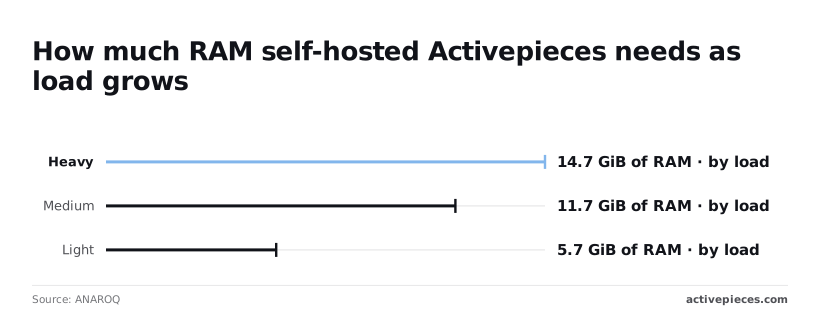
At heavy load it's 14.7 GiB and 7.32 vCPU, a server whose bill and patching someone on your team inherits, which means your team's committed to that resource level.
I've no comparable sizing figure for Automatisch, but its narrower scope is why it suits a small server and a one-person handoff.
To skip those server sizes, you can pay per plan on the Activepieces hosted cloud instead. For Automatisch, the documented path is to self-host, so a team that doesn't want to operate infrastructure has fewer choices there.
Licence terms
The table below shows the four terms that decide ownership, with the enterprise carve-outs last. Read it for what you can modify and resell, and for which features sit outside the open source code.
| Activepieces | Automatisch | |
|---|---|---|
| Self-hosting effort | Docker Compose; plan for the server sizes above | Docker Compose; lighter, narrower stack |
| Hosted cloud availability | Yes | Self-hosting is the documented route |
| Open source licence | MIT | AGPL-3.0 |
| Commercial use terms | Permissive; use and modify freely | Copyleft; network use of modified code requires sharing source |
| Features behind enterprise edition | Yes, under a commercial licence | Yes, under a commercial licence |
If you modify Automatisch and expose it to users, the AGPL requires you to publish those changes. MIT carries no such obligation, which matters if you embed. Both keep some features behind a paid edition, so check your must-haves against that list before you commit.
Worth checking against a plan that does not meter every step: one credit covers a whole run on Activepieces.
Pricing models for startup and scale
You pay for Automatisch in servers and hours rather than a subscription. Activepieces cloud charges by tier and monthly credits, so one cost is predictable on an invoice and the other depends on who maintains the box.
Activepieces plans
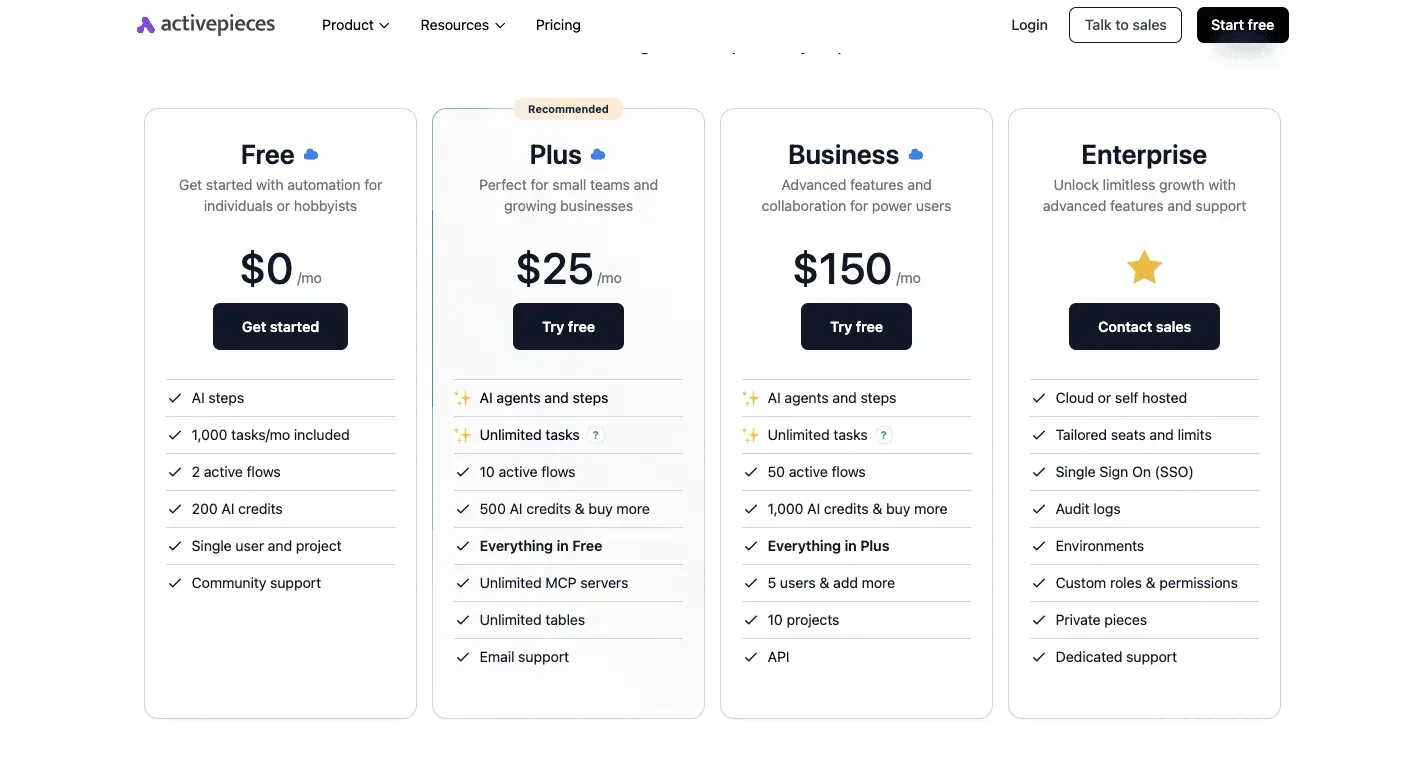
There are three self-serve tiers on the cloud product. Credits climb faster than price from Free to Plus, then price jumps tenfold for Team, so the step you actually feel is the second one.

Free is $0 with 1,000 credits, which is enough to prove a workflow works but not to run a team's operations on.
Plus is $20 with 10,000 credits, so ten times the room for twenty dollars, and it's where a small team usually lands.
Team is $200 with 50,000 credits, which means you're paying for headroom and the admin controls that come with that tier, not just volume.
Self-hosted enterprise, SSO beyond Team and embedding are handled through sales, so there's no public price to budget against for those.
That ladder is easy to forecast: count your monthly runs, find your tier.
Automatisch costs
There's no per-task meter and no credit ceiling, because Automatisch is open source and self-hosted. What you pay is a server, a database, backups, upgrades and whoever gets paged when a flow stops firing. Put a person's name against that before you start.
Same caveat as before: some features sit in a paid edition. I've no confirmed price for that edition, so ask the vendor directly if your must-haves land there.
Cost at small and larger volumes
For one person or a small team running a handful of flows, either route is cheap. Automatisch wins on raw spend if you already have a server and someone comfortable running it. Activepieces cloud wins if you'd rather pay a flat amount than own uptime.
As volume grows, Automatisch's cost stays roughly flat until you need to scale infrastructure.
Activepieces cloud moves up tier by tier, and the Team step is where you should check whether self-hosting would be cheaper than the subscription. Past that point, a sales conversation replaces the price list.
Integrations, AI agents and embedding compared
On all three needs here, Activepieces wins. Automatisch's smaller scope is enough only if your workflows touch a short list of common apps and nobody is building agents or shipping automation to customers.
| Need | Activepieces | Automatisch | Winner |
|---|---|---|---|
| Published integrations | Much larger catalogue | Smaller catalogue | Activepieces |
| Custom connectors | TypeScript pieces, published as packages | Custom apps written inside the codebase | Activepieces |
| AI agents and MCP | Built-in agents; pieces exposed over MCP | No agent or MCP feature in its docs | Activepieces |
| Embedding | Embed SDK for your own product | No embedding feature in its docs | Activepieces |
If your list is a handful of well-known apps, the smaller catalogue costs you nothing.
Integration count and custom connectors compared
Check your own app list before you compare catalogues. If every tool you use is covered, the larger count buys nothing. If one is missing, you write the connector, and that's where handoff pain starts.
Automatisch custom apps live in its codebase, so you carry a fork or upstream your work. Activepieces has 744 integrations, counted from packages/integrations/community in its open source monorepo, and roughly 60% were contributed by the community.
A missing one can be generated with AI and added privately to your own instance, so no vendor release or queue sits between you and the connector.
If you want agents on Automatisch, its docs describe no agent runtime or MCP support; it is a trigger-and-action tool.
You can call a model's API from a generic HTTP step, but you maintain the loop, retries and tool wiring yourself. Activepieces ships agents and exposes its integrations as MCP tools, so that work comes with the platform.
If customers need to build or connect automations inside your app, this row decides it. Automatisch is built as a standalone tool for your own team.
Activepieces provides an embed SDK for putting the builder in your product, so for this need the choice is already made.
When Automatisch is the better choice
Automatisch earns its place on the first two questions. If one person owns a server and the flows are plain trigger-and-action chores, there is little to configure, little to upgrade and little to explain at handoff.
With no per-task meter or credit ceiling, a busy month costs the same as a quiet one.
On apps, it holds up whenever your list is short and common. A smaller catalogue is a cost only when something you need is missing, and a team that has checked its apps by name and found them all has lost nothing.
The same goes for controls. A handful of colleagues on a server they control rarely need audit trails or central role management, and skipping them leaves less to maintain.
The AGPL is a fair point in its favour too. It only bites if you modify the code and expose it to users, so an unmodified internal install leaves you almost nothing to publish.
It stops being the right tool when agents, embedding or formal governance show up, and it makes no claim to cover them.
SSO, admin controls and security: who has what
Compliance is a separate test from embedding. A team that must prove access control to an auditor should verify five controls before buying, while a small internal team can usually skip most of them and stay with the leaner tool.
SSO and roles
SSO is where tiers bite, because it's often gated to a higher plan than the one you trial. Read each vendor's pricing page for the plan that names SAML 2.0, not the one that says "SSO" in passing.
Then check roles: can you separate people who build flows from people who only run them or view them? If every user can edit every connection, a departing contractor's access becomes a handoff problem, not a checkbox.
Audit logs and governance controls compared
Ask whether the tool records who changed a flow, who touched a credential and who ran what, and whether you can export that record. Without it, an incident review turns into guesswork across run histories.
Then look at admin controls: can an administrator restrict which integrations are available, manage users centrally and revoke access in one place?
On Automatisch, read the documentation line by line for each of these. I wouldn't assume audit logging or SAML exists in a self-hosted build until I had found it named in the docs.
Compliance status
Activepieces doesn't hold a SOC 2 certification; the programme is in progress. If your procurement process requires a finished report today, that's a blocker, and you should say so to your security reviewer up front instead of letting it surface at signature.
Self-hosting changes the question, since your own controls then carry the audit, but it doesn't hand you a vendor certificate.
Verdict: for a compliance-driven team, the deciding evidence is the plan that names SAML, roles and audit logs in writing, plus whatever attestation your reviewer demands.
For a handful of colleagues automating internal chores, basic accounts and a server you control are enough, and the extra governance is overhead you'd be maintaining for nobody.
Verdict and next step for choosing between them
For a small team that runs its own server and wants simple Zapier-style flows, Automatisch is the right choice.
Beyond that, Activepieces covers the breadth with 744 integrations, which means you likely won't need to build custom integrations, runs agents and exposes its integrations as MCP tools, and offers admin controls and an embed SDK, provided you'll actually use them.
Choose Automatisch if
You have a few colleagues, a server you control, and flows that are mostly "when this happens, do that" chores. There's less to patch and less to explain to whoever inherits the setup when you move on.
While every app you need is in its catalogue and nobody asks for audit trails or single sign-on (SSO, one company login for every tool), the simple setup holds.
If someone asks for SSO next quarter, you're either building it yourself or migrating, and migrations of live automations are rarely quiet.
Choose Activepieces if
Your apps aren't all covered elsewhere, you want AI agents inside your workflows, or you need permissions managed centrally instead of living in one admin's head. It also fits if you want to embed automation inside your own product for customers.
The condition is that at least one of those is real today. If none is, you're paying in setup and attention for capability nobody uses.
- List every app your flows touch and check that each one exists in the catalogue of the tool you're leaning toward. A missing app means a custom build that someone has to maintain.
- Estimate your monthly runs against the plan's credits, so one busy flow doesn't surprise you mid-month.
- Decide between self-run and hosted. Self-run means you own upgrades, backups and the 2 a.m. page.
- If you want a self-serve plan, go to the pricing page.
- If you need self-hosted enterprise, SSO beyond the Team plan, or embedding, use the sales form.
Whichever branch you land on, build one real workflow end to end before you commit. That's where handoff problems show up.
Related reading
References
Running the numbers
See what the same workload costs here.
Free forever plan, and every paid plan self-hosts at no extra cost.
See pricing Talk to sales