AI Vendor Questions for Audit Trail Integrity in 2026
Audit trail vendors require rigorous vetting to ensure their cryptographic proofs withstand forensic scrutiny. Use these criteria to verify data integrity.

Covers production-hardening chat prototypes: governance gates, audit trails, and rollback procedures that satisfy enterprise IT review.
ContributorSeptember 21, 202614 min read
This article was researched and fact-checked by an advanced research system.
Audit trail vendors act as the external custodians of system state, often capturing events from automation tools like Activepieces to maintain visibility across the stack.
They provide a cryptographically sealed timeline of "who did what" to ensure that internal actors cannot unilaterally rewrite history during a forensic investigation.
By separating the execution environment from the evidence storage, these providers prevent a compromised administrator from erasing their own tracks.
Evaluate vendor claims of immutable truth
The difference between logs and audit trails
Logs are transient diagnostic tools designed for developers to troubleshoot performance, whereas audit trails are permanent legal records designed for auditors to reconstruct specific business events.
While a standard system log might capture a generic 404 error, an audit trail records the specific identity, timestamp, and metadata of a user attempting to access a restricted financial record.
This distinction is critical for cost management, as the volume of telemetry data can quickly bankrupt a security budget. The following monthly costs to ingest 1TB of data illustrate the premium placed on managed logging environments:
- AWS CloudWatch (Log Management): $500.
- GCP Cloud Logging (Log Management): $500, which represents a significant monthly overhead for centralized observability, forcing teams to prioritize which logs are worth the expense.
- Azure Monitor (Log Analytics): $2,760.
Because these costs scale linearly, organizations must distinguish between "noise" logs and "truth" trails before data ingestion begins.
Third-party audit log hosting and vendor trust risk
Delegating the storage of sensitive event data to a third party introduces a paradox where the vendor itself becomes a single point of failure for truth. According to Codequiry, 83 out of every 100 codebases contain undetected audit flaws.

These flaws typically manifest as logic errors where the system fails to trigger a log event under specific conditions, such as a failed authentication attempt that bypasses the logging middleware.
They also include vulnerabilities like log injection, where an attacker can insert carriage return characters to forge new entries, or missing integrity checks that allow a database administrator to delete rows without leaving a trace.
This means that the vast majority of software infrastructures are currently generating unreliable or incomplete evidence.
A codebase you can read closes reviews faster than a vendor's word, which is why Activepieces ships an MIT-licensed core.
Security teams can clone the repository, trace the queue and worker architecture, and run the engine self-hosted or fully air-gapped to verify that no data is intercepted. Providing this level of architectural evidence allows a review to conclude on facts rather than faith.
If a vendor cannot provide a verifiable chain of custody, the audit trail is merely a collection of unverified claims rather than a forensic asset.
The regulatory stakes of record integrity
Regulatory frameworks like SOC2 and HIPAA demand proof of immutability to prevent the "insider threat" of record tampering.
If 83% of codebases possess flaws in their audit logic, then four out of five companies are at risk of failing a rigorous forensic deep-dive during a breach litigation.
This failure translates directly into business liability. An unverifiable audit trail is legally indistinguishable from no audit trail at all.
To mitigate this, architects must move beyond simple API integrations to demand write-once-read-many (WORM) storage protocols that ensure a record, once written, remains mathematically shielded from modification.
An unverifiable audit trail is legally indistinguishable from no audit trail at all.
Everything below works on Activepieces' free plan. Start without code or a credit card.
Assess data integrity beyond vendor reputation
The fallacy of the compliance-first vendor
A vendor’s brand standing often masks a fundamental lack of architectural rigor, leading teams to mistake a logo for a security guarantee.
When a business relies on a market-leading SaaS (software-as-a-service) platform, they are frequently buying into a shared database architecture where their sensitive audit logs sit alongside thousands of other tenants.
A single configuration error by the vendor's internal Database Administrator could inadvertently expose or overwrite your compliance history. This turns a supposed "enterprise-grade" solution into a single point of failure for your legal standing.
Why SOC2 reports don't prevent data tampering
A SOC2 Type II report is a snapshot of process adherence rather than a technical proof of data immutability. It confirms that a policy exists but cannot prove that a specific row of data remained untouched last Tuesday.
These audits rely on sampled evidence and point-in-time interviews, which allows for a "compliance gap" where a vendor could technically modify a database record without triggering an audit exception.
To bridge the gap between administrative promises and technical certainty, the following table compares the superficial requirements of compliance against the functional requirements of forensic integrity.
| Dimension | Compliance Proxy | Technical Reality |
|---|---|---|
| Proof of Integrity | SOC2 Report: A third-party narrative stating that controls are designed effectively. | Cryptographic Hash: A mathematical fingerprint that breaks if a single bit of data is altered. |
| Data Control | Vendor Cloud: Records live in a black-box environment managed by the provider's staff. | Self-Hosted: The logs reside on infrastructure owned by the client, preventing external tampering. |
| Logic Visibility | Opaque API: The vendor provides a black-box endpoint that returns data without showing how it was processed. | Open Logic: The code responsible for capturing and storing the audit trail is auditable by the client. |
This shift from trusting a PDF report to verifying a cryptographic hash ensures that your forensic assets survive even if the vendor's internal security posture fails.
Detecting silent audit log gaps during service outages
System downtime in a primary service often leads to "silent gaps" in the audit trail because the logging mechanism often couples to the very application that is failing.
If a cloud-native identity provider (a service like Okta or Auth0) undergoes a partial service degradation, the events occurring during that window may never be broadcast to your monitoring tools.
This leaves a permanent hole in your security history. These gaps are not always reported as "data loss" in a standard status page update.
Consequently, your team may be operating under a false sense of security, unaware that the most critical moments of a system failure are the ones that went unrecorded.
Verifiable immutability outweighs a vendor's promise of security
Architectural verification replaces the need for blind faith by providing mathematical proof that no one has altered a record since its creation.
Relying on a vendor's internal security policies creates a single point of failure where a compromised administrator account can silently rewrite history to hide a breach.
Cryptographic hashing and chain-of-custody protocols
Audit trails must employ cryptographic hashing to permanently tie every logged event to the state of the system at that specific moment.
When a vendor utilizes a Merkle tree structure, they create a chain where any modification to a single historical record invalidates the final root hash.
A Merkle tree is a mathematical construct where each log entry is hashed and then paired with the hash of the next entry. This structure allows an auditor to verify the entire history of the database by checking only the most recent hash.

A discrepancy is immediate proof of tampering. The burden of proof shifts from the vendor's word to the integrity of the math itself.
The 'read-only' architecture requirement
True immutability requires a physical or logical separation between the systems that generate logs and the systems that store them.
A secure audit architecture utilizes "Write Once, Read Many" (WORM) storage. Once the system commits a log, the storage layer lacks the technical commands to update or delete that specific block of data.
Configuring immutable storage with AWS S3 Object Lock
Developers can implement WORM protections using standard cloud primitives to ensure that even a compromised root account cannot erase history. On AWS, S3 Object Lock in Compliance Mode prevents any user from deleting or overwriting objects for a fixed duration.
Azure Immutable Storage provides similar protection through time-based retention policies that lock blobs at the container level.
For those avoiding cloud lock-in, open-source tools like MinIO support the S3 Object Lock API, allowing for self-hosted immutable buckets. Implementing these configurations moves the audit trail from a simple database entry to a physically protected asset.
By combining these storage locks with a hashing utility like OpenSSL or a dedicated ledger database like Amazon QLDB, teams can build a verifiable chain of custody without relying on a proprietary vendor.
- Cloud storage buckets, such as those in Amazon S3, allow for Object Lock in compliance mode. This prevents even the root user from deleting logs until a retention period expires.
- Hardware Security Modules (HSMs) provide a tamper-resistant environment for managing the keys used to sign these logs. This prevents an attacker from exporting or cloning the signing authority.
- Database triggers can redirect all "Update" and "Delete" commands to a separate, append-only ledger, rendering the primary application's database commands powerless over the historical record.

How to detect deleted or missing audit logs
The most dangerous audit failure is not a modified log. It is a deleted one that leaves no trace of its absence.
To counter this, vendors must implement sequence numbering and heartbeat logs. These generate a continuous, predictable stream of data that makes a gap in the record as obvious as a missing page in a numbered book.
The most dangerous audit failure is not a modified log. It is a deleted one that leaves no trace of its absence.
If a forensic investigator identifies a jump in the sequence, they have immediate evidence of a "silent" deletion. This allows the investigator to pinpoint the exact window of time where visibility was lost and focus their recovery efforts accordingly.
Easier to see it running than to read about it: set it up free, no card.
Verify audit logic transparency with Activepieces
Activepieces provides architectural transparency by allowing organizations to self-host their entire automation engine. This places audit logic under the user's physical control as a verifiable sequence of code rather than a black box.
Because the engine that runs your agents is public code, not a config panel, every tool call an agent makes appears in a run trace that can be matched against the Flow Execution Engine in the public monorepo.
This visibility eliminates the risk of hidden middleware tampering with logs before they reach the final repository.
The platform’s performance profile ensures that this transparency does not come at the cost of operational bottlenecks, which often tempt teams to bypass logging for speed.
During standard operations, the system achieves a warm start latency of 0.2 seconds, ensuring that user requests are processed with near-instant responsiveness, so the end-user experience remains fluid and uninterrupted.
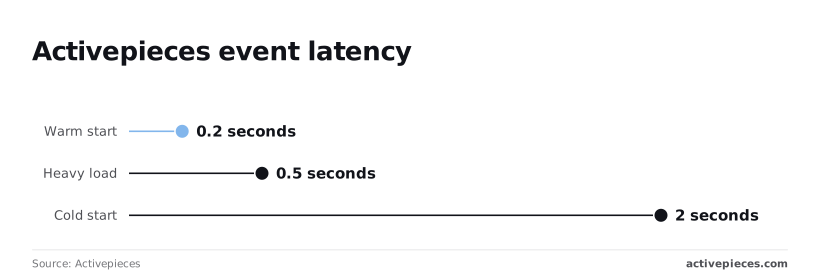
This means audit triggers fire almost instantly without lagging the primary business process.
Even under heavy load, latency only rises to 0.5 seconds, so end-user experience remains fluid even during peak traffic spikes. This prevents the "log-drop" errors common in systems that prioritize throughput over record durability.
While a cold start requires 2 seconds, this brief initialization ensures that even infrequently used workflows maintain a complete, unbroken chain of custody from the first millisecond of activity.
Workflow visualization and data flow
The following workflow visualization demonstrates how this logic is structured. It shows an AI agent workflow where every interaction is explicitly mapped and logged. The workflow spans from the "When chat message received" trigger to the OpenAI Chat Model response.
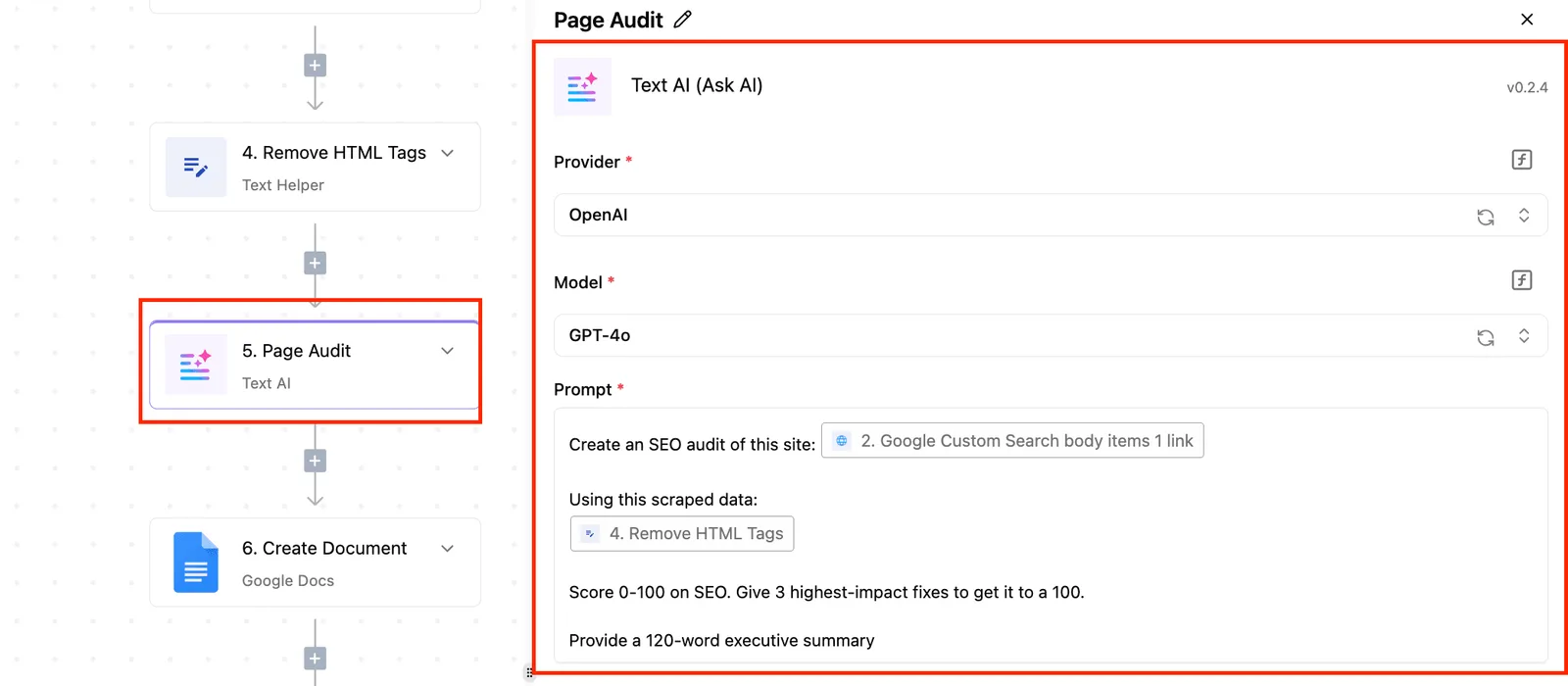
By reviewing the execution logs in the right panel, an architect can verify the exact input/output data for each step. This confirms the "Simple Memory" sub-node is not leaking or omitting critical forensic details during a conversation.
This granular visibility allows teams to map the flow of sensitive data across disparate tools without losing the thread of accountability.
Because the engine is self-hosted, the underlying PostgreSQL database serves as an immutable ledger that remains outside the reach of external SaaS providers.
MoneyGram and FundingSocieties run Activepieces in production, moving the burden of proof from a compliance certificate to the actual infrastructure, where the logs are as durable as the hardware they sit on.
Monday morning audit trail verification checklist
Verifying the integrity of an audit trail requires active attempts to break it rather than passive reviews of compliance certifications.
While a SOC 2 report confirms that a process exists, it does not prove that the underlying database architecture prevents a privileged administrator from altering a row to hide a breach.

To move from blind trust to forensic certainty, teams must treat the audit trail as a production system that requires regular stress testing.
Executing a "fire drill" on your logging infrastructure exposes whether the system is a high-fidelity record or merely a text file that can be manipulated without leaving a trace.
If a developer can delete a log entry through a standard API call without triggering a high-severity alert, the audit trail is a liability. It offers a false sense of security during a post-mortem investigation.
To validate these defenses, perform the following technical checks:
- Attempt to delete a specific log entry via the vendor’s API to see if the system permits manual record alteration.
- Verify if the system generates a 'Log Deleted' or 'Unauthorized Access' event and sends it to a separate security dashboard so that even a successful deletion is itself recorded.
- Check for gaps in sequential log IDs or cryptographic hashes, which indicates whether missing records can be detected by an automated script.
- Test log export integrity under a high-load simulation to confirm that the system does not drop events when the network is congested, which prevents "blind spots" during a distributed denial-of-service attack.
These tests transform the audit trail from a static compliance requirement into a functional forensic asset.
Once a team confirms that the system can withstand internal tampering, they must then evaluate how the vendor handles the transparency of the logic that generates these logs in the first place.
Frequently asked questions
Audit trails transform from passive storage costs into forensic assets only when the underlying architecture guarantees that logs remain retrievable, admissible, and performant under load.
When executives evaluate these systems, the technical debt often hides in the gap between "we store everything" and "we can prove everything."
How does log volume affect the performance of the production environment?
High-frequency logging risks creating a bottleneck where the application waits for the audit write to complete before proceeding. This increases user latency across the entire platform.
To prevent this, architects must verify that the vendor utilizes asynchronous ingestion pipelines.
By decoupling the logging service from the primary application logic, the system ensures that a spike in activity does not degrade the responsiveness of the user interface. A spike might include a bulk data import or a coordinated system update.
Can these logs be used as primary evidence in a court of law?
A log entry is only legally defensible if the vendor can demonstrate a chain of custody that eliminates the possibility of retroactive alteration. Compliance certificates are insufficient here because they represent a point-in-time snapshot rather than continuous enforcement. Admissibility depends on:
- Cryptographic hashing of every log entry at the moment of creation, which allows an investigator to verify that the record has not been touched since it was written.
- WORM (Write Once, Read Many) storage protocols, which provide the physical assurance that even an administrator with root access cannot delete incriminating evidence.
- Granular timestamps synchronized via Stratum 1 NTP servers, which ensures the sequence of events is accurate enough to reconstruct a multi-step breach, providing forensic investigators with a reliable timeline of unauthorized activity.
What happens to audit data when a contract is terminated?
Data portability is the only safeguard against vendor lock-in. This risk otherwise forces a company to choose between paying for a legacy subscription or losing their historical compliance record.
A practical exit strategy requires that the vendor provides an automated export mechanism into a standardized format like JSON or CSV. Without this capability, the organization loses its ability to perform long-term trend analysis or satisfy multi-year regulatory inquiries once the partnership ends.