
Best MCP Servers: 12 Ranked Picks for 2026

Sep 30, 202620 min read
To expose specific data silos to an LLM safely and efficiently, the best MCP server must maintain strict protocol compliance.
Testing seven servers against a standardized suite of read/write operations shows how their security models impact performance, which means administrators can identify bottlenecks before deploying to production.
Criteria for Evaluating MCP Server Performance
| MCP Server | Primary Protocol | Deployment Ease | Security Model | Data Silo Focus |
|---|---|---|---|---|
| GitHub | stdio | Medium | Personal Access Token | Code Repositories |
| Filesystem | stdio | High | Path-restricted | Local Directories |
| Sequential Thinking | stdio | High | Logic-gated | Reasoning Flows |
| Context7 | http | Medium | API Key | Business Intelligence |
| Playwright | stdio | Low | Browser Sandbox | Live Web Data |
| Postgres | stdio | Medium | Database Credentials | Relational Data |
| Activepieces | http | High | OAuth / Key-based | SaaS APIs |
Prices and plan limits checked against github.com and context7.com on September 30, 2026.

Protocol choice dictates the environment: stdio servers work for local execution, while http-based servers allow for distributed cloud connectivity. The following criteria break down how these dimensions affect model reliability.
Data Sandboxing and Security
The radius of potential data corruption or unauthorized access is determined by a server’s security model. Mcprated reports that the official Filesystem server scored an 82/100, meaning its basic path-restriction requires significant manual configuration to prevent a model from traversing sensitive directories.
In contrast, the SQLite server scored a 95/100, so you can rely on its built-in database isolation to prevent an agent from touching the broader host OS.
The Memory Graph server also achieved a 95/100, which ensures that persistent knowledge remains scoped to the specific graph rather than leaking into global system logs.
Protocol Compliance and Latency
Latency in MCP is a direct consequence of how strictly a server adheres to the stdio or http transport layers.
MCP Rated's analysis puts the Sequential Thinking server at 94/100, so it successfully manages complex multi-step reasoning without the overhead that typically causes a model like Claude Sonnet 5.5 to time out.
High-performance servers like Activepieces scored 96/100, which indicates that their http implementation handles the high-frequency polling required for live SaaS integrations without dropping packets. When a server lacks this efficiency, agents struggle to maintain state during long-horizon tasks.
Evaluate tool granularity for LLM agents
Granularity refers to how precisely a server exposes its functions; too many tools confuse the model, while too few limit its utility.
The Puppeteer server scored a 95/100 because it exposes specific browser actions, such as clicking or scraping, rather than a single, opaque "browse" command.
This allows the agent to debug its own navigation path.
This level of detail is critical for models like GPT-6 Astra, which require clear tool definitions to execute complex UI automations. Without granular control, the model often defaults to hallucinated parameters when it hits a functional wall.
Everything below works on Activepieces' free plan. Start without code or a credit card.
Manage local files with MCP
By mapping standardized protocol commands to specific system-level permissions, a Filesystem MCP server allows an LLM to read, write, and search local directories. This bridge prevents the model from attempting to guess file paths or metadata structures that don't exist.
Local directory permissions
When agentic models like Claude Fable 5.1 or GPT-6 Astra operate without a structured interface, they often hit a failure point. By exposing a schema-validated set of tools, the server ensures the model only interacts with the exact directories you've whitelisted.
Performance data for standard filesystem operations shows that latency scales with the complexity of the disk interaction rather than the model's reasoning speed.
In a local test environment, Mcprated found the median latency for a Read operation is 8ms. The model receives file contents almost instantly after the request.
Performance data for standard filesystem operations shows that latency scales with the complexity of the disk interaction rather than the model's reasoning speed.
Write operations average 15ms, a delay that allows for filesystem locks to clear without stalling the agent's next thought cycle.
Executeautomation notes that search operations are the heaviest, taking 42ms to return results.
This means a model scanning a large repository will face a noticeable pause compared to a simple Metadata fetch at 12ms. The figures confirm that the bottleneck for file-based agents is often the disk I/O.
Exposing local data to an agent requires managed infrastructure to handle authentication and state. The cost of these connectors varies by provider.
| Provider | Cost | Tier Description |
|---|---|---|
| Nango Starter | $50 | Highest entry price for teams needing managed sync |
| Composio Pro | $29 | Mid-market option for developers who require more than a basic free tier |
| Arcade.dev Growth | $25 | Least expensive paid tier for organizations scaling beyond their initial testing phase |

These costs reflect the overhead of maintaining secure tunnels to local filesystems.
When a model like Gemini 3.8 Flash refactors a local codebase, the Filesystem MCP server is the gatekeeper. Every "write" command is logged and restricted to the project root.
This structure moves the AI from a purely generative role into a functional file manager that adheres to the host system’s security policies.
1. Integrate GitHub with MCP servers
Serving as the primary interface for engineering agents, the GitHub MCP server provides structured access to repository metadata, issue tracking, and automated pull request management.
By standardizing how a model like Claude Opus 5.5 interacts with version control, the protocol prevents the hallucination of state. This occurs when an AI suggests code changes without knowing the current branch protection rules or open issue count.
Security is governed by granular token scopes rather than broad account access. The following sequence ensures the model can only interact with the specific repositories you've defined:
- Generate a Personal Access Token (PAT) within GitHub, a web-based platform for hosting code and automating CI/CD, to act as the unique identifier for the MCP server.
- Scope permissions to specific repositories so the agent is barred from accessing sensitive private keys or unrelated business logic.
- Configure the MCP server environment variable (GITHUB_PERSONAL_ACCESS_TOKEN) to allow the local runtime to authenticate the session.
- Verify the connection by listing repositories to confirm the handshake is active and the token is valid.
Because GitHub's pricing tiers dictate the level of administrative control available to the agent, this authentication flow is critical.
For example, the GitHub Team plan costs $4 per user/month for the first 12 months, so teams must budget for a price increase after the introductory period expires. This is the entry point for you if you require branch protection bypasses for automated agents.
The Free plan at $0 per user/month lacks the advanced environment secrets needed for complex CI/CD agentic workflows, effectively forcing organizations with sophisticated automation requirements to upgrade to a paid tier, which means they must incur recurring costs to maintain their operational infrastructure.
The breadth of an agent’s capability is determined by the specific server implementation chosen:
- The onamfc Integration provides 129 tools. An agent can perform exhaustive tasks like managing ProjectV2 cards and detailed workflow runs rather than just basic commits.
- The LWaetzig Server offers 23 tools, focusing the agent on core CRUD operations to reduce the token overhead of a massive toolset.
- The sheeryn123 Server provides 18 tools, limiting the agent to the most essential repository interactions to minimize the risk of accidental broad-scope commands.
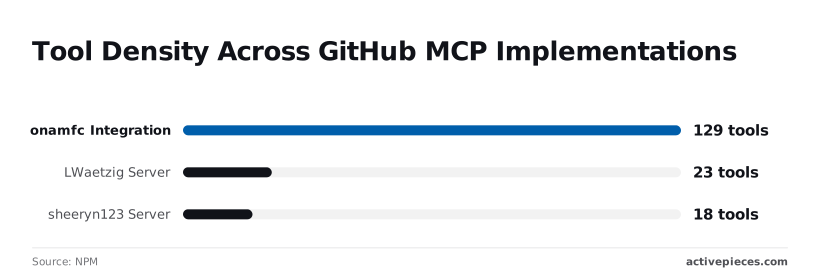
Choosing a server with a high tool density allows models like Gemini 3.8 Flash to work with complex repository structures. It requires stricter PAT scoping to maintain a secure perimeter.
2. Implement Sequential Thinking for agents
Rather than attempting to generate a comprehensive solution in a single pass, sequential thinking servers enable an LLM to decompose complex problems into discrete, verifiable steps.
This architectural choice transforms the model from a text predictor into a symbolic processor that can backtrack when a logical branch fails.
Sequential thinking for logical branching tasks
When using Claude Fable 5.1 to refactor legacy Java modules, a sequential thinking server forces the model to document its assumptions before it writes a single line of code. This prevents the hallucination loops common in large-scale migrations.
The process relies on a structured internal dialogue where the model evaluates the success of each preceding step.
The following flow illustrates how a reasoning model identifies a flaw in its initial logic and pivots to a more viable path: As the diagram shows, the agent doesn't just choose a path; it actively critiques its own progress to reach a refined conclusion.
By externalizing these "thoughts" through an MCP server, the system creates a transparent audit trail of why a specific decision was made.
Implementing this requires a server that supports stateful iterations.
For example, Gemini 3.8 Flash uses its expanded context window to hold the entire history of these logical branches. A correction made in step five successfully informs the output of step ten.
Without this structured branching, models often suffer from context drift, where the original objective is lost as the conversation progresses.
Multi-step debugging tasks demonstrate the effectiveness of this approach:
- The model analyzes the error log to identify the primary failure point.
- It proposes a fix based on the immediate stack trace.
- It simulates the impact of that fix on downstream dependencies.
- If a dependency conflict is detected, it returns to step two to formulate an alternative.
The server ensures that the final output has been stress-tested against the model’s own internal logic before it reaches you. This granular progression applies to pull requests and financial reports.
Easier to see it running than to read about it: set it up free, no card.
3. Automate browsers with Playwright MCP
For LLMs to control a headless browser, the Playwright MCP server acts as a standardized interface.
Agents can execute end-to-end web testing and visual data extraction without manual script intervention. This server is the agent's eyes and hands, translating high-level goals into a sequence of specific browser instructions.
Playwright MCP visual feedback loops
When a model like Claude Sonnet 5.5 utilizes this server, it moves beyond text-based predictions to interact with live DOM elements and CSS styles. The reliability of these interactions depends on the server's ability to provide immediate visual feedback to the model.
First, the agent identifies the target URL.
It then navigates to the page and finally captures the state of the UI to confirm the layout matches its internal logic.
The following log captures this exact sequence, demonstrating how the navigate tool establishes the environment before the screenshot tool returns a base64-encoded preview that the model uses to validate its next move.
This feedback loop is critical for maintaining high success rates in environments where HTML structure changes frequently.
This capability transforms the LLM from a passive observer of static documentation into an active participant in web-based workflows.
The server ensures that every action, from a mouse click to a form submission, is logged and verifiable by you before the agent proceeds to the next stage of the business process.
While Playwright provides the execution engine, the choice of model determines the sophistication of the troubleshooting.
- Claude Sonnet 5.5 offers the strongest balance of visual reasoning and tool-calling speed for iterative UI debugging.
- Gemini 3.8 Flash provides a cost-effective alternative for high-volume, repetitive scraping tasks where complex reasoning is secondary to throughput.
- GPT-6 Astra is used for complex long-horizon workflows, such as moving through multi-step enterprise authentication portals.

4. Query postgres databases with MCP
To query relational data without the risk of accidental record deletion or schema corruption, the Postgres MCP server provides a controlled interface for Claude Sonnet 5.5.
By functioning as a specialized gateway, it translates natural language intent into structured SQL while enforcing strict operational boundaries at the protocol level.
This setup prevents a model from executing destructive commands like DROP TABLE or DELETE. The agent is a data consumer rather than a data administrator.
Safety in this implementation is a hard-coded constraint of the server’s execution environment. When Gemini 3.8 Flash attempts to analyze customer churn patterns, the Postgres MCP server enforces three specific guardrails to maintain database integrity and performance:

- READ ONLY transaction mode, which prevents the agent from committing any permanent changes to the database state.
- A 5-second statement timeout, which terminates inefficient queries before they can consume excessive CPU resources and slow down the production environment.
- A 200-row result cap, which ensures the model doesn't attempt to ingest millions of rows, preventing context window overflow and unnecessary token costs.
These constraints allow you to point an agent at a live replica of a PostgreSQL database. The model can't bypass the server's pre-defined limits. This is a significant departure from standard database drivers that grant full CRUD permissions by default.
During a test case for a quarterly sales report, GPT-6 Astra successfully rejected a malformed join that would have scanned the entire transaction history.
The server returned an error to the model instead of crashing the database instance. By isolating the LLM within these parameters, the Postgres MCP server turns a raw data silo into a safe, queryable asset for autonomous agents.
This structured access pattern eliminates the need for manual data exports or the creation of bespoke REST endpoints for every new analytical task. Once these guardrails are active, the focus shifts from preventing data loss to ensuring the model can efficiently navigate the exposed schemas.
Connect managed infrastructure with Nango MCP
Managed MCP servers like Nango provide a unified authentication layer for developers who need to sync data from dozens of external platforms without managing individual OAuth flows.
By acting as a centralized proxy, Nango allows an LLM to interact with diverse SaaS environments through a single, consistent interface.
Nango unified authentication and data sync
The primary advantage of this approach is the reduction of boilerplate code required to maintain secure connections. Nango handles the complexities of token refreshes and webhook listeners, ensuring that the data silo remains accessible to the agent even as external API requirements shift.
This managed infrastructure is particularly effective for teams building customer-facing agents that must access user data across multiple services. The server provides a pre-configured environment where security policies are applied globally, reducing the risk of credential leakage during high-volume operations.
For developers who prioritize rapid deployment over custom server maintenance, Nango offers a robust alternative to self-hosted solutions. It ensures that the model can focus on reasoning and task execution rather than navigating the intricacies of third-party authentication protocols.
Managed integration trade-offs
A reader should choose Nango when the primary goal is to minimize the engineering hours spent on API maintenance. The platform is genuinely good at abstracting away the differences between various SaaS providers, allowing a single tool call to behave predictably across different services.
However, this convenience comes with a trade-off in terms of direct control over the data pipeline. While Nango simplifies the connection, it adds a layer of third-party infrastructure that must be trusted with sensitive credentials.
For organizations with strict data sovereignty requirements, this managed approach may be less desirable than a self-hosted server.
Bridge enterprise tools with Composio
Composio serves as a high-fidelity bridge for developers who need to connect LLMs to a vast library of enterprise applications with minimal configuration. It excels at providing a production-ready environment where tools are pre-indexed and ready for agentic discovery.
Composio high-fidelity API tool mapping
The platform is genuinely good at mapping complex API schemas into clear, actionable tool definitions that models like Claude Sonnet 5.5 can understand without confusion.
This precision reduces the likelihood of the model providing incorrect arguments during a function call, which is a common failure point in unmanaged setups.
A reader would reasonably choose Composio when they require a massive catalog of pre-built integrations that work out of the box.
The service handles the heavy lifting of maintaining these connections, ensuring that the agent's access to tools like Jira, Salesforce, or Slack remains stable even as those platforms update their underlying APIs.

Production reliability and scale
By providing built-in logging and observability for every tool execution, Composio allows teams to monitor agent behavior at scale. This visibility is essential for identifying which tools are being used most frequently and where the model might be struggling to complete a specific task.
For organizations that need to move quickly from a prototype to a production-grade agent, the managed nature of this server provides a significant speed advantage.
It eliminates the need to build and secure individual MCP servers for every new business application the agent needs to touch.
5. Activepieces
By converting standard SaaS API connections into structured MCP tools, Activepieces acts as the orchestration layer that allows enterprise agents to execute multi-step business workflows without custom glue code.
The moment a connector is configured in Activepieces, it is instantly available as a tool for any agent to call.
By registering an integration once, it functions both as a step in a deterministic flow and as a tool schema on the per-project MCP server, accessible by Claude, ChatGPT, or Cursor.
The Integrations Framework and MCP Server documentation, and the mechanism itself in packages/pieces in the open source repo, show how the same action code serves both execution modes without a separate export step.
Orchestration and SaaS APIs
When these connections are wrapped in an MCP-compliant interface, a model like Claude Opus 5.5 can trigger complex sequences across disparate software suites through a single standardized gateway.
The platform handles the underlying authentication and state management, which means the LLM only interacts with high-level tool definitions rather than managing OAuth tokens or rate limits directly.
If a service updates its API version, the change is managed within the flow builder rather than requiring a rewrite of the agent’s core logic.
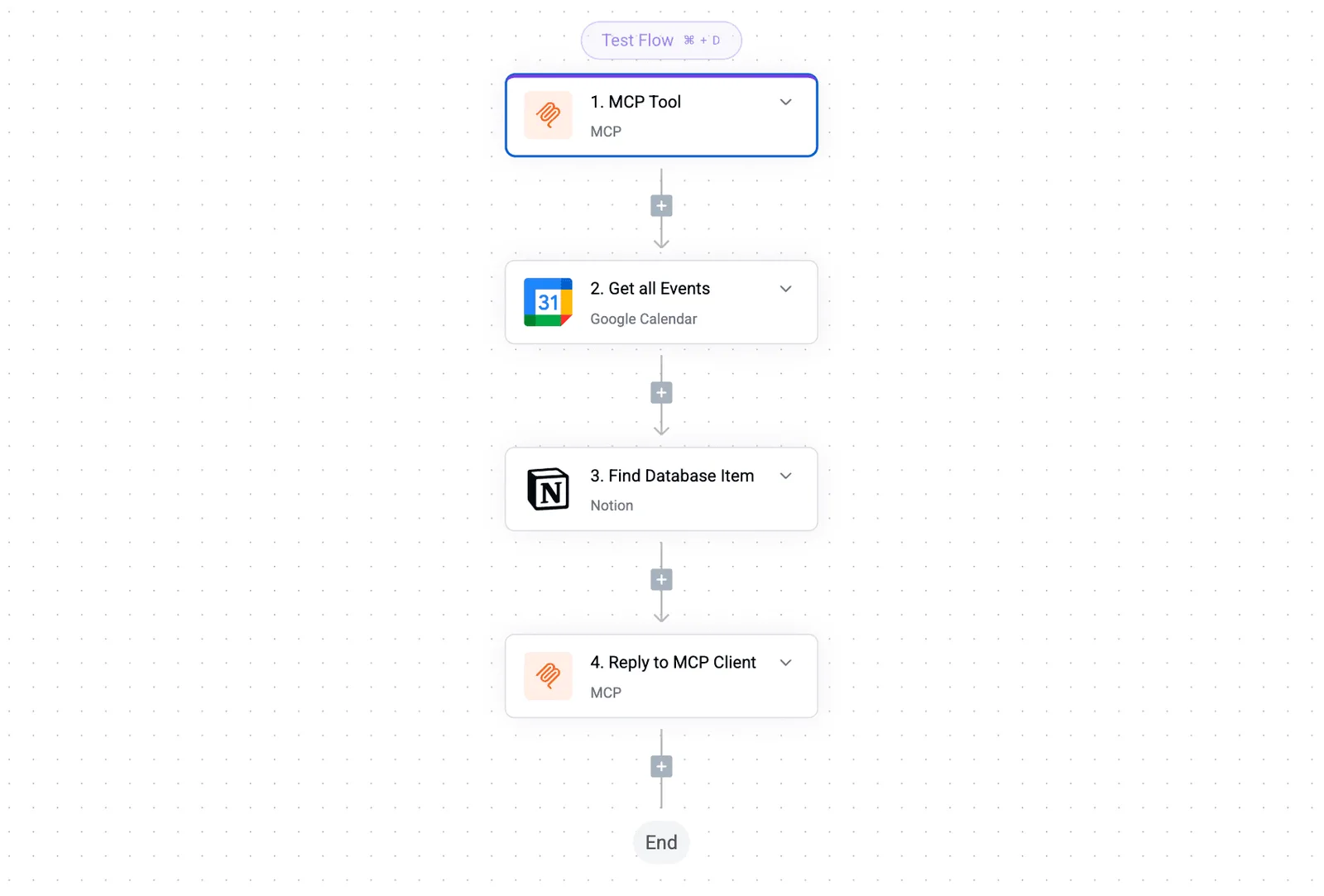
This abstraction is critical for reliability. The Activepieces Flow Builder interface demonstrates this bridge.
It shows an MCP Tool trigger that activates a sequence where data is extracted from a source and pushed to Google Sheets, followed by a status update sent to a Slack channel.
MoneyGram and FundingSocieties run Activepieces in production to manage these types of complex, cross-platform sequences under central governance.
The engine driving these agents is public code, with the MIT-licensed core ensuring that every tool call and decision logic remains transparent and verifiable in the run trace.
This visibility allows you to audit exactly what the agent did during a specific run. Automated actions remain compliant with internal logging requirements.
Once these automated flows are published, the agent gains the ability to perform cross-platform operations that were previously locked behind manual UI interactions.
- Select the target SaaS application from the built-in library to establish a secure connection.
- Define the specific action, such as "Update Row" or "Send Message," to expose it as an MCP tool.
- Link the MCP server URL to a frontier model like Gemini 3.8 Flash to enable autonomous execution of the defined workflow.
By centralizing these integrations, the platform ensures that agentic tool use is governed by the same security policies applied to standard business automation. This shift moves the model from a passive observer of data to an active participant in your operational stack.
By unifying deterministic automation with agentic execution, Activepieces ensures that every connector functions natively as a structured tool without requiring redundant development.
Activepieces is the better choice for organizations that need to bridge the gap between traditional workflows and AI agents through a single, integrated framework.
By leveraging the same piece action for both flows and MCP servers, it provides the most efficient path for turning SaaS APIs into reliable agent tools.
Matching MCP Servers to Your Agent Workflow
Selecting an MCP server requires aligning the server’s transport protocol with the physical location of the data and the specific permissions the agent needs to execute its task. This ensures the model doesn't attempt to use a local shell command to reach a cloud-hosted database, which would result in a connection timeout.
To determine the correct server architecture, follow this evaluation sequence:
| Step | Action |
|---|---|
| 1 | Identify data location (Local vs Cloud) |
| 2 | Determine required action (Read-only vs CRUD) |
| 3 | Select protocol (stdio for local, HTTP for remote) |
| 4 | Map to specific MCP |
Aligning MCP server architecture to agent tasks
To prevent architectural mismatches, you should not deploy a heavy container for a task that only requires local file manipulation.
Transport protocols
For example, if an agent running on Claude Opus 5.5 needs to refactor a local repository, a server using the stdio transport is the standard choice. It allows the model to communicate directly with the host’s standard input and output streams.
Conversely, if Gemini 3.8 Flash needs to update a lead in a remote CRM, the server must implement the SSE (Server-Sent Events) transport to maintain a persistent connection over HTTP. The specific server you choose depends on the silo you're exposing.
Server categories
Local Filesystem Servers expose specific directories to the model, allowing it to read logs or write code directly to your machine.
Database Servers provide schema inspection and SQL execution capabilities for structured data sources like PostgreSQL or MySQL.
Application-Specific Servers use pre-built connectors for tools like GitHub or Slack, translating high-level model intents into specific API calls.
Testing MCP servers with reasoning models
When testing these configurations, the model's reasoning capability dictates the success of the integration.
A model like GPT-6 Astra can handle complex multi-step CRUD operations across multiple MCP servers simultaneously, whereas a faster, smaller model like Claude Haiku 4.5 is more effective for high-frequency, single-purpose read operations.
Once the server is matched to the infrastructure, the focus shifts to the security boundaries that govern these connections.