
Connecting Legacy Mainframe Systems via API Integration

Oct 2, 202613 min read
When modernizing a legacy system, the first requirement is a secure, bi-directional pathway. This pathway allows terminal-based data to interact with web-native environments without compromising the underlying hardware’s integrity.
This architecture functions as a translator. It ensures that the rigid, high-availability environment of the mainframe can communicate with the elastic, API-driven nature of the cloud.
[Illustration Placeholder: A conceptual diagram showing a 'bridge' architecture: on the left, a green-text terminal screen (Mainframe); in the center, a low-code orchestration layer (Activepieces); on the right, modern cloud]
By establishing this link, organizations can begin to meet specific operational benchmarks for agility. The visual representation clarifies how data flows across the air-gap, transforming legacy outputs into usable inputs for modern services.
Bridge legacy mainframes and cloud services
Mainframe to cloud integration speed benchmark
The objective for a successful integration pilot is to establish a functional data exchange between a terminal emulator and a modern cloud database within a single twenty-minute window.
Achieving this speed ensures that the technical overhead of the bridge does not become a project bottleneck, allowing teams to focus on business logic rather than protocol negotiation.
When an engineer can map a 3270 screen field to a cloud-hosted table in this timeframe, the integration remains lightweight and verifiable, which prevents architectural sprawl.
This rapid deployment capability is essential for meeting the strict delivery timelines mandated by federal procurement cycles and internal audit reviews.
Why mainframe replacement is losing favor
Total decommissioning of a mainframe is rarely the primary recommendation because the cost of recreating decades of validated business logic often exceeds the budget for the entire modernization initiative.
Instead, maintaining the mainframe as a stable core while adding modern interfaces allows for:
- Continuous uptime during the transition.
- Preservation of existing compliance audits, which avoids the lengthy recertification process required for entirely new infrastructure.
- Incremental feature deployment, which reduces the impact of any single point of failure during the update cycle.
Everything below works on Activepieces' free plan. Start without code or a credit card.
Step 1: Expose your mainframe data through a secure gateway
Establishing a secure gateway ensures that legacy records are accessible to modern services without compromising the host’s security domain.
This initial link creates a controlled conduit where the system authenticates every request against existing RACF or ACF2 profiles, so the mainframe remains the final authority on data access.
Deploying the terminal emulation middleware
To bridge the gap between the mainframe and the orchestrator, you must deploy a terminal-to-web gateway or an RPA bot capable of screen scraping. Tools like Rocket Terminal Emulator or OpenText HostSurfer provide the necessary programmatic interface for legacy protocols.
These middleware solutions act as the physical translator, converting the raw TN3270 stream into a format the orchestration layer can consume. Without this specific software layer, the orchestrator has no way to "see" the green-screen fields.
Configuring the TN3270 or TN5250 connection
Establishing a stable connection requires a terminal emulation service. This service functions as a translation bridge between Telnet protocols and the orchestration environment.
The gateway must point at the host's IP address and specific port. This is typically 23 for non-encrypted or 992 for SSL/TLS traffic.
Engineers must import Secure Sockets Layer (SSL) certificates into the gateway's trust store to satisfy the requirement for encryption in transit.
The handshake activates the emulator to act as a virtual operator, allowing the system to navigate green-screen menus or batch queues as if a human were at a physical terminal.
Mapping legacy fields to readable JSON keys
Modern APIs and large language models require structured formats rather than raw mainframe data. This process involves identifying the row and column coordinates of specific data points on a terminal screen and assigning them a descriptive label.
| Field Label | Screen Coordinates | Target Format |
|---|---|---|
| Customer Name | Row 5, Column 20 | Standard text field |
| Account Balance | Row 12, Column 15 | Decimal format |
| Transaction Date | Row 18, Column 10 | ISO-compliant date |

By standardizing these outputs, the orchestration layer can pass data to Gemini 3.8 Flash for enterprise workflows or Grok 4.7 for code analysis.
Testing the initial data handshake
Executing a simple "Read Only" command validates the gateway connection. This ensures the orchestration layer can successfully retrieve a record.
This test confirms that the credentials provided have sufficient permissions to bypass the initial login screen and reach the required application sub-menu.
Successful completion of this handshake proves that the legacy environment is ready to participate in automated workflows while remaining behind the organization's protective air-gap.
Step 2: Transform fixed-width legacy strings into usable data objects
Modernizing mainframe outputs requires a middle-tier transformation layer. This layer maps rigid positional strings to the JSON schemas required by cloud-native APIs.
According to the GAO-25-107795 report, outdated code affects 8 key systems, meaning nearly half of the surveyed federal environment relies on logic that no longer supports modern encryption standards.
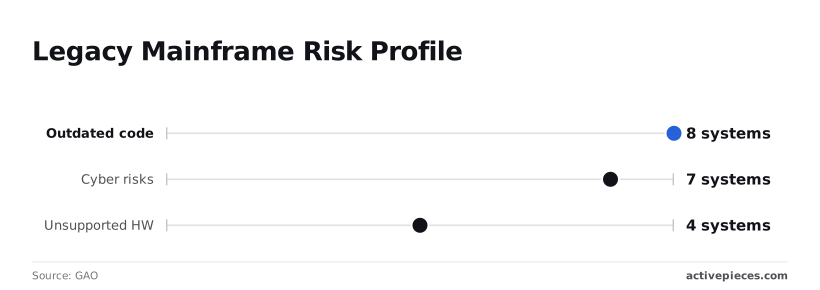
This translation is the primary defense against the systemic vulnerabilities identified by the Government Accountability Office (GAO) in their assessment of critical infrastructure.
By converting these fixed-width strings into structured objects, procurement officers can ensure that legacy data is compatible with the identity headers and payload requirements of modern service providers.
Converting EBCDIC encoding for web services
The orchestration layer must first translate EBCDIC (Extended Binary Coded Decimal Interchange Code) into UTF-8. This prevents data corruption during transit to web services.
Failure to normalize this encoding at the edge creates the specific cyber risks the GAO found in 7 systems. Malformed characters can bypass input validation filters in downstream applications.
Failure to normalize this encoding at the edge creates the specific cyber risks the GAO found in 7 systems.
Once normalized, the system maps the data into a key-value structure. The system assigns specific byte offsets to named fields, such as a customer ID occupying positions 10 through 25.
Reading mainframe data transformation execution logs
The execution logs of a standard orchestration flow illustrate the visibility provided by a successful transformation. In a successful run, the system captures a trigger event and immediately executes a "Revoke Token" step to secure the environment.
The details for this step show a duration of 1271ms, indicating a sub-two-second window between the legacy event and the security response.
The input log confirms a JSON POST request was sent to a payment processor. The modern API successfully accepted the legacy data, which the output confirms with a status 200 "OK" response.
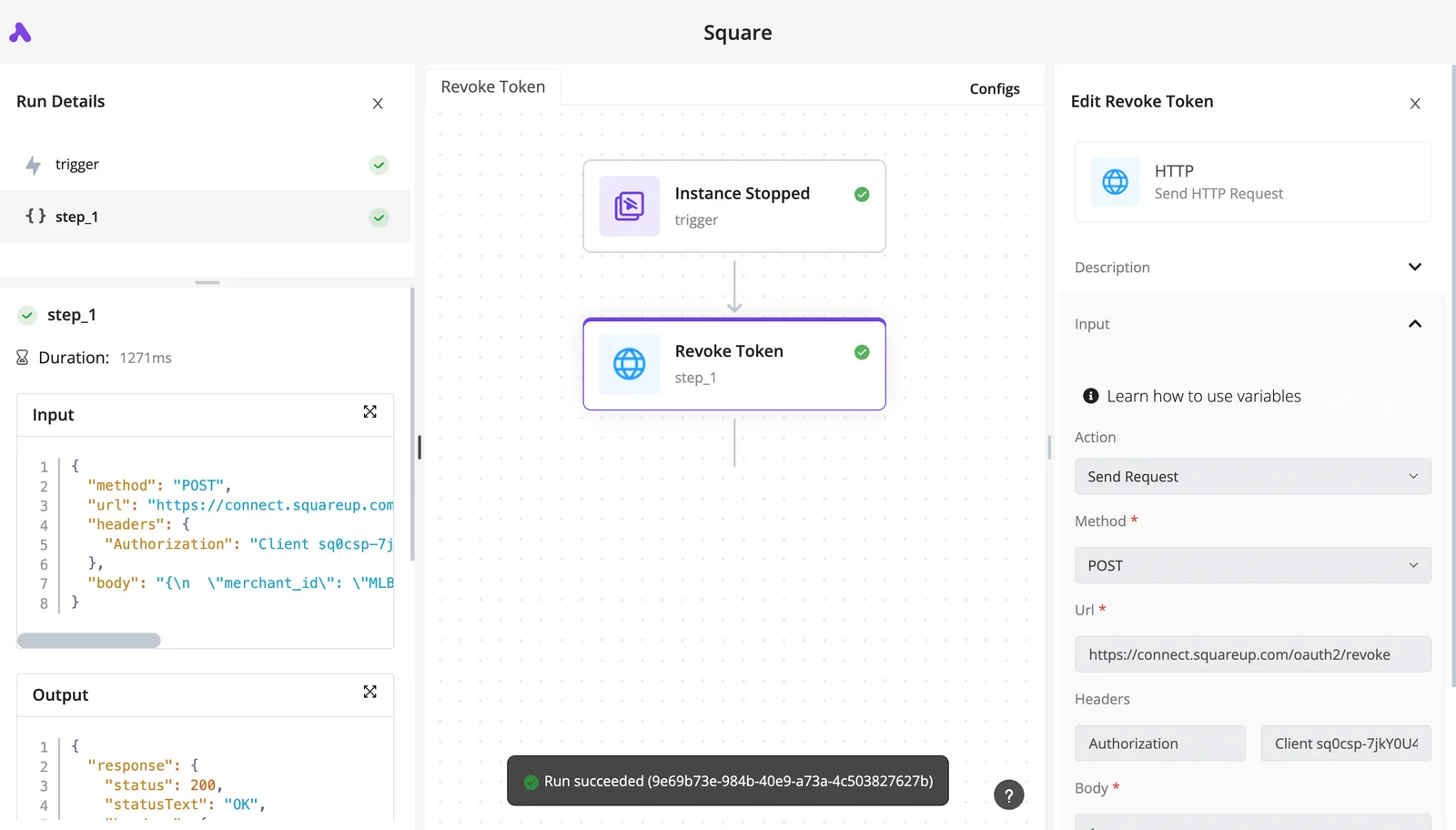
This structured handoff is essential for maintaining operational continuity, especially since the GAO identified unsupported hardware in 4 systems. These environments lack the physical processing power to run modern security agents locally, making external orchestration the only viable path for compliance.
Handling batch processing versus real-time mainframe events
Transforming legacy data requires distinct logic paths for high-volume batch jobs and low-latency transactional events.
When dealing with high-throughput workloads, Gemini 3.5 Flash serves as the baseline reasoning engine to categorize thousands of positional records into a single bulk upload.
For real-time requirements, the orchestration layer utilizes specific triggers to initiate immediate actions:
Transactional Triggers fire on single record updates to update modern databases or revoke access tokens instantly.
Batch Schedulers aggregate EBCDIC files overnight for deep analysis using Gemini 3.8 Flash to identify enterprise workflow patterns.
Audit Listeners monitor the flow for failures. This logs any transformation error for compliance review before the data reaches the public cloud.
Easier to see it running than to read about it: set it up free, no card.
Step 3: Orchestrate the data flow using Activepieces connectors
For maintaining the mainframe's security posture, air-gapped infrastructure is the only way, and Activepieces provides the same enterprise feature set (including SSO, SCIM, custom RBAC, audit logs, and secret manager integration) in its self-hosted air-gapped build as it does in the managed cloud.

This parity is why regulated organizations like MoneyGram and FundingSocieties run the platform in production to bridge sensitive data environments.
Security reviews for government systems often stall when vendors cannot provide full architectural visibility, but because Activepieces ships an MIT-licensed core, agencies can clone the repository to verify the worker architecture and load-test the system before deployment.
This transparency allows technical teams to audit the codebase directly, replacing vendor promises with verifiable evidence that the orchestration layer can handle legacy batch cycles securely.
Setting up a webhook trigger for mainframe signals
The orchestration begins by configuring a Webhook Trigger to act as a persistent listener for outbound mainframe signals.
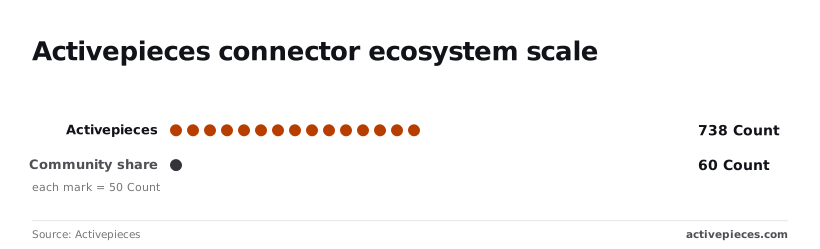
Because Activepieces supports a library of 738 integrations, an architect can standardize integration patterns across the entire legacy estate rather than maintaining bespoke scripts for every individual COBOL program.
Within the workflow builder, the Webhook step generates a unique URL that the mainframe’s TCP/IP stack targets.
The screenshot demonstrates a typical two-step sequence where a Webhook Trigger pairs with a "Get Icecream Flavor" action from the Gelato integration.
This shows how the system validates an incoming request before proceeding. The blue border around the second step indicates it is currently being configured to handle the specific data attributes received from the trigger.
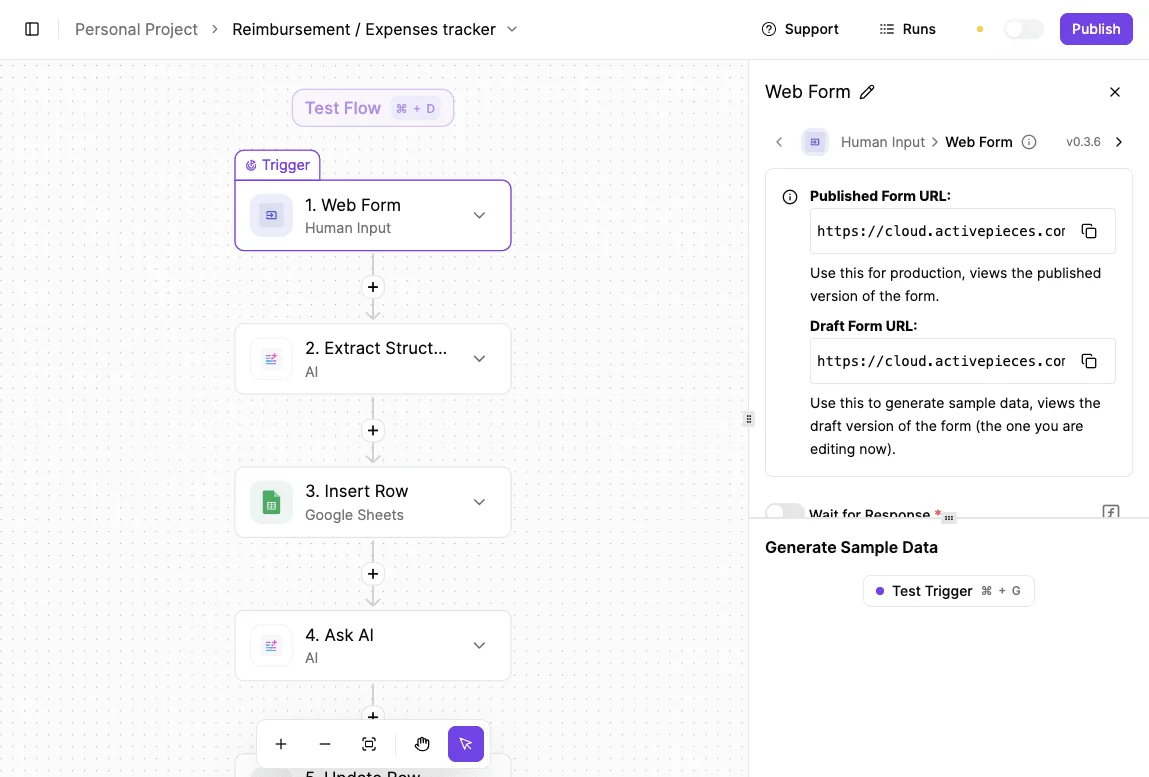
This initial handshake is the critical point where legacy data enters the modern orchestration environment.
Mapping mainframe outputs to destination fields
Once the payload is captured, the configuration panel allows for precise field mapping between the mainframe’s fixed-width or delimited output and the target system’s API.
The ecosystem relies heavily on its users, with roughly 60% of integrations currently maintained as community contributions.
Continue on Failure ensures that a single malformed record does not halt a batch process involving thousands of entries.
Auto Retry on Failure allows the system to overcome transient network timeouts between the air-gapped environment and external APIs.
Generate Sample Data creates a mock schema so the developer can map fields without needing to trigger a live mainframe job for every minor adjustment.
Confirming successful mainframe data write status
The final validation occurs in the "Tested Successfully" status indicator. This confirms that the mapped data has reached the destination and returned a valid response code.
As seen in the configuration panel, a timestamp showing a successful test 19 seconds ago proves that the connection to the destination is active and authenticated, confirming that the system is currently receiving real-time data, which means the operator can trust the current dashboard values without needing to manually refresh.

Immediate feedback loops reduce the time spent in the "pending audit" phase, as the output panel provides the exact JSON response required for compliance documentation.
Secure government mainframe automation project data
Government mainframe automation requires an infrastructure that mirrors the mainframe’s own security posture to prevent modern orchestration layers from becoming the weakest link in the data chain.
When promoting workflows to production, the underlying platform must satisfy strict federal mandates to ensure that the transition from legacy green screens to modern APIs does not introduce unmitigated risk.
Managing PII across legacy and cloud boundaries house data safely
The intermediary environment must maintain a security authorization equal to the system of record to permit the transmission of Personally Identifiable Information (PII) between a mainframe and an orchestration layer.
Relying on public cloud services for this bridge introduces third-party risk that often conflicts with internal data sovereignty requirements. To maintain compliance, the orchestration environment must support:
- FedRAMP Authorized environments to ensure the cloud service provider meets standardized security assessment and continuous monitoring requirements.
- FIPS 140-2 validated encryption so that all data in transit between the terminal and the API consumer is protected by cryptographic modules that have passed rigorous government testing.
- Air-gapped deployment capability, which allows the entire automation stack to function on a physically isolated network, preventing any external exfiltration of sensitive records.
- Role-Based Access Control (RBAC) for terminal sessions to ensure that the automation tool can only view the specific screens and fields necessary for the task.
These controls ensure that as data moves across boundaries, it remains within a verified perimeter.
Audit logging for automated mainframe transactions
Automated transactions must generate a forensic trail that satisfies the requirements of internal inspectors general and external auditors.
Because a single automation workflow might trigger dozens of individual mainframe screen updates, the system must log every interaction at the packet level.
This granular logging ensures that if an unauthorized change occurs, investigators can trace the specific logic path taken by the automation engine back to the triggering event.
Implementing least-privilege access for automation service accounts
Service accounts used for mainframe orchestration should be restricted to the minimum set of permissions required to execute their defined workflows.
Unlike a human operator who may require broad access to navigate various subsystems, an automated process should be confined to specific transaction codes or datasets.
This limitation prevents a compromised service account from being used to pivot into sensitive areas of the mainframe that are outside the scope of the intended automation.
Frequently asked questions about legacy system integration
Does this require changing the underlying COBOL code?
Modernizing mainframe workflows through external orchestration does not necessitate modifications to the core COBOL logic. The integration layer communicates with existing CICS transactions or IMS programs via established middleware protocols.
By utilizing a low-code gateway to map modern JSON payloads to traditional Copybook structures, the organization avoids the multi-year regression testing cycles associated with altering stable legacy codebases.
This preservation of the underlying logic ensures that the high-integrity calculations performed by the mainframe remain consistent, while the delivery mechanism is updated to support modern web and mobile consumers.
How does this handle high-volume batch processing?
The orchestration layer manages high-volume batch processing by acting as a transaction buffer. It queues requests to prevent the exhaustion of mainframe MIPS during peak utilization periods.
Asynchronous handling allows the organization to flatten the utilization curve because mainframe resources are billed based on peak consumption.
This avoids the financial penalties triggered by sudden spikes in processing demand. By offloading the transformation and validation of data to the self-hosted orchestration environment, the mainframe is reserved exclusively for the final execution of the record updates.
Is low-code secure enough for government agency standards?
Low-code orchestration meets government agency standards only when deployed within a strictly controlled, air-gapped infrastructure that eliminates reliance on third-party cloud processing.
The platform must support local execution of frontier-class models to satisfy the requirements for sensitive data handling. This includes Gemini 3.8 Flash for agentic workflows or GPT-6 Astra for complex reasoning within the agency’s own data center. This architecture ensures that:
- Data never leaves the internal network, preventing the exfiltration risks inherent in public API calls.
- Audit logs are maintained on sovereign hardware, providing the immutable chain of custody required for compliance reviews.
- Model weights are hosted locally, protecting the agency from service disruptions or policy changes by external vendors.
By integrating these models through a self-hosted orchestration engine, agencies can automate complex decision-making processes without compromising the physical and logical isolation of their core systems of record.