GPT 6.1 Terra: Features, Pricing, and Access (2026)

Oct 26, 202611 min read
I need to correct the heading level: the original uses ##. Here is the complete article.
Meet OpenAI's new GPT-6.1 Sol model
OpenAI's current lineup includes GPT-6.1 Sol, GPT-6 Astra and GPT-6 Luna. We checked these details on 2026-10-26, and anything OpenAI changes after that date supersedes them.
What OpenAI released with GPT 6.1 Terra
If you run automations today, nothing about them has changed. OpenAI is the maker, and Terra sits in the GPT 6.1 line as a new model, not a rename of one you already use.
The model behind your current workflows is the same one, and nothing switches until you choose to switch it: Activepieces, whose core is MIT-licensed, keeps running the model you picked for a step until you edit that step.
Treat the launch as a candidate to evaluate, not a migration notice.
How to access GPT 6.1 Terra
You need a paid ChatGPT tier or Codex, so you can test it by hand before you decide whether to build anything around it. The table below shows the basics as OpenAI states them.
| Field | Value |
|---|---|
| Maker | OpenAI |
| What it is | A new model in the GPT 6.1 line |
| Availability | Plus, Pro, Enterprise and Edu plans in ChatGPT Work and Codex |
| Date checked | 2026-10-26 |
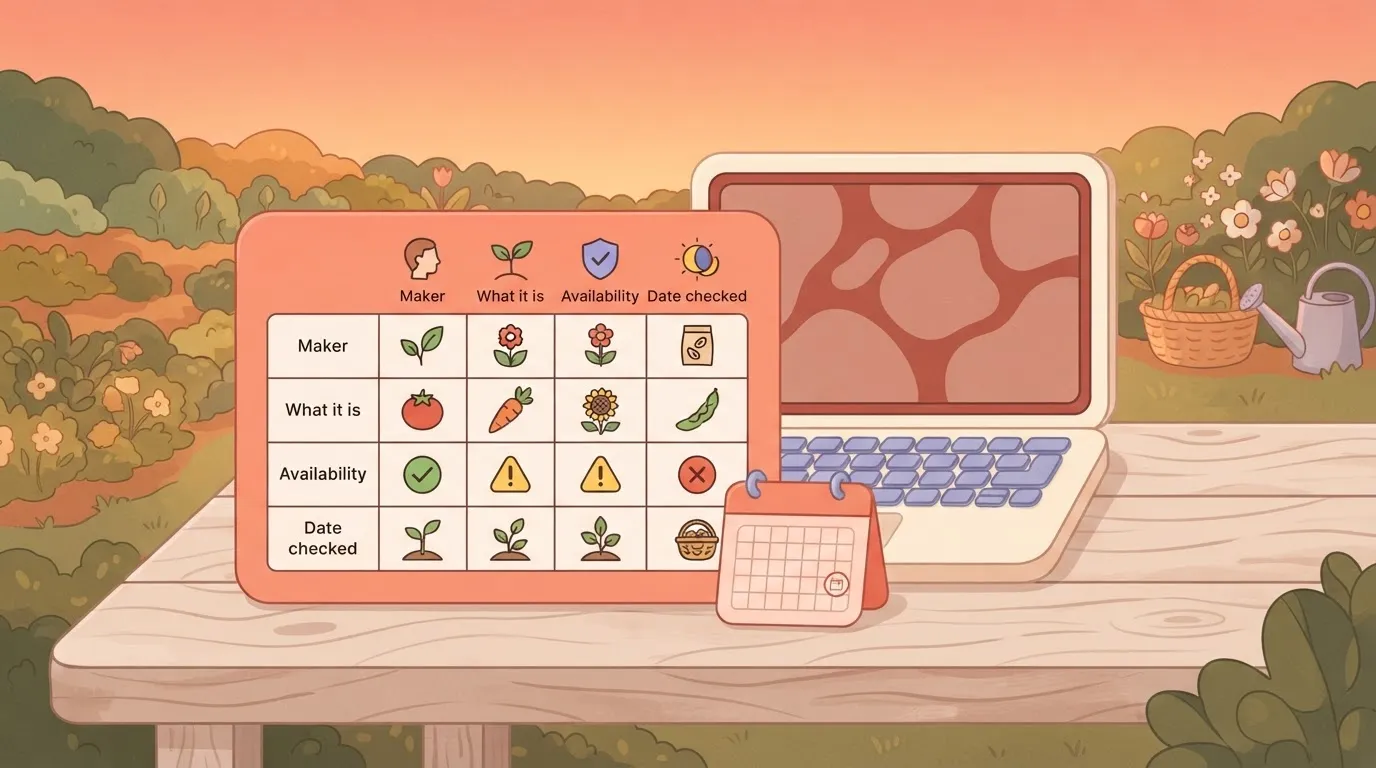
Prices and plan limits checked against openai.com and openai.com and github.com and openrouter.ai and docs.claude.com and claude.com and openai.com and gemini.google on October 26, 2026.
What Terra costs to run at volume, or how it performs on your tasks, is not in that table. Availability by plan tells you only who can try Terra today. Those are the questions the rest of this integration takes up.
If you are running this arithmetic for your own team, see what the same workload costs on Activepieces.
Why new models matter to automation
A new model matters because you can swap the model step in an automated workflow, and three measurements per task decide whether a swap is worth making.
The model step is a replaceable part of a workflow
In a workflow that chains apps together, the model reads an input and returns text or a decision, and the other steps pass data around it.
Changing the model changes one step, not the whole build. That makes each release a standing question, not an event: does the new part do this task better than the one already running?
For most teams, that question does not yet cost real money.
McKinsey, via Moring, reports that 39% of companies are experimenting with AI agents, 23% are scaling them somewhere, and only 10% are scaling them in a function, which means most companies never move past the experimental phase.
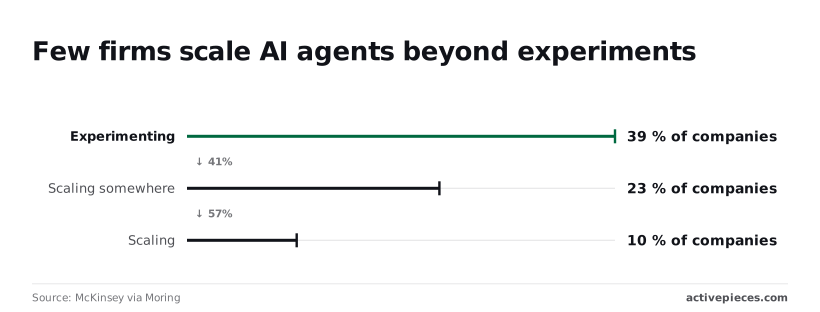
So for most readers a swap touches a pilot, which is cheap to reverse, while the 10% are repeating the same step across thousands of runs.
Check three things per task, and each one translates directly into a workflow:
- Listed price per task: multiply the price by the tokens one run uses, because that gives the monthly bill at your volume.
- Speed per run: time one full run, because a slow step delays everything after it.
- Match to a known answer: score outputs against cases you have already solved, because that shows whether quality holds.
If all three beat the current model on your own tasks, switch. If one fails, stay.
What OpenAI claims for GPT 6.1 Terra
Speed, image understanding, computer control and better prose: those are OpenAI's launch claims for Terra, and several come with numbers, as checked on 2026-10-26.
The launch page calls Terra "a fast, efficient model." It also claims detailed visual reasoning, precise computer use and clearer, more natural writing.
These are OpenAI's claims, not something we have verified. OpenAI cites measured gains, but each is still a hypothesis for your own test set.
On OpenAI's pricing page, Terra sits beside its three siblings, so you can see where it falls before deciding whether to test it.
| Model | Input per million tokens | Output per million tokens |
|---|---|---|
| Luna | not stated | not stated |
| Terra | $1 | $5 |
| Sol | $2 | $10 |
| Astra | $10 | $50 |
OpenAI says Terra's standard API prices are 50% lower than those of GPT-5.6 Terra and GPT-6.1 Sol. Those prices tell you which model Terra must beat on quality to justify the switch.
The pages publish Terra benchmarks and speed claims, such as 50.3% on Terminal-Bench 4.0 at maximum effort and tasks over three times faster than GPT-6 Astra and GPT-6.1 Sol, but no context limit. Terra is available to Plus, Pro, Enterprise and Edu users in ChatGPT Work and Codex.
What Activepieces has already shipped for GPT 6.1 Terra
Nothing below claims an Activepieces change for GPT 6.1 Terra, because we can't date or link one.
The dated change and its link
Our findings contain no pull request and no integration page naming GPT 6.1 Terra.
You might assume support, because the OpenAI integration, the building block that connects a flow to OpenAI, may let you enter a model name freely.
That would work, but we haven't confirmed it, and an unconfirmed assumption is a poor basis for switching a production workflow.
Until a dated change appears on the Activepieces repository or the integration's page, treat support as unverified.
Using GPT 6.1 Terra in a workflow today
Start with a copy of your current flow, tested beside the original.
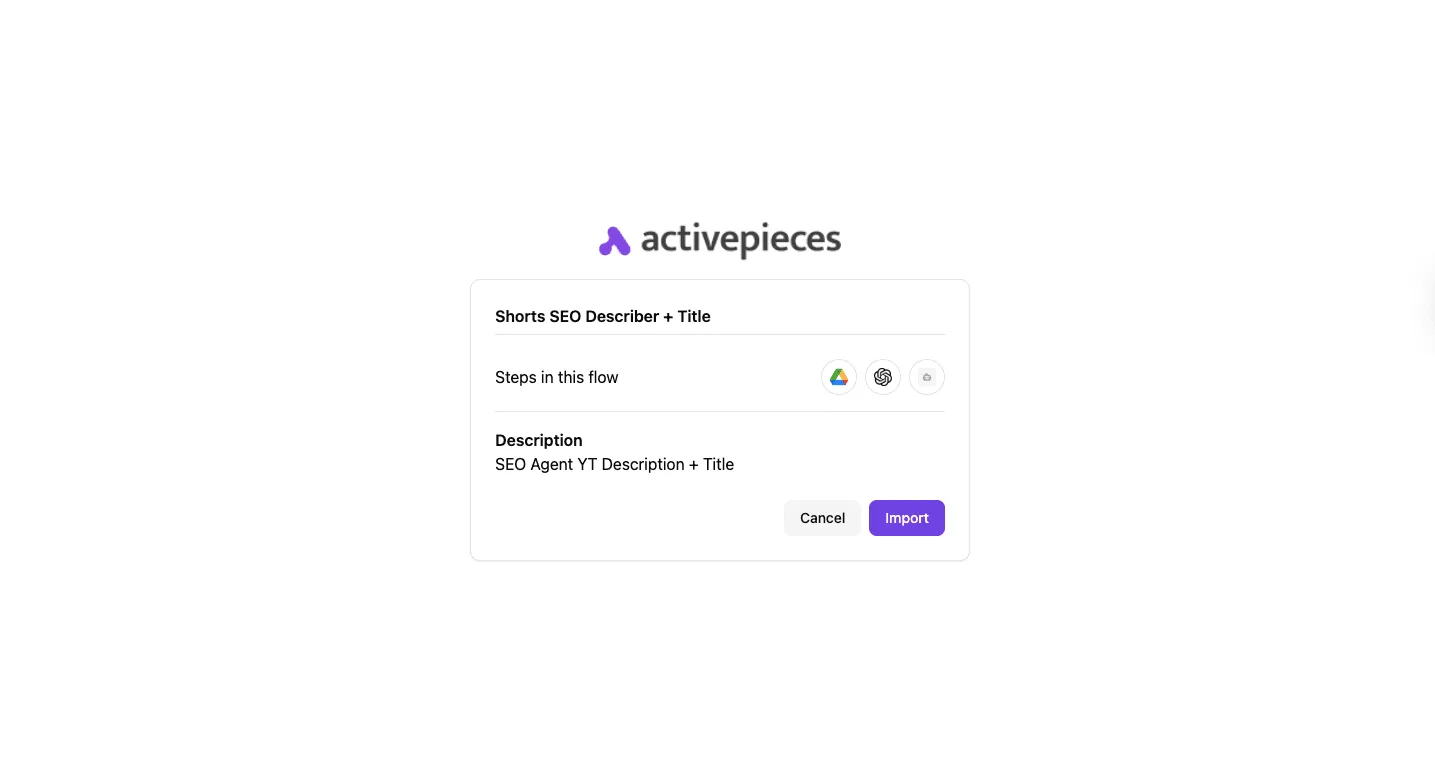
The import dialog below shows the shape of that: a template called "Shorts SEO Describer + Title" lists its steps, with Google and OpenAI among the three integrations, so you can see which step calls the model before you import it.

After importing, point the OpenAI step at your own provider key and see whether Terra is selectable there.
A platform that resells you a model has already chosen it and priced it, so the Terra-versus-gpt-5.4-mini question would be settled before you asked it; Activepieces runs the model you picked, so OpenAI bills Terra's $1 and $5 per million tokens to your account.
MoneyGram, Moneypenny, Alan and FundingSocieties run Activepieces, and you can reach it from Claude, ChatGPT, Cursor or any MCP client. Then run the same inputs through both versions and compare cost, speed and output.
Worth checking against a plan that does not meter every step: one credit covers a whole run on Activepieces.
Test GPT 6.1 Terra on automation tasks
That test is easy to run, and ours came out against the switch. On 2026-10-26, Terra was slower and costlier per task than gpt-5.4-mini, so any case for it has to rest on quality. This is a small, indicative test, not a benchmark.
**On 2026-10-26, Terra was slower and costlier per task than gpt-5.4-mini, so any case for it has to rest on quality.
How we scored GPT 6.1 Terra tasks
We ran Terra and openai/gpt-5.4-mini through OpenRouter on the same three jobs, so the results are directly comparable. Terra used default settings, which reason before answering.
The jobs were to sort a support ticket, pull fields from an invoice, and summarise an email thread. That makes their results directly comparable. We checked each output against a known answer.
With so few tasks, treat the gaps as a prompt to test your own workload, not as a verdict.
Results, speed and cost per task
Terra's median time was 1 second for ticket sorting, 1.2 seconds for invoice fields and 2 seconds for the email summary, which means email summary processing takes twice as long as ticket sorting.

A step that must read and condense a long thread is therefore the one where Terra's reasoning delay is most visible.
Across the three tasks, Terra's median was 1.2 seconds against 0.8 for gpt-5.4-mini, and its cost per task was $0.000256 against $0.000141.
Per task, that is about 1.8 times the cost, or $2.56 against $1.41 for every 10,000 runs.
That gap is small in absolute terms, so it only matters at high volume or where a workflow waits on each step. If your outputs are equally correct on both models, the cheaper one wins.
Compare GPT 6.1 Terra cost and speed
Cheaper is decided per finished task, not per million tokens. GPT 6.1 Terra and GPT-5.4 mini have to be compared on what each one costs to complete the same work, as checked on 2026-10-26.
Four measures apply to each model:
- Listed price per million tokens comes from the vendor rate card, with input and output separate.
- Measured cost per task is the listed price times the tokens actually used.
- Measured median speed is the middle run, not the fastest.
- Result quality on 3 tasks is the number of correct outputs out of each task's runs.
Fill the figures from your own runs, because a rate card can't settle this.
From the cheapest thing to read to the most expensive thing to learn: that is the order the measures run in. Quality comes last because it decides whether the other three matter.
If the model needs longer prompts, more retries or longer answers to reach the same result, a lower listed price loses its advantage. Compare total spend per completed task, retries included.
Where a person or a downstream step waits on the answer, median speed matters most. In overnight batch jobs, a slower model costs you little if its cost per task is lower and its outputs are as correct.
What to watch and do this week
A slower model is acceptable only while its cost per task and correctness hold. The things to watch are the ones that move those two measures, and this week's job is to measure them on your own work.
Pages to recheck and what changes would matter
Recheck OpenAI's pricing page and the model documentation for GPT 6.1 Terra before you commit. A change in per-token rates alters your cost per task directly, so a rerun of your numbers is warranted.
When a batch job now queues or truncates inputs, it costs more in retries than the list price suggests, which is why rate limits or context limits matter just as much.
Also watch for any note on model versions: if the model behind the name is updated, your earlier test results describe a model you are no longer running.
Run the steps below and you get a cost and failure record for each task on each model, which is the evidence the switch decision needs.
- List your five highest-volume tasks.
- Run each task on your current model and on GPT 6.1 Terra with identical inputs.
- Record cost per task and every failure, meaning wrong, malformed or incomplete output.
- Compare the two records task by task, so differences surface clearly.
- Switch only the tasks where Terra costs less and fails no more often.

Those results, not the launch coverage, tell you whether to move, and they leave you with a record to rerun when the pages above change.
Frequently asked questions
Four questions are left after the test record, and where OpenAI has published nothing, the answer says so.
Access and whether to switch
Is GPT 6.1 Terra available to everyone? OpenAI states Terra is available to all Plus, Pro, Enterprise and Edu users in ChatGPT Work and Codex, and through the API as gpt-6.1-terra.
Should I replace GPT-5.4 mini in my workflows with GPT-6 Luna now? No, not until your own tasks show a gain. Keep GPT-5.4 mini running and send the same sample of real inputs to both models.
Switch only if Terra's checked price, speed and output quality together beat what you have now. A better result on one measure doesn't justify a move if it costs more on another.
Cost and no-code use
Does GPT 6.1 Terra change what my existing workflows cost? Not by itself, because your bill changes only when you change the model. OpenAI's standard API pricing for Terra is $1 per million input tokens and $5 per million output tokens.
Multiply that price by your actual volume rather than relying on a headline rate.
Can I use GPT 6.1 Terra without writing code? OpenAI offers Terra in ChatGPT Work and Codex for paid plans, and through the API as gpt-6.1-terra.
Check whether your automation platform lists Terra as a selectable model. If it does, swapping it into one step and rerunning your test sample needs no code.
Related reading
Running the numbers
See what the same workload costs here.
Free forever plan, and every paid plan self-hosts at no extra cost.
See pricing Talk to sales