
Lovable Cloud Pricing in 2026 and What a Build Costs

Nov 4, 202616 min read
You must choose your tier before you know your entry cost.
Lovable's pricing, per BuildStackTools, is a monthly credit allowance, and the Pro price depends on how large an allowance you pick, from $25 upward, meaning Pro is accessible for small teams, including those who also wire up their back-office automations with tools like Activepieces.
Lovable Cloud pricing is a credit-based model in which a builder pays a monthly plan fee for a set allowance of credits, with Cloud hosting and AI usage metered separately, so the actual monthly cost depends on workload rather than the plan's listed price.
Lovable meters Cloud and AI usage on top of that. Your bill's credits plus usage, not the plan name.
Don't budget from any cell marked "Unverified": those were not confirmed on the pricing page or docs. The table, checked 4 November 2026, lists each plan against the limits that decide cost.
| Plan | Monthly price | Annual price | Credits | Daily limit | Included Cloud and AI usage | Seats | Upgrade trigger |
|---|---|---|---|---|---|---|---|
| Free | Unverified | Unverified | Unverified | Unverified | Unverified | Unverified | Unverified |
| Pro | From $25 (100 credits) | Unverified | 100 to 10,000 by tier | Unverified | Unverified | Unverified | Credits run out, or you need team features |
| Business | Unverified | Unverified | Unverified | Unverified | Unverified | Unverified | Unverified |
| Enterprise | Unverified | Unverified | Unverified | Unverified | Unverified | Unverified | Unverified |
Only Pro has a confirmed price, so the rest of this section works from Pro.
What Lovable Cloud is and what Lovable meters separately
Lovable Cloud's the built-in backend: the database, sign-in and server-side logic your generated app runs on. Credits pay for the building, meaning each prompt that changes your app.
Running the finished app consumes Cloud and AI usage, which draws from the same credit balance.
A cheap build month can therefore still produce a large bill once real users arrive.
If part of your backend's really workflow automation, Activepieces meters the run, not the steps inside it: 1 credit per flow run, so a ten-step flow costs what its two-step workaround did.
Zapier's per-task and Make's per-module billing, both on their pricing pages, charge more as you split work into smaller steps.
Lovable Cloud pricing tiers and credit limits
On Pro, the trigger is the credit count. According to BuildStackTools, 100 credits cost $25 a month and 200 cost $50, so you pay $0.25 per credit at the bottom.
At 400 credits the price is $100, and at 800 it's $200, according to BuildStackTools. That's still $0.25 each, which means the pricing's perfectly linear through this range. Scaling in that range buys volume, not a discount.
The discount starts later. Lovable docs indicate that 1,200 credits cost $294, or about $0.245 per credit, so a discount has appeared for customers crossing into this volume.
5,000 credits cost $1,125, about $0.225 each, and the per-unit rate continues its downward drift.
Moving from 800 to 5,000 credits cuts the unit price by roughly 10%, while the monthly bill rises more than fivefold, meaning the increase in total spend swamps the small savings per credit.

What one named builder actually pays each month
Take Tolu, a solo founder building a customer portal with sign-in, a database and an AI feature. She pays the plan fee plus whatever her credits, Cloud usage and AI usage add that month.
Read the table by row: only the first row's fixed, and the other four move with what she does. It shows how each line is built, using her three kinds of month.
| Line | Light month | Typical month | Heavy month |
|---|---|---|---|
| Plan fee | one flat fee | same flat fee | same flat fee |
| Credits used | few prompts, inside the allowance | most of the allowance | allowance exhausted |
| Cloud usage | small database, few users: near the included amount | modest metered overage: units used × Cloud rate | traffic and storage growth: units used × Cloud rate |
| AI usage | a handful of test calls: calls × per-call rate | real users trying the feature: calls × per-call rate | launch traffic: calls × per-call rate |
| Top-ups | none | none or one | credits bought beyond the allowance: packs × pack price |
| Total | plan fee alone | plan fee + metered extras | plan fee + every meter + top-ups |
Across the three columns the fee never moves. The gap between the cheapest and costliest month comes entirely from the rows below it. Budget those rows from her workload, not from the plan name.

In a light month, Tolu sketches screens and wires up sign-in. Credits are spent per prompt, and few prompts leave the allowance mostly untouched.
Her database's nearly empty and the AI feature runs only on her own test calls. The bill's roughly the plan fee, which is the one month where the sticker price's a fair guide.
Typical month: building and iterating
Now she iterates: fixing layouts, adjusting database tables, and refining the AI feature's behavior. Each correction consumes credits, so the allowance drains faster than her first month suggested.
When early users arrive, Cloud and AI usage are each billed on their own meter. The total's the plan fee plus two small metered lines, and neither appears on the pricing page headline.
Lovable Cloud cost in a heavy launch month
By launch week the allowance has run out. Debugging prompts are expensive because a vague bug report can trigger several attempts before one works.
She buys a top-up to finish, while real traffic pushes Cloud and AI usage up together. Three meters now stack on the fee, and the total reflects workload, not tier.
That makes her bill a range, not a number. Tracking credits per week during the typical month gives her the best forecast of the heavy one.
If you are running this arithmetic for your own team, see what the same workload costs on Activepieces.
Charges beyond your Lovable Cloud price
You only see five of these charges by running a real month of work, because they sit outside the sticker price. The list below's what Lovable's docs say you can hit, so each one's a line to budget for.
- A debugging loop spends credits on every retry and fix, so one stubborn bug costs more than the feature it interrupted.
- Usage beyond the 20 Cloud and 4 AI grants is billed on top of the plan, so a busy app can outrun the included balance.

- Credits expire, so unused balance's money you have already spent.
- External services your app calls aren't included and bill separately.
A failed attempt and its fix each consume the same unit as a clean build, because credits are metered per message, not per working feature.
If the first week of a project looks like a debugging loop, forecast the month from that week, not from your best day.
Metered Cloud and AI usage
Once the 20 Cloud and 4 AI grants are spent, you pay for what remains. Cloud and AI usage draw on their own balances, separate from message credits. An app with real users will hit that point before one that only you test.
If you fall back on top-ups, their validity differs by credit type: top-up credits last 12 months, monthly-plan credits 2 months, and annual-plan credits 1 month.

So top-ups are the only credits you can buy ahead without a fast clock, while annual-plan credits are the ones to spend first.
Lovable seats, domains and third-party service costs
Price teammates and custom domains per person and per site before you commit, because both are line items beyond the plan price.
Because services such as a payment processor or an email sender bill on their own meters, Lovable's allowance doesn't touch them. Add their per-run charges to your estimate, because those meters keep running whatever your credit balance says.

Lovable's affordability case
Ignore what it replaces and the bill looks high, the believers say. Their argument is that the credit meter's a fair price for output that would otherwise cost a freelancer thousands. Here's that case at its strongest, then tested against the worked bills.
Lovable versus hiring a freelancer on cost
The claim has three parts. First, a working MVP from a freelancer typically runs $5,000 to $40,000, so even a heavy month of credits is a rounding error against it.
Second, hosting and backend come bundled into the same credit balance, so there's no separate invoice from an infrastructure vendor.
Third, credits are a budget: when the allowance runs out, you can top up or stop building.
Buyers agree, the believers say, and demand is their evidence. According to TechCrunch, Lovable's annualised revenue was $100m in July 2025, $400m in February 2026, $500m in June 2026 and $600m in September 2026.

That's six times growth in about 14 months, which means a great many people are paying and renewing.
None of that tells you what any one of them pays beyond the plan price, because revenue counts everything billed, including usage on top of plans.
Where Lovable's affordability claims hold up
Each claim survives only up to a point, and each has a figure that would break it:
| Claim | What the worked bills show | Number that would disprove it |
|---|---|---|
| Replaces a $5,000–$40,000 freelancer MVP | Holds for a first prototype, where the monthly bill stays far below the freelancer's fee | Once you iterate for months, cumulative spend approaching the low end of $5,000 means you're paying freelancer rates for a product you must still maintain |
| No separate backend invoice | Partly true: hosting's included, but Cloud and AI usage are metered apart from credits | Any month where the Cloud and AI line exceeds the plan price |
| Credits cap spend | True for credits only; per-run charges keep running whatever your balance says | Any invoice larger than plan price plus the credit top-ups you chose to buy |
Once you iterate for months, cumulative spend approaching the low end of $5,000 means you're paying freelancer rates for a product you must still maintain
Read the table as a division of labour. The freelancer comparison is strongest at the prototype stage and weakest during long iteration. The backend claim fails the moment usage is metered separately, and the cap claim covers one meter out of several.
To test your own workload, log credits burned, Cloud usage and AI runs for one month. Then compare the total, not the plan price, to the three thresholds above.
Worth checking against a plan that does not meter every step: one credit covers a whole run on Activepieces.
Why Lovable credits cloud budgeting
After a month of logging you'll have a range, not a point, because a credit isn't a fixed unit of work.
A small copy change and a feature that touches several files can draw very different amounts, and Cloud and AI usage then bill on their own meters on top.
Because two variables move at once, the plan price only fixes the floor.
Lovable vs Bolt vs Replit vs v0
Read the usage-unit and limit columns first: they tell you which meter you're really buying, and whether a bad month stops your work or bills you. The table below sets Lovable beside three rivals on the four things that decide a bill.
| Tool | Entry paid price | Usage unit | Built-in backend | At the limit |
|---|---|---|---|---|
| Lovable | Monthly subscription | Credits per message, plus separately metered Cloud and AI usage | Lovable Cloud | Buy more credits or move up a tier; Cloud and AI usage keeps metering |
| Bolt | Monthly subscription | Tokens | Built-in database option | Buy more tokens or upgrade |
| Replit | Monthly subscription | Usage credits tied to agent work | Hosting and database inside the workspace | Usage beyond the allowance's billed on top |
| v0 | Monthly subscription | Credits, with token-based consumption underneath | None of its own; connects to external services | Buy more credits or upgrade |
I'm not quoting entry amounts because each vendor revises its tiers often; take the current figure from the vendor's own pricing page on the day you buy.
For Lovable and Replit, which alone bundle a backend in the same account as the builder, the second meter exists from the first day.
With v0 the backend bill arrives from whichever service you connect, which is a third invoice rather than a third meter on the same one.
What happens when Lovable credits run out
At the limit, every tool here asks you to pay more, but the unit differs. Buying a top-up of credits or tokens is a known purchase you decide on. Usage billed beyond an allowance is a charge you discover afterwards.
That's why Lovable's two-part structure matters most for a project with live users. Credits stop when you stop prompting; Cloud and AI usage keeps running as long as people use the app.
Budget the first from your build pace and the second from your traffic, and add them as separate lines.
Where Activepieces fits next to a Lovable app
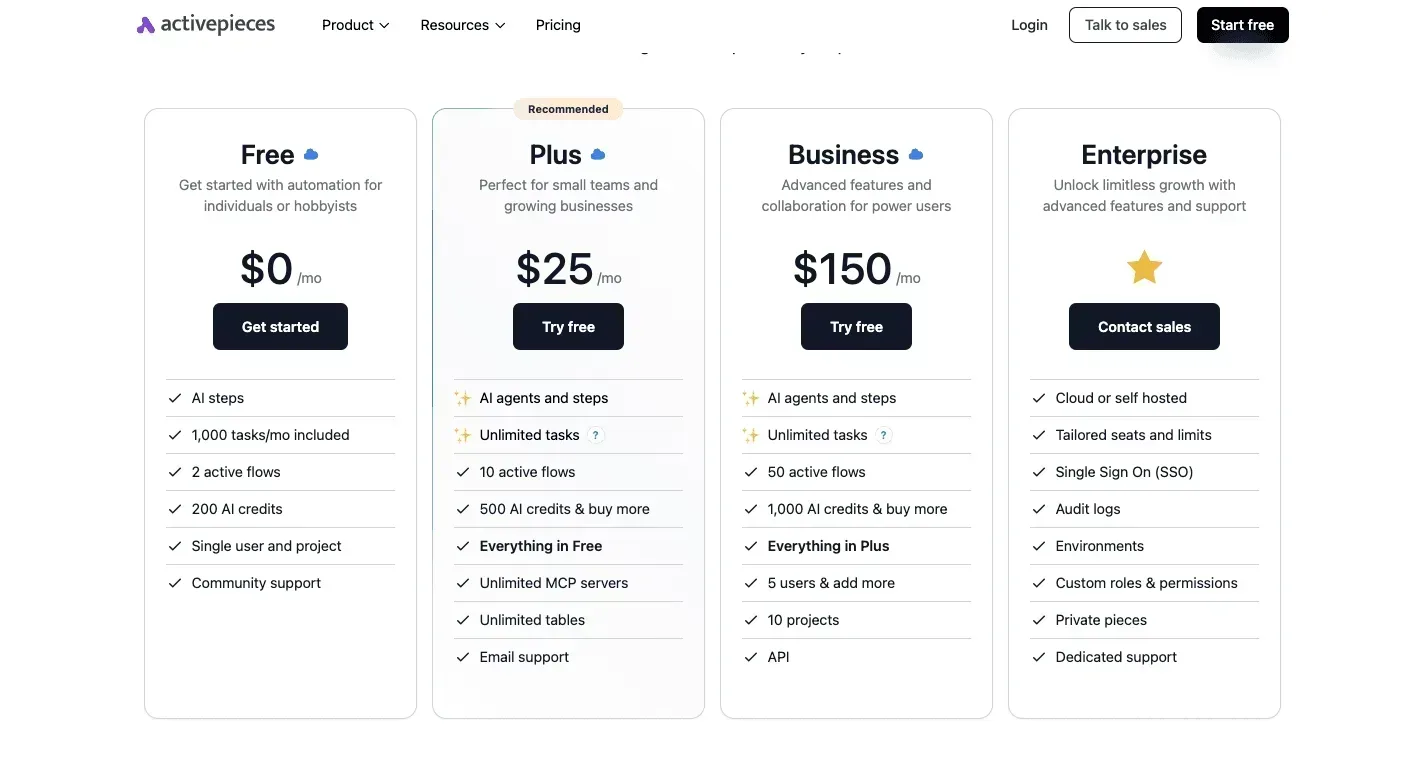
Instead of drawing on your Lovable credits or Cloud usage, recurring backend jobs such as a Slack alert, a CRM sync or a scheduled AI step can run as Activepieces workflows, and the free plan includes 1,000 credits a month with unlimited flows.
That keeps the app's meter for what only the app does, and it gives those jobs a separate line in your budget.
Jobs worth moving out of the app
The test is simple: does the job run on a timer or an event, without a user in the page? If so, it's a candidate.
Every time you ask Lovable to build or revise that logic, you spend credits, and every time it runs inside the app's backend, it can add to the metered Cloud and AI usage.
A job that fires all day, whether or not anyone opens the app, is exactly the kind of load that makes the second line grow without a visible cause.
Below is one such job in Activepieces.
A Stripe "Payment Failed" trigger feeds a Slack "Send Message To A Channel" action, and the run details on the left show the step completed and the run succeeded, at 1 credit for the run however many steps it has.
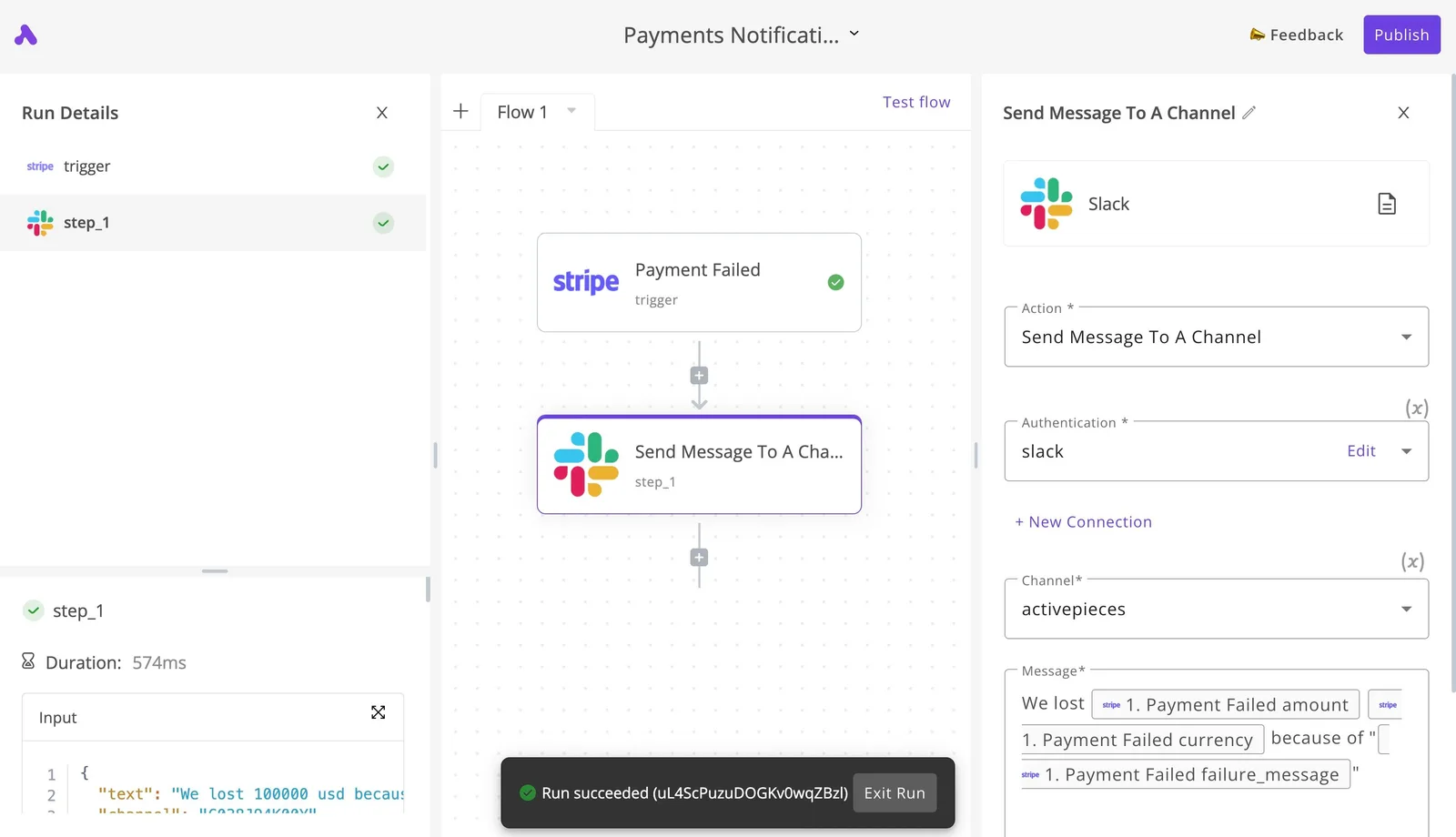
Two steps, no app code, and nothing to regenerate when the message wording changes, so your team updates messaging without engineering delays. Take from it that this kind of glue's configured on a canvas, not prompted into your app.
Anything a user touches directly belongs in the app: screens, sign-in, and logic that must answer a request in the moment. Moving those out only adds a hop.
What does the same job cost elsewhere?
To compare cost, set the unit Activepieces meters, 1 credit per run, against your job count rather than against a Lovable plan.
The free plan gives 1,000 credits a month, and Plus is $20 a month for 10,000 credits, as listed at activepieces.com/pricing, which means anyone needing more than 1,000 monthly credits must pay $20 to upgrade.

The right comparison is your own runs per month against those allowances, and past the allowance Plus charges $0.007 a credit, so going over your limit costs $0.007 per overage credit.
This doesn't apply to everything. If a job needs your app's database and auth in the same request, moving it adds a network call and a second system to maintain.
If a workflow runs a model step, the model provider's usage still gets billed somewhere; with your own AI keys on Plus and up, that step is 1 credit and the inference cost lands on your own provider bill.
And a handful of rarely-run jobs may not justify a second tool at all. Count the jobs that fire often and need no user, move those, and leave the rest.
Frequently asked questions
Is Lovable Cloud free to start?
Treat any free starting allowance as a trial, not a budget, because Cloud usage's metered separately from your plan. Read the current allowance on Lovable's pricing page, then watch what your first real project consumes.
Database, storage and AI calls each draw down their own meter, and a small prototype tells you little about an app with real users.
Do unused Lovable credits roll over? Don't assume they do. Check the plan terms on the day you subscribe, because rollover rules are the kind of detail vendors change.
Budget as if each period's allowance expires, and treat any carryover as a bonus. If you build in bursts, a quiet month can cost the same as a busy one.
Can I pay only for usage without a plan?
Usage charges alone don't replace the plan if you need the build credits, because the credit allowance sits inside the plan while Cloud and AI usage's metered on top of it.
Confirm in your billing settings whether a plan-free, pay-as-you-go path exists for your account. If it doesn't, the plan's a fixed floor under whatever usage adds.
Is Lovable cheaper than hiring a freelancer?
For a first working prototype, often yes. For a production app that keeps changing, the answer depends on how many credits your revisions burn and how much metered usage the live app generates.
Price both routes on the same scope: the features you need, the number of revision rounds you expect, and the monthly running cost once users arrive. A freelancer quote is a one-time number, but the Lovable bill recurs.
What should I check before upgrading on Monday? Check what pushed you toward the upgrade before you pay for it. Work through these in order:
- Open your usage view and see whether you ran out of credits or hit a Cloud or AI meter.
- List what you plan to build over the next billing period and estimate how many revisions each integration will need.
- Separate the build work from what the live app will do once it has users, since those draw on different meters.
- Read the plan page for rollover, overage and limit behavior.
- Set a spending alert, if one's available, before you start building.
If step one shows a usage meter and not credits, a higher plan may not fix the problem.
Related reading
References
Running the numbers
See what the same workload costs here.
Free forever plan, and every paid plan self-hosts at no extra cost.
See pricing Talk to sales