Ripple 65B Preview MCP: What It Is (2026 Guide)

Nov 16, 202612 min read
As of 16 November 2026, I couldn't confirm Ripple 65B Preview MCP on any vendor page, so I can't give you a vendor-sourced definition. What follows separates what the name implies from what the vendor has actually documented, which is nothing I could verify.
If the "MCP" in the name refers to the Model Context Protocol, as it usually does, it would point to a server that lets AI models call outside tools, the same general category that automation platforms such as Activepieces also operate in, but that is an inference from the label and not a documented fact.
"65B" conventionally denotes about 65 billion parameters, but no vendor page states it for this product. "Preview" means a pre-release offering, so terms, limits and behaviour may change without notice. "MCP" is the Model Context Protocol, a standard for letting a model call external tools.
Read each label as a liability line: size claims need a source, preview status removes stability guarantees, and tool access extends reach.
Ripple 65B Preview MCP name and documentation
What tool access exposes
In an MCP setup, the model asks a tool server to act, and that server holds the credentials. The risk sits in what the server can touch.
Open the connector catalogue Activepieces publishes and the breadth is plain: 750 integrations, including Webhook, Google Sheets, Gmail and HTTP, filterable by category.
Each card is a system you could point a tool-enabled model at, so every one you enable widens who can see what. Treat each connection as a separate approval, not a default.
I found no vendor page describing intended use cases, supported deployments or production guidance for this product. Absent that, assume nothing about approved use.
Until the vendor documents it, keep any pilot to low-risk, reversible tasks, and record the date and page you checked so a later change in terms is visible.
This takes minutes, not a project: automate it in Activepieces free.
Published cost, limits and requirements for the preview
When you go looking for a price, rate limit or preview term, there is nothing from the vendor that we could confirm. The only hard numbers are memory sizes, and they decide what hardware a pilot needs.

You can't set a budget line against this preview, because the vendor publishes no price. Until the vendor states one, assume the terms can change and treat any spend as unrecoverable.
Ripple 65B Preview hosting and hardware requirements
At 57.21 GB, the quantized NVFP4 file is the one that fits, according to Oflight. Loaded in vLLM, an open-source inference server, it needs 69 GB.

That fits one 80GB GPU with 11 GB spare, so a single card can host a pilot.
Full precision is a different bill. The BF16 file is 129.57 GB and needs 156 GB in vLLM.
It doesn't fit one 80GB card, so full precision means a multi-GPU machine and a larger bill. An FP8 size isn't published, so nobody can plan around that middle option.
Nothing in the table below is a guarantee: it sets out each figure, its source and the date of the check, and records only what the vendor documents.
| Item | Published value | Source page | Date checked |
|---|---|---|---|
| BF16 size | 129.57 GB file; 156 GB in vLLM | Oflight requirements column | 16 Nov 2026 |
| NVFP4 size | 57.21 GB file; 69 GB in vLLM | Oflight requirements column | 16 Nov 2026 |
| FP8 size | Not published | Oflight requirements column | 16 Nov 2026 |
| Rate limits | Not published | Vendor docs and changelog | 16 Nov 2026 |
| Preview terms | Not published | Vendor docs and changelog | 16 Nov 2026 |
You can't size a workload against rate limits or preview terms, because the vendor publishes neither. A change in either could stall a pilot without warning, so keep every task one you can pause or repeat.
The strongest case for adopting the preview now
Try it now, the argument goes, because a preview is cheap to try and, on two coding benchmarks, matches a rival.
Ripple-65B Preview scores 80.52 on Terminal-Bench 2.1 against 80.1 for Reflection Beam 501B, and 44.3 on DeepSWE v1.1 against 44.4, so each model leads on one test by a narrow margin.
Because the gap is that small, a team has no reason to pay more for the rival on capability alone. The pilot's integration cost may also be lower.
MCP tool access means connecting the model to existing systems through one standard protocol rather than custom code for each, and that could shorten a trial.
On price, the case strengthens. At $0.10 per 1M input tokens, according to ModelPriceLab, Ripple-65B undercuts DeepSeek V4 Pro at $0.66 and Gemini 3.8 Flash at $0.75, so cost-conscious teams will favor it.


Against that, Claude Sonnet 5.5 costs $2, twenty times as much, which means organizations must demonstrate clear performance benefits to justify adoption. For a low-risk pilot, that makes an experiment inexpensive to run and inexpensive to abandon.
Where the Ripple 65B Preview price argument fails
Two figures undercut the thesis, though. GLM-5.3-Flash lists at $0.079, so a cheaper coding model already exists. GPT OSS 120B lists at $0.01, one-tenth of Ripple's price, making deployment costs negligible in comparison.
A saving that any of several rivals matches is not a reason to accept preview terms that can change without notice.
Read the benchmark parity and the price together: a buyer gets a competitive model at a low rate, but not a unique one. Early access is a reason to test, not a reason to depend on it.

You can follow the rest of this with the builder open. Start free, no card.
The case for pilot testing previews
When a vendor withdraws a preview, the notice is the shortest of any model class, and that's the strongest operational reason to keep it out of production.
Early access is a reason to test, not a reason to depend on it.
SunsetDiff puts the minimum notice at 14 days for an OpenAI preview and 14 days for a Gemini preview, against 60 days for a publicly released Anthropic model, so teams get four times the runway to adapt systems using Anthropic's public releases.

A fortnight is one sprint. If a workflow depends on a preview, you may have to find, test and approve a replacement before the next sprint review.
Vendors write preview terms to be revisable, so the notice period is the one commitment you should not assume.
(chart)
Three failure patterns follow from that gap.
Mistake: broad tool permissions
If you grant an MCP-connected model wide access because the pilot is "only a test," every connected system becomes exposure.
A preview can change its behaviour without notice, so the permissions you approved on day one may not match what the model does on day thirty.
Grant read-only access to one dataset, and add a write permission only when you have a reason you can record.
With a 14-day figure, a preview can be gone before a quarterly change window opens. Treat anything built on it as disposable: no customer-facing dependency, no process that can't be done by hand, and no output you can't undo.
Mistake: no fallback model
You survive a 14-day notice period only if a tested alternative already exists.
Even the 60-day window for released models is short for a team that's never run its prompts on a second model.
Keep one named fallback, and rerun your test set against it each month. If that's too much work, the pilot is already larger than it should be.
Before the pilot starts, decide which tasks are low-risk and reversible enough to qualify.
Connecting MCP tools to business apps with Activepieces
Between a model and your business apps, Activepieces can put a workflow, built and tested by someone on your team, in front of every tool call, and a run counts as 1 credit however many steps those checks take.
It's a place to enforce which tasks qualify for the pilot, provided its own documentation confirms the control you need.
Treat each connection it makes as a new liability line until you've confirmed what that connection can do.
The useful property is containment. A model with direct tool access acts on whatever the tool allows. A workflow limits the model to the steps someone built and tested.
Activepieces exposes workflows to MCP clients through a per-project MCP server, and the integration action that runs as a step in a flow is the same one offered to the model as an MCP tool.

That mechanism is laid out in the Integrations Framework and MCP Server documentation and implemented in packages/pieces of the MIT-licensed open source repo, which holds the 750 integrations, roughly 60% of them community-contributed, meaning the integration library is primarily externally developed.
Read the current MCP and approval pages on the vendor's site, and record the date you read them. Preview terms can change, and so can the product around them.
A bounded Ripple 65B Preview test workflow
In the screenshot below, a test flow stays inside that boundary. It has a schedule trigger selected, and the integration selector shows spreadsheet apps (Google Sheets, Microsoft Excel 365, AITable and Retable).
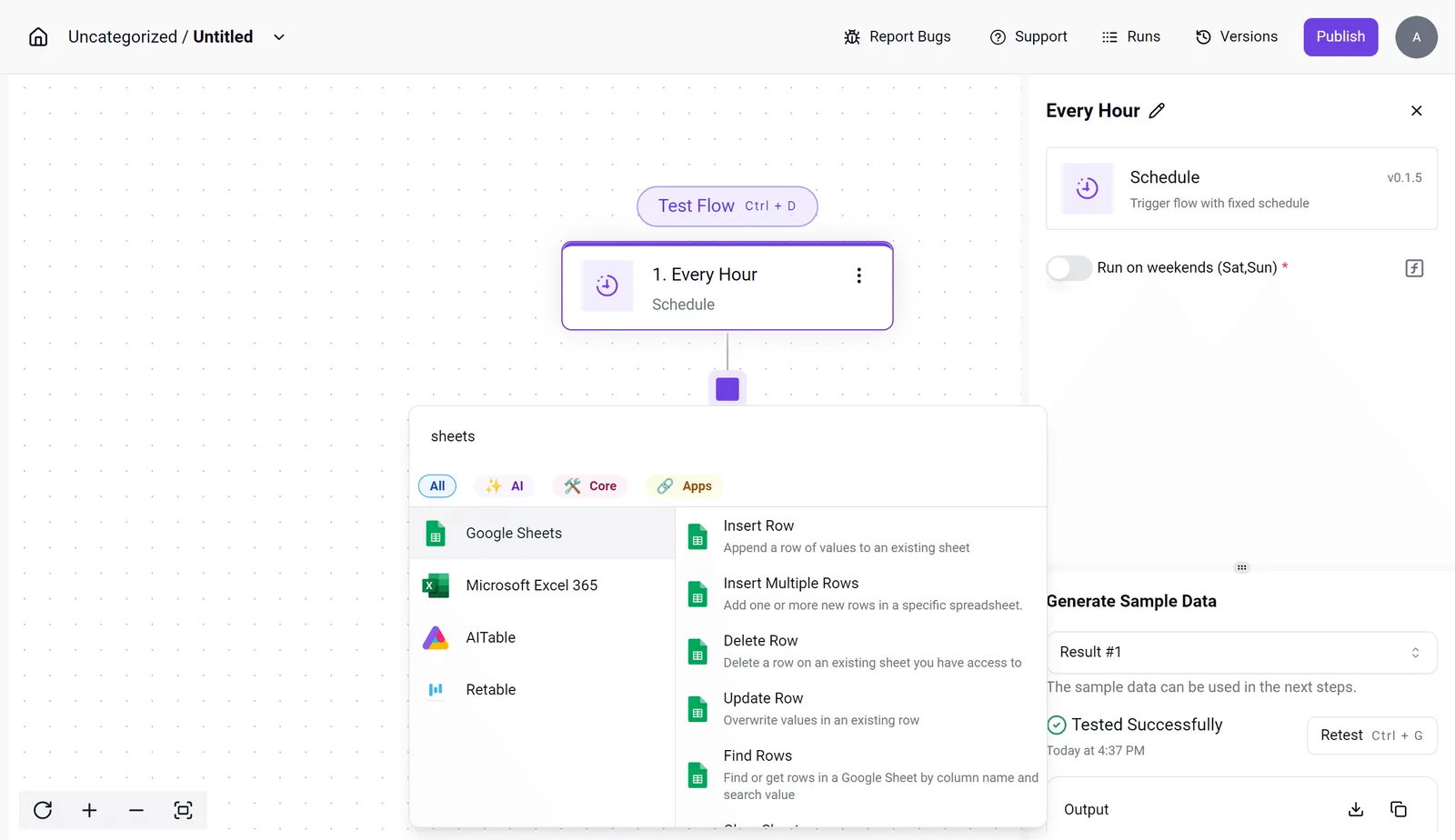
Among the actions offered are Insert Row, Update Row, Find Rows and Delete Row. The settings panel shows a successful sample-data test.
Choose the action per step. A pilot that only needs Find Rows should not get Delete Row, because a delete is the one action in that list you can't undo.
After that, check three things in the vendor's documentation. The three are whether a flow can become an MCP tool and under what conditions, whether an approval step can sit before any write, and whether the vendor keeps run history and who can read it.
If the vendor doesn't confirm any of the three, do not connect that flow to the pilot.
The Monday plan for testing Ripple 65B Preview
Begin with the paperwork, not the connection: the pilot is six steps, each one narrowing what the model can reach, so skip none of them to save time.
- Read the preview terms on the vendor's own page and record what they say about limits, data retention and changes without notice.
- Pick one read-only task, such as summarising documents, that nobody would miss if it stopped.
- Set read-only MCP permissions, so the model can look but not write, send or delete.
- Define a pass/fail measure before the first run, so results can't be argued afterwards.
- Set a review date and a rollback model, meaning the system you return to if the preview changes.
- Decide in advance what result ends the pilot, whether failure, success or a change in terms.
Read the list as the order of exposure: reading comes before access, access before measurement. Do not reorder it, because each step is the control for the next. The paragraphs below define the terms behind steps one and three.
"65B" is a parameter count, the size of the model, and says nothing about whether it suits your task. "Preview" means the vendor reserves the right to alter terms, limits and behaviour. MCP is the protocol through which a model calls external tools.
Directly, the model touches nothing of yours. It asks an MCP server, and that server holds the credentials. Permissions therefore belong on the server, where you control them, not in a prompt asking the model to behave.
Record only the uses the vendor's pages name, with the page address and the date you read it. A use the vendor doesn't name stays outside the pilot until it's confirmed.
Frequently asked questions
Is Ripple 65B Preview free to use?
Treat it as not free until the vendor's pricing or preview-terms page says so in writing. Even then, free access during a preview is a promotional condition, not a commitment. The vendor can start charging or add limits on its own schedule.
Budget the pilot as though charges could begin without notice. Any tools the model reaches through MCP carry their own costs and terms, so check those separately.
Can I run Ripple 65B on my own hardware?
Only if the vendor's model page states that weights are available for download and licenses that use. Otherwise, assume a preview runs on the vendor's infrastructure.
In that case everything you send, including the contents of tool calls, leaves your perimeter and is visible to the vendor under its terms. That's a reason to keep pilot data low-sensitivity, not a reason to look for a workaround.
Which MCP clients work with Ripple 65B Preview?
Use only the clients the vendor's documentation names. A client that connects isn't the same as a client that's supported. Third-party reports of compatibility are leads to verify, not confirmation.
Until a client appears on the vendor's own pages, it stays outside the pilot, as with any use the vendor doesn't name, and you should recheck that list on the day the pilot starts.
When does the preview end or become generally available?
No date is confirmed here. Read the preview terms for whether the vendor may change the schedule, alter limits or withdraw access without notice, because a preview typically offers no assurance on any of these.
Plan the exit before the pilot starts. Keep the tasks reversible, keep outputs stored outside the model's environment, and name a fallback so that withdrawal costs a week of convenience rather than a broken process.
Related reading
References
Build it
Set this up in minutes.
No code required. Connect your accounts, and Activepieces runs it from there.
Start free Talk to sales