What Private AI Agents Are and Why They Matter in 2026
Oct 13, 202615 min read
When model execution, data storage, and application logic reside entirely within a controlled environment, such as when you orchestrate local workflows using Activepieces, you have a private AI agent. This architecture prevents data leakage and ensures regulatory compliance.
A private AI agent is a self-hosted autonomous system where the large language model, its training data, and the execution engine remain entirely within an organization's sovereign infrastructure to ensure absolute data privacy.
Because sensitive inputs never traverse public internet gateways, third-party providers are prevented from ingesting or intercepting data.
Private AI agents defined by infrastructure and data sovereignty
The three layers of local execution
Establishing true data sovereignty requires a vertical integration of the stack to ensure that no single component relies on an external handshake. This structural isolation is visualized as three concentric circles where security hardens as you move toward the center.

The outermost ring consists of the Virtual Private Cloud or air-gapped hardware that isolates the entire operation from the public web. This ensures that no unauthorized outbound packets can leak metadata.
Inside the middle ring, you will find the local inference engine and vector database. This layer ensures that open-weight models like Mistral Large 4 or DeepSeek-V4-Pro-0813 run on internal GPUs so that proprietary queries remain on-premises.
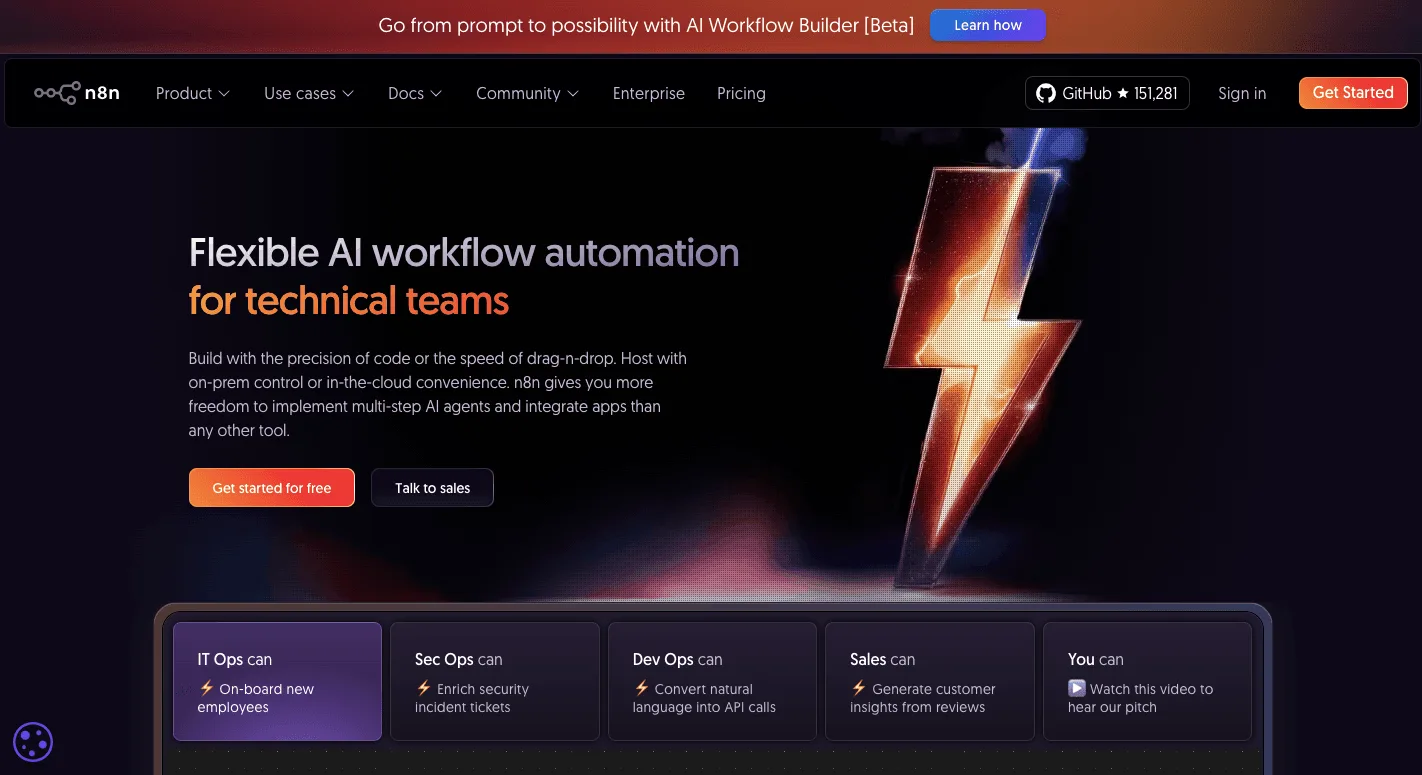
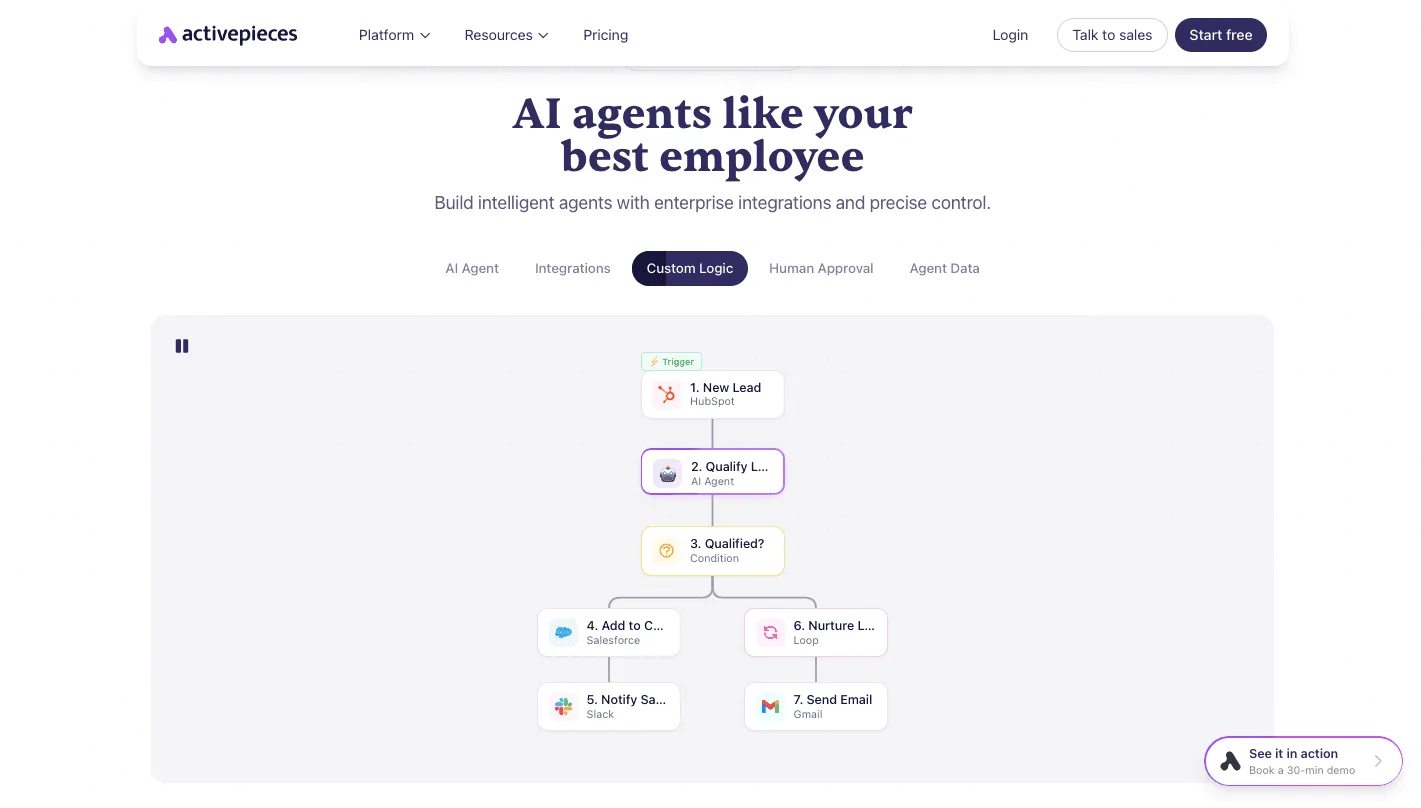
The innermost core contains the automation engine, such as Activepieces, which provides 739+ integrations to orchestrate the flow between the model and internal databases. The brain of the agent is physically adjacent to the data it processes.
By maintaining this hierarchy, an organization ensures that even a sophisticated reasoning model can't inadvertently exfiltrate information through a standard API call.
Why 2026 is the tipping point for sovereign intelligence
The convergence of high-parameter open-weight models and the necessity of real-time auditability drives the shift toward self-hosted agentic workflows. Frontier models like Mistral Large 4 now provide the reasoning capabilities previously exclusive to closed-source APIs. Performance isn't a valid excuse for compromising security anymore.
New data residency laws for automated decision-making systems now require forensic trails of every thought and action. This level of transparency is only possible when the execution logs are stored on owned infrastructure.
Performance isn't a valid excuse for compromising security anymore.
As agents move from simple chat to multi-step reasoning, the volume of sensitive context they handle increases. This makes the risk of using external endpoints mathematically untenable for enterprise risk departments.
Everything below works on Activepieces' free plan. Start without code or a credit card.
Technical requirements for hosting private agentic workflows
Sovereign agentic infrastructure requires a hardware stack capable of sustaining model weights and KV caches without external API calls. This architectural shift necessitates a move away from shared cloud clusters toward dedicated local compute to ensure that sensitive telemetry never leaves the physical premises.
Bridging hardware and weights with inference servers
A local inference engine acts as the translation layer between your raw hardware and the model file. Software like Ollama, vLLM, or LM Studio provides the API endpoint that allows other applications to talk to the model.
Choosing the right server depends on your scale. While Ollama is excellent for local development, vLLM is designed for high-throughput production environments where multiple agents need to query the model simultaneously.
Local ram needs by llama model size
The primary constraint for on-premise inference is the total available Video Random Access Memory (VRAM). A model that exceeds physical memory will spill into system RAM.
Nobody wants a significant drop in tokens-per-second, but that is exactly what this overflow causes. According to Docs, the memory footprint for high-parameter models like Mistral Large 4 must accommodate both the static weights and the dynamic context window.
If the VRAM is insufficient for the full context, the system will truncate the history of the conversation. This leads to the agent losing track of the original user intent during long-running workflows.
Securing the data retrieval layer locally
Maintaining data sovereignty requires that the Retrieval-Augmented Generation (RAG) system resides within the same network security zone as the inference engine. The vector database must support local execution to prevent third-party indexing services from receiving document embeddings.
By running the embedding model, such as Mistral Embed, on the local GPU, the system processes internal document text entirely behind the firewall.
Access to these local resources must be mediated by a centralized identity provider. A centralized provider ensures that only authorized service accounts can trigger model calls.
The cost of air-gapped maintenance vs. cloud convenience
Choosing a self-hosted deployment replaces recurring API subscription fees with upfront capital expenditure and ongoing operational overhead.
Docs states that in an air-gapped environment, a security officer must manually verify and transfer large weight files via a secure gateway because updates to models like Mistral Large 4 or DeepSeek-V4-Pro-0813 can't be pulled over the internet.
While cloud providers offer immediate scaling, a local cluster is limited by its physical rack space. A sudden spike in automation volume will result in a queue of pending tasks rather than an automatic increase in available compute.

When public frontier models still make sense
Public frontier models remain the primary choice for organizations prioritizing absolute reasoning capability over infrastructure control. While self-hosted clusters provide data isolation, they often trail behind the rapid iteration cycles of managed services, where the most advanced logic for complex agentic workflows is deployed first.
The intelligence gap between gpt-6 astra and local alternatives
Public models currently provide a level of reasoning and long-horizon planning that local, open-weight alternatives can't yet replicate within standard enterprise hardware constraints.
For demanding reasoning tasks, Anthropic positions Claude Fable 5.1 as their premier solution for long-horizon agentic work. Users get native handling of multi-step dependencies that smaller, self-hosted models often break.
GPT-6 Astra from OpenAI is a flagship for complex coding. It's a depth of logic that allows developers to automate entire feature sets rather than just single functions.
80% of the cost has vanished as the market shows a clear trend toward the commoditization of these high-tier capabilities, which means businesses can now deploy advanced AI at a fraction of the previous budget.
In March 2023, the price per 1 million tokens for GPT-4 class models was $30.00, representing a significant barrier to entry for widespread application development.
By May 2024, this cost dropped to $5.00, so developers are suddenly finding it economically viable to scale projects that were previously too expensive. The financial barrier to using frontier intelligence for non-sensitive tasks has effectively vanished.
The collapse of intelligence pricing in 2026
This aggressive deflationary trend has accelerated through 2026 as competition between frontier labs intensified. The cost for 1 million tokens on flagship models like GPT-6 Astra has now stabilized at approximately $0.60, a price point that was unthinkable just three years ago.
The financial barrier has effectively vanished because the marginal cost of a reasoning step is now negligible for most enterprise budgets. Organizations must now decide if the extreme affordability of public intelligence outweighs the strategic risk of data exposure.
Maintenance costs of self-hosting AI models
Maintaining a self-hosted AI stack introduces a continuous procurement and maintenance cycle that managed APIs bypass entirely.
To match the performance of a high-volume, latency-sensitive model like Claude Haiku 5.5, an internal team must manage GPU orchestration to ensure specific tasks like classification and routing don't suffer from cold-start latency.
Model versioning and weights management require significant high-speed storage and memory overhead. Patching and security hardening for the entire inference engine adds a layer of vulnerability management to the IT roadmap.
When you need high-speed extraction, Claude Haiku 5.5 provides a near-instant response time because the provider handles the underlying hardware scaling. Choosing to self-host means assuming the role of a service provider. Every hardware failure or driver conflict directly halts the business's automated workflows.
Easier to see it running than to read about it: set it up free, no card.
Why data leakage makes public AI a non-starter for enterprise
While the operational burden of self-hosting is high, the cost of a single data exfiltration event through a shared model weights system is often terminal for a firm’s intellectual property protections.
Public AI infrastructure creates an uncontrollable surface area where proprietary logic and regulated data can be absorbed into a provider’s global intelligence.
Data retention risks in GPT-6 and Claude Opus
Every interaction with a managed service like OpenAI GPT-6 Astra or Anthropic Claude Opus 5.5 carries the risk of persistent data retention unless specific, enterprise-grade opt-outs are legally and technically verified. Organizations that rely on these public endpoints face four critical data leakage vectors:

- The training set might include prompts, which allows the model to reproduce proprietary code or strategy in responses to competitors.
- Third-party plugin data exfiltration occurs where secondary tools integrated into the model environment pull data to external, unvetted servers.
- Metadata logging by providers creates a searchable trail of corporate research patterns and internal project names.
- Accidental PII exposure in the context window happens where sensitive customer details are cached in the provider’s infrastructure.
This systemic exposure means that once a secret is used to ground a prompt, it isn't exclusively yours anymore.
GDPR and CCPA compliance with open-weight models
Strict adherence to data residency and privacy frameworks like GDPR or CCPA is a barrier to entry that disqualifies competitors who rely on public cloud reasoning.
By deploying open-weight models such as Mistral Large 4 or DeepSeek-V4-Pro-0813 within a fully air-gapped environment, a firm ensures that its automation logic never crosses the firewall.
Regulatory fines associated with cross-border data transfers are prevented by this isolation, which also protects the company from the legal ambiguity of training-data provenance.
In a market where trust is the primary differentiator, the ability to prove that no customer data ever touched a third-party server becomes a decisive sales advantage.
Deploying private agents with Activepieces and local models
Activepieces runs agentic workflows and data processing entirely within your private infrastructure, ensuring that sensitive API payloads never traverse the public internet.
By hosting the orchestration layer on your own hardware, you maintain the same SOC 2 Type II governance controls found in the managed cloud while keeping all execution behind the firewall.
Air-gapped installation and MIT-licensed core
Activepieces uses an MIT-licensed core that can be deployed via Docker or Kubernetes without requiring an outbound connection. This ensures that your automation logic remains functional even when the network cable is pulled, preventing telemetry leaks to external vendors.
The Community edition is a way to run unlimited workflows on your own hardware, so you can scale internal operations without incurring per-execution cloud fees.
For organizations with strict compliance mandates, the platform supports a fully air-gapped installation process.
Managing secrets and SSO in a private environment
Securing a private automation environment requires centralized control over who can build agents and where their credentials live.
While many vendors monetize control by stripping features from their self-hosted builds, Activepieces includes the same SSO, SCIM, custom RBAC, and audit logs in its air-gapped edition that it provides in the managed cloud.
These governance capabilities are used in production today by regulated organizations like MoneyGram and FundingSocieties to manage sovereign workflows. Air-gapped means full control, not a fraction.
Every credential Activepieces touches can be routed to your own secret manager instead of an external database, ensuring no vendor ever holds the keys your business runs on.
This architecture allows teams to meet 2026 security audits by keeping the entire governance layer behind the firewall.
Scaling workflows with Kubernetes and local GPUs
Running agentic workflows locally requires matching your hardware profile to the specific reasoning requirements of the model being deployed.
An 8B parameter model, such as Ministral 3 8B, requires between 6.4GB and 16GB of RAM according to LocalModel. This means a standard workstation can handle basic classification and routing.

| Model Size | RAM Requirements | Consequence for Infrastructure |
|---|---|---|
| 8B models | 6.4GB – 16GB | Enables deployment on commodity edge hardware or standard office PCs. |
| 14B models | 16GB – 32GB | Requires mid-range professional GPUs or upgraded server memory for stable inference. |
| 70B models | 45.3GB – 64GB | Demands high-end enterprise A100/H100 clusters to maintain acceptable token latency. |
Prices and plan limits checked against docs.claude.com and openai.com and gemini.google on October 12, 2026.
As you move toward high-reasoning models like Mistral Large 4, the 45.3GB to 64GB RAM requirement for 70B models necessitates a dedicated GPU cluster, effectively ruling out local execution on standard consumer hardware, which means individual developers are forced to rely on expensive cloud infrastructure to run these systems.
Activepieces scales across these resources by running on Kubernetes, allowing you to distribute agentic workloads across multiple nodes as demand increases.
The Monday morning checklist for private AI migration
Migrating to a private AI infrastructure requires a systematic isolation of the model execution environment from public API endpoints to prevent data exfiltration.
A standard private instance on a public cloud still relies on the vendor's underlying management plane. True sovereignty is only achieved when the orchestration and inference layers are hosted within a perimeter you physically or virtually control.
- Audit every active API key for public reasoning engines to identify where proprietary telemetry is currently escaping the network.
- Deploy a local inference server, such as vLLM or NVIDIA Triton, to host weights for Mistral Large 4 or DeepSeek-V4-Pro-0813 so that no prompt data leaves the internal subnet.
- Configure a private container registry to store validated images of your automation tools. This ensures that no external updates can inject unverified code into the production environment.
- Establish a centralized secrets management vault to handle authentication for internal services, which removes the need for developers to store sensitive credentials in plain text.
- Map all agentic workflows to ensure they only call internal endpoints or whitelisted services, preventing an autonomous agent from inadvertently sending sensitive logs to a third-party debugger.
For organizations operating under strict regulatory oversight or within air-gapped facilities, the transition must include enterprise-grade governance features. Standard deployments often lack the oversight required for compliance audits.
Implementing Single Sign-On (SSO), System for Cross-domain Identity Management (SCIM), and Role-Based Access Control (RBAC) ensures that only authorized personnel can modify agent logic.
Teams requiring these managed governance layers or dedicated support for air-gapped installations can inspect the same feature parity between the self-hosted docs and the SOC 2 Type II managed cloud at https://www.activepieces.com.
Frequently asked questions about private AI?
Can private AI agents run without an internet connection?
Fully air-gapped agentic workflows are possible when the orchestration engine, the execution environment, and the large language model are all hosted within the same perimeter. This configuration ensures that sensitive operational logic never leaves the internal network.
This is the primary requirement for organizations handling classified or regulated data. When using a local model like Mistral Large 4, the inference occurs on internal silicon.
No telemetry or prompt data is transmitted to external servers. Consequently, the entire automation lifecycle remains invisible to outside observers.
What is the minimum hardware for a private AI agent?
The hardware requirement is determined by the parameter count of the chosen model and the necessity of dedicated VRAM for low-latency inference.
Running a dense model such as Mistral Large 4 through a local provider requires enterprise-grade GPUs. These prevent the system from bottlenecking during complex reasoning tasks.
A setup lacking sufficient memory will offload processing to the system RAM. This results in token generation speeds too slow for real-time agentic interactions.
How do you update local models without exposing data?
Updating local models involves a unidirectional synchronization process where new weights are pulled into a staging environment before being moved to the production network. This physical or logical separation ensures that the update mechanism can't be used as a backchannel for data exfiltration.
Proprietary models and the local hosting myth
It is critical to distinguish between open-weight models and proprietary frontier models. While you can host Mistral or DeepSeek locally, models like GPT-6 Astra or Gemini 3.8 Flash are closed-source and cannot be downloaded or air-gapped.
Even if your orchestration engine is local, querying these frontier models requires a public API handshake. True data sovereignty is only possible when using open-weight weights that reside entirely on your own internal GPUs.
- Download the latest open-weight model weights, such as Mistral Large 4, into a secure DMZ.
- Verify the cryptographic hashes of the model files to ensure the integrity of the weights.
- Transfer the verified files to the isolated execution environment via a secure gateway.
- Restart the local inference service to load the new version into memory.