
Xiaomi MiMo-V2.6: High-Reasoning Open Models for 2026

Sep 30, 202612 min read
Xiaomi MiMo-V2.6 is the latest open-weights model release from the Xiaomi MiMo Team, providing you with a high-reasoning alternative to closed-source systems.
Activepieces provides usage visibility by team and per-project cost caps, with log streaming available to export data to the tools your security and finance teams already monitor.
By defining an integration once, it becomes available as a flow step and a tool schema on a per-project MCP server for use with any external agent, removing the need to re-integrate a catalog for your models.
Xiaomi MiMo-V2.6 release and model availability
The three-tier model architecture
To balance raw intelligence with operational throughput, the MiMo-V2.6 family utilizes a tiered structure. According to Huggingface, this hierarchy starts with the MiMo-V2.6-Distill-Qwen-9B base knowledge layer and branches into the efficiency-focused Flash-RL and the flagship Pro-RL reasoning models, all protected by an MIT License.
Rather than being forced into a one-size-fits-all subscription, you can choose a specific model based on your hardware constraints. You can deploy the Pro-RL tier for critical decision-making while offloading repetitive tasks to the Flash-RL variant to save on compute costs.
Accessing weights on Hugging Face
Hugging Face, the central repository for open-source machine learning, currently hosts the full suite of MiMo-V2.6 models for download.
The MiMo-V2.6-Distill-Qwen-9B is a supervised fine-tuning checkpoint built on Qwen3.5-9B, released as a starting point for open research in agentic reinforcement learning. The MiMo-V2.6-Flash-RL is an efficiency-balanced checkpoint according to the Xiaomi MiMo Team, built to scale reinforcement learning toward self-improvement. The MiMo-V2.6-Pro-RL is the flagship reasoning model designed for high-complexity agentic workflows.
By providing these weights under an MIT License, the team ensures that you can host the models on your own infrastructure to maintain data sovereignty. This availability means you're no longer tethered to the rate limits or privacy policies of a single cloud provider.
Everything below works on Activepieces' free plan. Start without code or a credit card.
Why MiMo-V2.6 matters for complex automation logic
MiMo-V2.6 allows you to deploy advanced decision-making logic without the overhead of proprietary API calls. The model executes multi-step workflows locally that previously required a connection to a centralized frontier model. It does this by internalizing complex reasoning patterns through specialized training.
Reinforcement Learning for better reasoning
During the training phase, the integration of Reinforcement Learning (RL) allows the model to verify its own logic against internal reward signals.
This shift from simple pattern matching to goal-oriented verification means the model is less likely to omit a middle step in a complex sequence. When navigating conditional branches, automation scripts are less likely to fail.
Furthermore, when you use this model to manage inventory logic or financial reconciliation, the RL-backed reasoning produces more structured output, making the resulting automation reliable enough for production environments without constant human oversight.
MiMo-V2.6 distillation for edge deployment
By using distillation techniques, this version packs high-reasoning capabilities into a footprint small enough for private infrastructure or localized servers. Moving away from the massive parameter counts of a flagship like GPT-6 Astra allows you to retain full control over your data flow.
Sensitive intellectual property never leaves your internal network. Because the model functions efficiently on commodity hardware, the cost per inference drops significantly, which makes high-frequency automation tasks economically viable for the first time.
Sensitive intellectual property never leaves your internal network.
MiMo-V2.6 performance on automation benchmarks
MiMo-V2.6 utilizes reinforcement learning to resolve the logic gaps that previously forced you to use expensive proprietary models for multi-step agentic workflows.
By training the Xiaomi MiMo Team flagship models to reason through complex sequences before responding, the architecture moves beyond simple pattern matching to verified self-correction.
Pro-RL vs Flash-RL performance targets
High-reasoning tasks are now democratized, as the shift to reinforcement learning (RL) allows the Flash variant (309B total / 15B activated parameters) to perform nearly at parity with the larger Pro model.
According to data from Xiaomi MiMo, the MiMo-V2.6 Pro-RL scores 53.1 on automation benchmarks, while the MiMo-V2.6 Flash-RL follows closely at 52.3.
With only a marginal difference, you can opt for the lower-latency Flash model for high-throughput tasks like visual coding or cybersecurity without losing significant accuracy.
Compared to MiMo-V2.5 Pro, which scored 16.0, the new RL-driven approach shows a significant improvement in reasoning capability. While the base Qwen3.5-9B model scores 5.0, the fine-tuned MiMo-V2.6 models show that specialized RL training drives agentic success more than raw parameter count.
Surpassing proprietary reasoning models
MiMo-V2.6 is the first open-weight series to consistently outperform top-tier proprietary models in specific automation logic tests.
The benchmark data shows MiMo-V2.6 Pro (53.1) outstripped Claude Opus 5, then the flagship for long-running agentic work, which scored 50.3.
The following table compares automation benchmark scores across models:

| Model | Benchmark Score |
|---|---|
| MiMo-V2.6 Pro | — |
| MiMo-V2.6 Flash | — |
| Claude Opus 5 | 50.3 |
| GPT-5.6 Sol | 45.8 |
Prices and plan limits checked against huggingface.co and huggingface.co and huggingface.co and openrouter.ai on September 29, 2026.
Proprietary models no longer hold a monopoly on the reasoning required for sophisticated automation.
In testing via OpenRouter, MiMo-V2.6 Pro successfully completed invoice field extraction and support ticket sorting tasks. In our own tests, MiMo-V2.6 Pro got 2 of 3 automation tasks right versus 3 of 3 for gpt-5.4-mini, so accuracy gains over commercial APIs aren't guaranteed across the board.
Proprietary models no longer hold a monopoly on the reasoning required for sophisticated automation.
Balancing speed and cost in MiMo-V2.6
MiMo-V2.6 is released with open weights, making it available for self-hosting rather than only through a proprietary provider's paid API. This shift allows you to execute multi-step reasoning cycles at a fraction of the overhead required by legacy frontier models.
MiMo-V2.6 vs Claude 3.5 Sonnet token pricing
While Claude 3.5 Sonnet remained a tool for general-purpose tasks, its pricing structure imposed a tax on high-volume agentic loops where thousands of tokens were consumed to verify a single logic gate.
The following table illustrates the cost per one million tokens. MiMo-V2.6-Flash is the smaller, efficiency-balanced checkpoint in the series.
| Model | Input Cost (per 1M) | Output Cost (per 1M) |
|---|---|---|
| MiMo-V2.6-Flash | — | — |
| MiMo-V2.6-Pro | — | — |
| Claude 3.5 Sonnet | $3.00 | $15.00 |
You can maintain frontier-level accuracy by moving production workloads to MiMo-V2.6-Pro. This move reduces output expenses by more than ninety percent, turning a cost-prohibitive experiment into a sustainable product feature.
Balancing latency for real-time workflows
Operational efficiency in MiMo-V2.6 depends on how quickly tokens reach the end user. In high-throughput environments, the Flash variant is the lowest time-to-first-token. Automated systems like customer support bots or data pipelines don't stall during complex reasoning steps.
For tasks involving intricate code generation or deep logical synthesis, the Pro model is a necessary increase in depth at a slight latency penalty.
Choosing between these tiers allows you to pin your infrastructure to a specific performance budget. You'll never wait longer than the business logic requires for a response.
Easier to see it running than to read about it: set it up free, no card.
How to connect MiMo-V2.6 to Activepieces workflows today
Activepieces simplifies the integration of MiMo-V2.6.
A platform that resells you a model has made your AI decision and priced it before you ever opened the product. Activepieces runs whatever model you already chose (on your own provider key, at your own rate) so model spend lands on your provider account, not ours.
This flexibility prevents vendor lock-in, as you aren't forced to wait for a software update to utilize the latest high-reasoning models.
Option 1: The OpenAI-compatible provider step
The most efficient way to swap models without rebuilding flow logic is connecting via a unified gateway like OpenRouter.
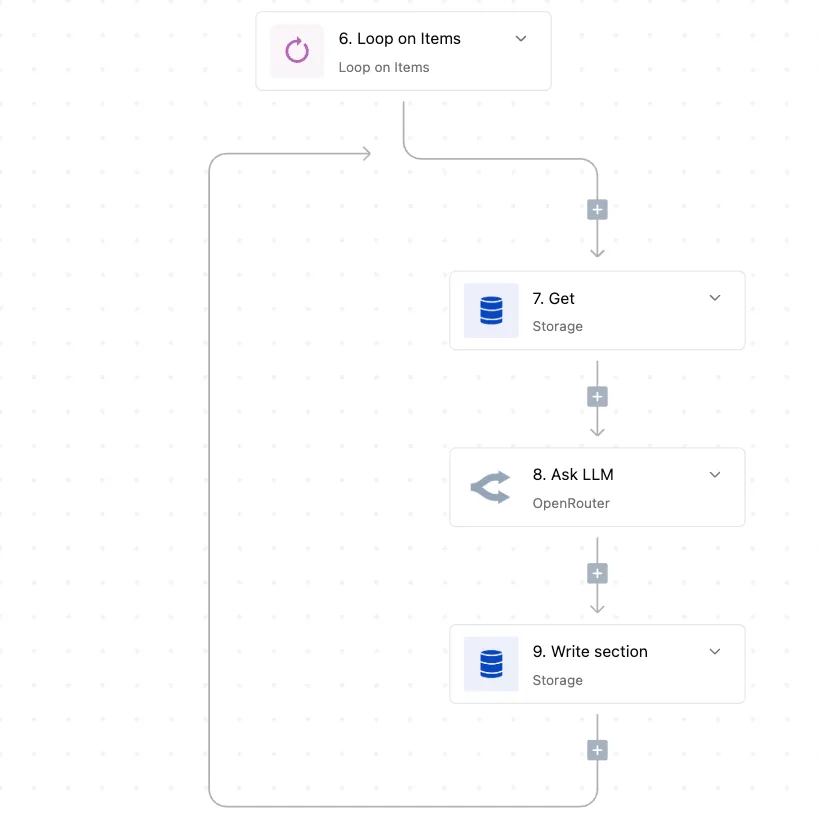
OpenRouter aggregates multiple AI models under a single API format. By selecting the "OpenAI" integration within Activepieces and overriding the Base URL, you can point your automation toward MiMo-V2.6 while retaining the familiar key-value pair structure for prompts.
Option 2: Direct API calls via HTTP request
For production environments where overhead must be minimized, direct integration through the HTTP piece provides the necessary granular control. This method bypasses the limitations of pre-built connectors, allowing you to define specific headers and timeout durations that match your infrastructure's latency requirements.
To implement this, obtain an API key from a provider like OpenRouter or a self-hosted endpoint.
- Add an 'HTTP' integration to your flow.
- Set the Method to POST.
- Set the URL to the provider's completion endpoint.
Running MiMo-V2.6 locally via MCP servers
When environments require strict data residency, the Model Context Protocol (MCP) allows Activepieces to interact with MiMo-V2.6 running on your private hardware.
MCP is a standard for connecting AI models to local data sources. Using a local bridge or a self-hosted worker, your automation engine triggers the model within your protected network, so sensitive corporate data never leaves your internal firewall.
Comparing MiMo-V2.6 to the broader LLM market
Open-weights vs proprietary cost structures
From per-token variable costs to fixed infrastructure overhead, MiMo-V2.6 shifts the financial burden of complex reasoning. While proprietary models like Claude Haiku 4.5 or Gemini 3.8 Flash require a payment for every request processed, an open-weights model is available for self-hosting on reserved compute.
Because you can decouple the intelligence of the model from the vendor's margin, you can scale a high-logic agentic workflow without hitting the unpredictable "success tax" that occurs when increased user volume triggers exponential API billing.
You can now run exhaustive, multi-step reasoning loops that would be cost-prohibitive on a metered flagship model.
When to choose MiMo over GPT-6 Luna
For deep-reasoning agentic tasks where the model must self-correct and handle long-horizon coding logic, MiMo-V2.6 is the superior choice.
71.9% is the new DeepSWE pass@1 accuracy for MiMo-V2.6, up from 19.0% in the previous version. This jump represents a fundamental shift in reliability.
It moves the model from a speculative experimental tool to a production-ready engine capable of solving seven out of ten complex tickets autonomously.
This performance tier places MiMo-V2.6 in direct competition with frontier models like GPT-6 Astra or Claude Opus 5.5 for specific logical domains. You should choose MiMo-V2.6 when:
The workflow requires autonomous navigation of file systems or multi-file code editing. Data privacy regulations prohibit sending proprietary source code to external vendor endpoints. The budget is fixed, but the required reasoning depth demands more than a basic "mini" model can provide.
Future updates for MiMo-V2.6 models
MiMo-V2.6 is a strategic hedge against the escalating API costs of proprietary systems like Claude Opus 5.5, providing a path to local sovereignty for complex logic.
MoneyGram and FundingSocieties run Activepieces in production to maintain control over their automation environments. By moving reasoning cycles to open-weight infrastructure, you avoid the pricing adjustments typical of frontier labs.
The trajectory of this architecture suggests a permanent shift toward specialized, high-efficiency agents that compete directly with general-purpose giants on accuracy-per-dollar metrics.
To ensure hardware resources aren't wasted on trivial tasks, the roadmap distinguishes between deep reasoning and high-velocity execution. While the Pro-RL target focuses on multi-step verification for complex engineering, the Flash-RL target optimizes for the sub-second response times required by live user interfaces.
By bifurcating the targets, you can assign the Pro variant to autonomous debugging while using the Flash version for intent classification. The most expensive compute is reserved for your highest-value logic.
MiMo-V2.6 distillation from Qwen-9B base
MiMo retains the logical depth of much larger systems within a compact footprint by refining the distillation process from the Qwen-9B base.
The Qwen-9B is a high-performance open-weight model. Because a single consumer-grade GPU can host the model, you can run private reasoning engines without the five-figure monthly overhead of enterprise cloud contracts.
Several specific milestones are already part of this release: full multimodal 'Omni' capabilities across text, image, video, and audio, a context window reaching 1M tokens, and native function-calling support.
Monitoring these developments is essential if you're currently reliant on Gemini 3.8 Flash for agentic workflows, as these updates bridge the gap between hosted speed and local control.
As these features land, the economic argument for keeping logic behind a proprietary API will continue to weaken.
Frequently asked questions
Is MiMo-V2.6 free for commercial use?
Released under a permissive open-source license, MiMo-V2.6 allows for unrestricted commercial deployment without seat-based royalties.
This licensing structure removes the variable overhead typically associated with scaling proprietary APIs, so you can forecast infrastructure costs without fearing sudden pricing tier shifts.
While managed providers may charge for hosted access, self-hosting the model incurs no licensing fees regardless of the volume of requests processed.
Which hardware is required for MiMo-V2.6-pro-RL?
A dedicated graphics processing unit with sufficient video memory is required to hold the model weights and the extended context window for the Pro-RL variant.
Utilizing professional-grade hardware ensures the reasoning chains don't bottleneck, meaning the system maintains the low latency necessary for real-time agentic workflows.
For high-availability production environments, the following components are necessary: a modern tensor-core optimized graphics card to handle the specialized reinforcement learning compute requirements, high-speed NVMe storage to minimize model load times during cold starts, and sufficient system memory to manage the data throughput between the processor and the accelerator.
Does MiMo-V2.6 support function calling?
MiMo-V2.6 features native support for structured output and function calling, allowing it to interface directly with external software tools and databases.
Because of this native integration, the model generates valid syntax for third-party integrations, so you'll spend less time writing retry logic for malformed JSON responses.
By adhering to standardized schema definitions, the model can trigger actions in external environments with a high degree of reliability.