
AI Agents for Product Managers: What to Use and When
Learn how AI agents for product managers work and explore common use cases. Discover how Activepieces can automate your business workflows.

Feb 23, 202613 min read
You have probably bookmarked a few AI tools already. Maybe you tried one, maybe you meant to.
Every week, there is another launch, another promise to save you hours as a product manager. But what actually fits into your workflow?
This guide breaks down AI agents by use cases so you can clearly see what to use, when to use it, and how to make AI support your product decisions.
Stop collecting AI tools you never fully use. Build workflows that actually run with Activepieces!
TL;DR
- AI agents for product managers automate feedback analysis, documentation, prioritization, and reporting across your product stack.
- Product teams need them now due to rising complexity, tool sprawl, faster shipping cycles, and higher expectations.
- They turn customer feedback into insights, support roadmap decisions, monitor competitors, and keep stakeholders updated.
- You can use prompt-based assistants, embedded AI features, or no-code agent builders, depending on your needs.
- Activepieces connects 636+ integrations and lets you run end-to-end product workflows automatically.
Everything below works on Activepieces' free plan. Start without code or a credit card.
Why Product Teams Need AI Agents Now
AI agents for product managers solve issues, such as:
Increased Complexity
Product management used to focus on roadmap planning and sprint planning.
Now, you need to review customer feedback, scan analytics dashboards, read support tickets, join customer calls, and refine product strategy in the same week.
Much of that analysis stretches beyond your main strengths into areas that are not your full expertise, such as advanced revenue modeling or behavioral data review.
Most software waits for input, which forces you to open dashboards and interpret numbers manually before deciding what to do next. Agents, on the other hand, can continuously monitor performance metrics or draft a summary with supporting data before you even log in.
More Tools
Many product teams adopted more tools over the last few years, yet coordination became harder because each platform created another version of the truth that someone had to moderate.
You often move between your existing tools to answer a single question, copying a detail from one system and pasting it into another, which drains focus and fragments your thinking.
AI agents connect those systems with reasoning. So if you say, “Keep everyone updated on the launch,” the agent reads the product requirements document (PRD), checks telemetry data, reviews sentiment in a Slack channel, and prepares a summary grounded in current information.
That orchestration model replaces manual syncing and reduces the need for extra meetings, which keeps product workflows stable even as your stack grows.
Faster Shipping Cycles
Release timelines shrink each quarter, so you need to move quickly. You often experience that pressure during sprint planning when unclear requirements or stalled tickets slow momentum.
Waiting for clarification can be time-consuming, especially when you pause your task until someone answers a question about acceptance criteria. But agents can get context from specs, Slack threads, and meeting notes, then answer questions in English, so progress continues.
Project boards also drift when repetitive tasks pile up. Agents can monitor activity and flag hidden dependencies such as “Feature A can’t launch because the API update in Repo B remains under review,” which prevents last-minute surprises.
For documentation, agents can scan merged code, compare changes with the original spec, and generate tailored updates for customers and support, so you save time and focus on delivery.
Higher Expectations
Customers expect products to adapt instantly.
Personalization is now a baseline requirement, and an agent can analyze behavior patterns and customer conversations to detect emerging trends. It then suggests adjustments that align with broader product strategy.
Basic tools, such as an AI chatbot, can answer surface-level questions, but agents move further by executing multi-step goals on your behalf.
How can AI agents help product teams?
AI agents help product teams by monitoring performance metrics, connecting fragmented tools with reasoning, keeping teams updated during fast shipping cycles, and meeting rising customer expectations for personalization. They continuously analyze feedback, flag hidden dependencies, draft documentation, and execute multi-step goals, reducing manual coordination as product stacks grow more complex.
AI Agents for Product Managers: Use Cases
These agents take on specific responsibilities, including:
AI Agents for Customer Feedback Analysis
For a product manager, an agent for customer feedback analysis can provide a steady stream of structured insight.
Basic search tools scan for keywords. Agents go further by interpreting why customers feel frustrated and connecting those signals to product decisions.
These agents get input from support tickets, NPS comments, app reviews, Slack discussions, and transcripts from customer calls into a single view. It also reviews signals from analytics, surveys, and support tickets, so no source of user feedback is isolated.
Using a large language model like GPT-4 or Claude, it interprets the intent behind raw feedback and categorizes themes. You can instruct it, “Monitor onboarding and pricing,” and it will track those areas continuously and flag shifts early.
AI Agents for Writing and Documentation
Documentation supports product management, yet it often feels like a side task that grows every sprint. After a planning session, you translate rough ideas into user stories, define acceptance criteria, and update specs.
An agent can ingest a 45-minute Zoom transcript and multiple Slack threads, then generate user stories from rough ideas in a structured PRD. It keeps documentation aligned with delivery by scanning changes in tickets and automatically drafting release notes when features ship.
It further supports creating content tasks. When you need to write for your job postings to reflect a new product focus, the agent reads your latest themes and adjusts language accordingly.
AI Agents for Roadmap Prioritization
Roadmap planning often turns subjective when feedback, revenue, and engineering effort are in separate systems.
An agent acts as a prioritization engine that connects those inputs. It links feature requests to revenue exposure and usage trends, then recalculates scores as new data arrives. One agent may assess revenue impact while another evaluates capacity.
In advanced setups, multi-agent systems combine these analyses into a single recommendation.
You can ask, “If we pivot to focus on Enterprise security this quarter, which five features should we drop from the current sprint?” The agent reviews backlog items, current velocity, and demand signals before answering.
AI Agents for Competitive Research Reports
Competitive analysis requires ongoing review of market activity.
An AI agent for competitive research can monitor competitor websites, pricing pages, and product updates, then extract key information about new features or packaging changes.
The agent compares those findings with your roadmap and evaluates how they affect customer personas and target segments. It produces research reports that summarize implications for decision making and emphasize risks or opportunities.
Over time, you build a record of shifts and case studies that show how competitors respond to market changes.
AI Agents for Stakeholder Reporting
Stakeholder communication consumes time because it requires assembling data from multiple systems and shaping a narrative.
An agent can connect to Jira, customer relationship management (CRM) dashboards, and documentation, then extract real data to generate summaries for each audience.
It also produces updates that highlight key insights, revenue impact, and delivery status so you can align stakeholders without long prep cycles. Reports trigger on events such as the end of a sprint or follow a set schedule, which keeps companies informed.
What workflows can AI agents automate for product managers?
AI agents for product managers automate feedback analysis, writing and documentation, roadmap prioritization, competitive research reports, and stakeholder reporting. They connect to tools like Jira, Slack, and CRMs to pull signals, generate PRDs and release notes, score features by revenue and usage, track competitors, and send scheduled updates to stakeholders automatically.
Easier to see it running than to read about it: set it up free, no card.
Types of AI Agents for Product Managers
Not every agent works the same way, so understanding the main categories helps you decide what fits your current workflow and what requires deeper integration.
Prompt-Based AI Assistants
A prompt-based assistant responds to whatever you type. It pauses for instructions, processes them, and returns an output.
You provide role, task, and project context in one message. For example, you can write, “Act as a senior PM. Draft a PRD for a new login flow using these user interviews and keep it under 600 words.”
The assistant processes those requests with an LLM and produces a draft in plain English.
Most PMs use these assistants to generate first drafts, summarize research, or pressure-test ideas. You can paste notes and ask for the top pain points. You can request alternative prioritization angles or ask it to critique a proposal.
However, the assistant only knows what you share in that session. It helps you think faster, but it doesn’t automate heavy lifting on your systems.
Embedded AI Features in Project Management Tools
Some AI features live directly in project management tools. You see them as smart buttons, slash commands, or automated rules built into platforms such as:
- Jira
- Notion AI
- Linear
- Monday.com
These features access the tool’s internal database, which means they understand ticket history, linked pull requests, due dates, and labels. When you highlight a long spec and click summarize, the system instantly condenses it.
Still, it has a trade-off, such as they can only operate within a single product. They don’t coordinate multiple systems or manage complex flows beyond that environment.
No-Code AI Agent Builders
No-code agent builders let you create your own AI agents in no-code tools. You design logic visually, connect models, and define actions.
These platforms coordinate tasks between systems and automate recurring workflows. When used well, they reduce manual coordination and give product teams the ability to design processes that run.
How Activepieces Lets You Create Agents for Product Workflows

Activepieces gives product teams a way to build agents that do real workflows.
You use visual building blocks called pieces to connect your tools. For instance, you place them on a canvas, define triggers and actions, and decide how data moves between steps.
When an event happens, such as a new support ticket or a status change, the agent reads the input, processes it, and takes the next action automatically.
Key features include:
- Visual builder that lets you design product workflows without backend code.
- Human approval steps that pause execution until someone confirms.
- Structured data outputs that push clean JSON into integrated tools.
- 636+ pieces that connect AI services, CRM platforms, analytics, and collaboration apps.
Connect Your Entire Product Stack
To make agents useful, Activepieces lets you connect with 636+ data integrations, some of which are:
Jira
When you connect Jira to Activepieces, agents can monitor ticket movement, detect stalled items, and post updates.
For example, when a ticket moves to “Done,” an agent can generate a summary and send it to Slack automatically. If a high-severity bug appears, the agent can create linked tasks and notify the right owner.
If the sprint load exceeds the velocity, the agent flags the risk before the sprint starts. Instead of checking dashboards, you receive direct insight.
Slack
Activepieces also integrates with Slack, which lets your agents read messages, summarize long discussions, and extract commitments.
Let’s say a support spike appears in a channel. The agent alerts the team with a short summary rather than flooding everyone.
Slack bots also act as smart assistants. You can ask, “What is the status of the onboarding redesign?” and the agent pulls the answer from your docs.
HubSpot
HubSpot tracks customer lifecycle data that often gets ignored in product planning:
- Deals
- Churn reasons
- Ticket history
- Account size
Once integrated, agents can scan closed-lost deals and highlight patterns such as repeated requests for a missing feature. If a high-value account shows low activity, the system can notify your product team before churn happens.
You can also query accounts by feature usage and draft targeted outreach for research interviews.
AI Tools
Native AI systems connect language models such as GPT or Claude directly into flows. These steps analyze text, extract structure, and generate responses based on prior inputs in the workflow.
An agent can combine a HubSpot ticket, Jira history, and Slack conversation in one step, then produce a summary that fits a defined format. Structured extraction forces the output into clean JSON, so other systems accept it without errors.
These are some of the AI tools you can connect to using Activepieces:
How can AI agents read and write to product management data?
Through Activepieces integrations, agents read triggers like ticket status changes, Slack messages, or HubSpot deal data, then write back actions such as posting Slack summaries, creating linked Jira tasks, or flagging sprint risks. Structured data outputs push clean JSON into connected tools, letting agents update product management data without manual copying.
Rebuild Product Management Around AI Agents With Activepieces
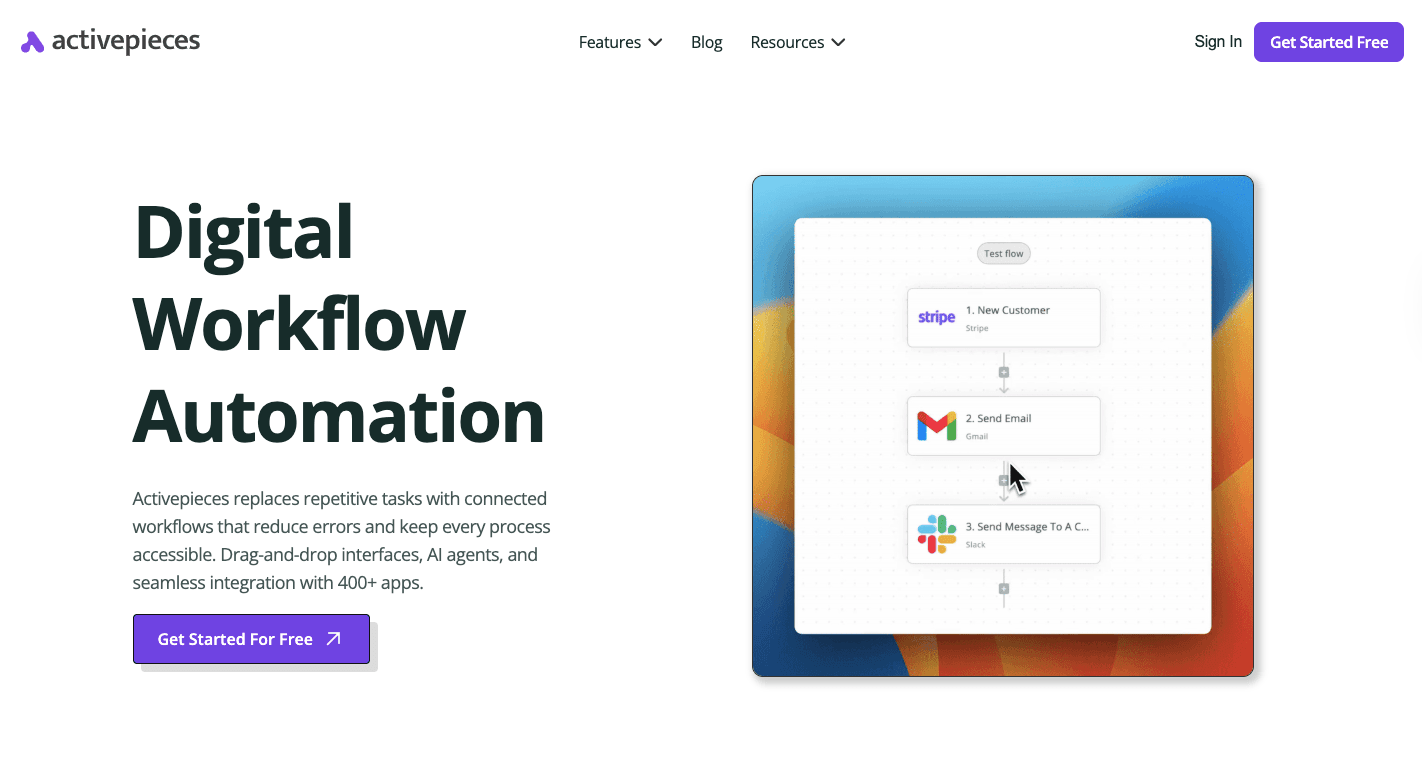
Most teams add AI on top of old processes without changing how product management actually operates. You still chase updates, move data between tabs, and manually coordinate handoffs.
Activepieces lets you redesign the system itself.
You can map your real process first, then build agents that run those flows end-to-end.
Activepieces offers 636+ integrations called pieces. You can also define triggers, logic, and actions without backend code. If needed, developers can extend pieces in TypeScript for full control.
Enterprise teams get single sign-on (SSO), role-based access, audit logs, and cloud or on-prem deployment.
Activepieces helps streamline critical workflows and reduce manual coordination so you can work smarter and focus on product direction.
FAQs About AI Agents for Product Managers
What are AI agents for product managers?
AI agents for product managers are software systems that observe events in your tools, reason over data, and take actions based on defined goals. Unlike a simple chatbot, an agent can monitor support tickets, analyze trends, update Jira, and notify stakeholders.
It uses an AI model with more raw training data to interpret context, detect patterns, and generate structured outputs that fit directly into your workflow.
How do AI agents improve product workflows?
Agents reduce manual coordination by automating sprint planning updates, backlog triage, documentation, and reporting. They pull signals from multiple systems, summarize changes, and trigger next steps automatically.
This allows you to measure impact in real time and focus more on strategic work.
What is the best AI agent platform for product managers?
The best platform connects deeply with your stack, supports structured automation, and scales securely. Activepieces stands out because it combines visual workflow design, AI-native integrations, approval controls, and flexible deployment for teams of any size.
What are the benefits of agentic AI?
Agentic AI enables systems to plan, decide, and execute multi-step tasks autonomously, which increases speed, improves visibility, and reduces operational overhead.