
MuleSoft vs Zapier: Side-by-Side Comparison
Looking for a MuleSoft vs Zapier side-by-side comparison? Read our guide to see how they stack up and what makes Activepieces different.

March 27, 20269 min read @ashrafsam
Sometimes it is not about features, it is about what is actually working for you right now. Maybe your automations are breaking more often, or you are spending too much time fixing things.
That is usually when MuleSoft and Zapier come up as options. Each one solves a different kind of problem.
In this MuleSoft vs Zapier comparison, you will learn the differences between these platforms in terms of integrations, pricing, security, and AI capabilities.
TL;DR
If you're comparing MuleSoft vs Zapier, the differences show up in these key areas:
- Integrations and automation: MuleSoft handles complex systems, Zapier focuses on simple app connections, and Activepieces supports both with flexible workflows.
- Pricing: MuleSoft uses custom pricing, Zapier charges per task, and Activepieces charges per active flow.
- Security and compliance: MuleSoft offers strict control, Zapier provides basic protection, and Activepieces adds visibility and approvals.
- AI capabilities: MuleSoft connects AI through APIs, Zapier adds AI steps, and Activepieces builds AI directly into workflows.
The fastest way to settle a shortlist is to try one. Activepieces is free to try, no credit card.
What Is Zapier?
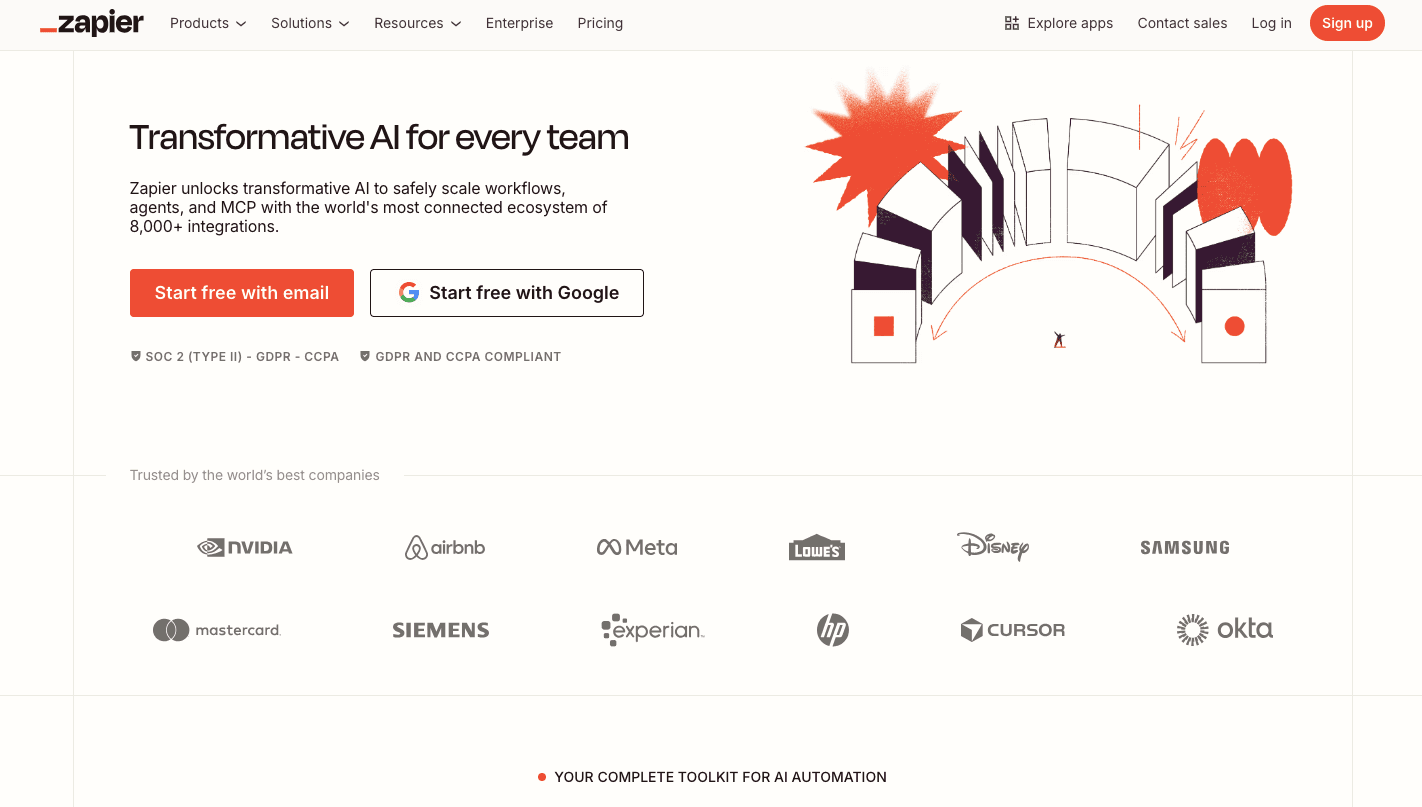
Zapier is an easy-to-use automation tool well-suited for small businesses that require fast connections. Many medium-sized businesses further use it to support their operational needs.
A drag-and-drop interface for building simple connections helps users handle basic automation of web apps quickly.
Using simple "When this happens, do that" logic, Zapier creates automated workflows that move data between apps. For example, a new form entry can trigger an email or save details in a CRM.
Each workflow controls the tasks performed on connected apps, allowing users to sync data automatically.
Integrations and Automation
Zapier allows you to connect thousands of different apps, like Slack, HubSpot, Mailchimp, and Gmail, so data moves between multiple applications smoothly.
To build workflows, you start by choosing a trigger, then add actions and map fields. If more steps are needed, Zapier enables multi-step Zaps to move data through several applications.
Additionally, Zapier provides pre-built templates to set up integrations. It also offers an extensive library of over 9,000 pre-built connectors, including SaaS applications.
Zapier excels at quick connections, and marketing teams often rely heavily on it.
Pricing
As usage grows, the platform offers pricing tiers based on the number of tasks used each month. Each action counts as a task, so a workflow with several steps can use multiple tasks in one run.
When workflows run often, costs increase quickly, so teams need to track usage.
Zapier offers these pricing plans that start at these rates:
- Free plan with 100 tasks and Zapier Copilot.
- Professional plan costs $29.99 per month with 750 tasks, multi-step Zaps, webhooks, and AI fields.
- Team plan costs $103.50 per month with 2,000 tasks, shared Zaps, SAML SSO, and premier support.
- Enterprise plan offers custom pricing with advanced controls, annual task limits, and a technical account manager.
Security and Compliance
As more workflows get added, security becomes more important. Zapier reduces technical overhead by managing infrastructure, so you do not have to handle servers or backend systems.
You can control exactly which Zapier Tables or third-party apps an AI agent can see, and it cannot access anything unless permission is given. If stricter rules are needed, you can set global system instructions so agents follow company policies.
AI Capabilities
Zapier enables users to build AI-driven workflows that analyze data and take action automatically. These workflows follow the same structure but include decision steps based on data.
For instance, you can describe a process in plain English, and the system maps out the workflow. The AI Copilot then suggests steps and helps connect apps during setup.
Zapier MCP, on the other hand, allows AI agents to interact with over 9,000 apps as if they were native tools.
What Is MuleSoft?
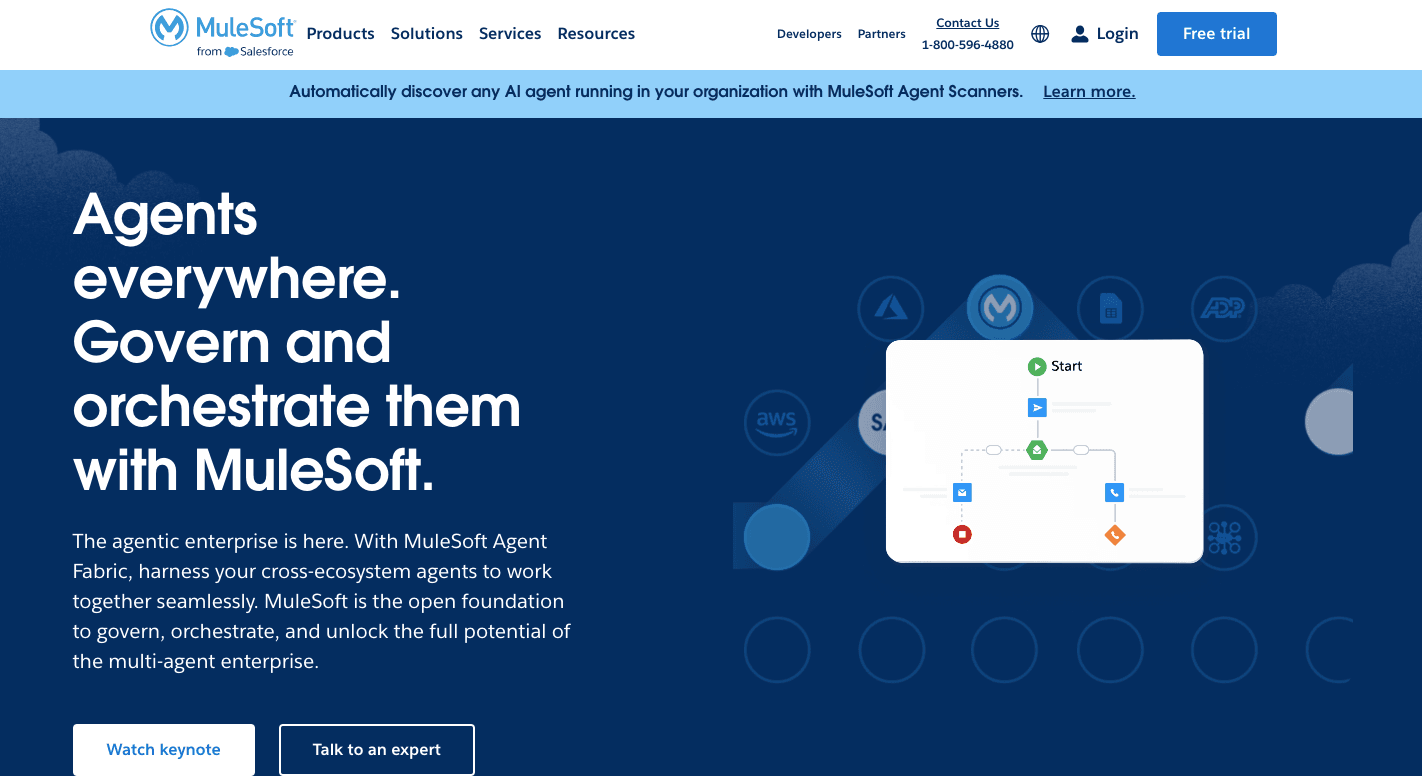
MuleSoft is built for large enterprises that deal with many tools, strict rules, and high data volume.
Among enterprise iPaaS platforms, it is widely adopted by global companies that rely heavily on it to keep systems working together and build production-ready workflows.
Compared to simpler tools, MuleSoft targets technical users such as developers and system architects. Setting it up requires significant technical expertise to design and deploy systems step by step.
Besides that, it provides service orchestration and a unified platform for managing the entire API lifecycle, from design to testing and monitoring. It also uses DataWeave for advanced data transformation between formats and supports heavy big data processing.
Integrations and Automation
MuleSoft's developer-focused platform lets you manage complex integrations between cloud tools and on-premise systems.
First, system application programming interfaces (APIs) unlock data trapped in legacy systems. Next, process APIs combine logic from multiple systems to complete a task. Then, experience APIs shape that data for apps or users.
This setup connects different business units through a shared API layer.
MuleSoft also offers API management to control every endpoint. Integration architects define the overall integration strategy and connect ERP systems like SAP or Oracle.
You can even combine data from many data sources with custom development.
Pricing
MuleSoft does not use fixed plans; costs depend on system size, deployment type, and required features.
Security and Compliance
MuleSoft ensures that all connected systems maintain data integrity by controlling how data moves between services. Strong controls support secure and governed data exchange between internal teams and external partners.
Data security relies on encryption and tokenization, which protect sensitive information during transfer and storage. The platform includes robust features for meeting HIPAA, GDPR, and FedRAMP standards.
Through its Anypoint Platform, you can monitor APIs for potential threats and track unusual activity. MuleSoft, in addition, lets IT manage deployment pipelines with strict governance, so updates follow approval steps before release.
AI Capabilities
MuleSoft includes features like Einstein AI for automated code generation, which helps developers build integrations faster.
Rather than building workflows from scratch, you can describe tasks and generate code for APIs or transformations. AI can also call existing APIs to perform actions, such as updating records or processing requests.
Reading a table only gets you so far. Build the same workflow in Activepieces and compare it yourself.
Why Activepieces Is Better Than Zapier and MuleSoft

Zapier is fast but limited to simple use cases. Meanwhile, MuleSoft handles deep integrations but requires extensive setup and strong technical skills.
Activepieces gives you both power and speed, so you can run AI-powered automation and complex workflows.
You can start with a basic flow, then expand without rebuilding anything. As your setup grows, data flows stay structured even when you connect multiple applications.
Now, let's talk about Activepieces' advanced features compared to Zapier and MuleSoft.
Integrations and Automation
Activepieces synchronizes data on multiple applications while keeping logic flexible, so you are not locked into rigid setups.
Currently, Activepieces offers 659 pre-built pieces. That number keeps on increasing through the community contributions.
Let's say you want to integrate an app that isn't included yet in the library of connectors. Using a TypeScript framework, building integrations becomes easier.
As flows grow, the system keeps everything visible through a visual user interface. You can also add conditional logic or adjust actions to your workflow automation.
Instead of basic connections, Activepieces supports seamless integrations that adapt as systems expand. It furthermore provides a higher level of governance than other platforms in the market.
Pricing
Activepieces uses a usage model that focuses on active flows, not task volume.
- Standard plan lets you start free with 10 active flows, then only pay $5 per active flow per month with AI agents and unlimited usage.
- Unlimited plan offers custom pricing with governance, RBAC, and enterprise support.
- Embed plan starts at $30,000 per year with an embedded builder and AI agents.
Costs stay predictable since you do not pay for every run.
Security and Compliance
Activepieces tracks every flow run with input and output logs, so you always know what happened. When something fails, you can trace the exact step and fix it quickly.
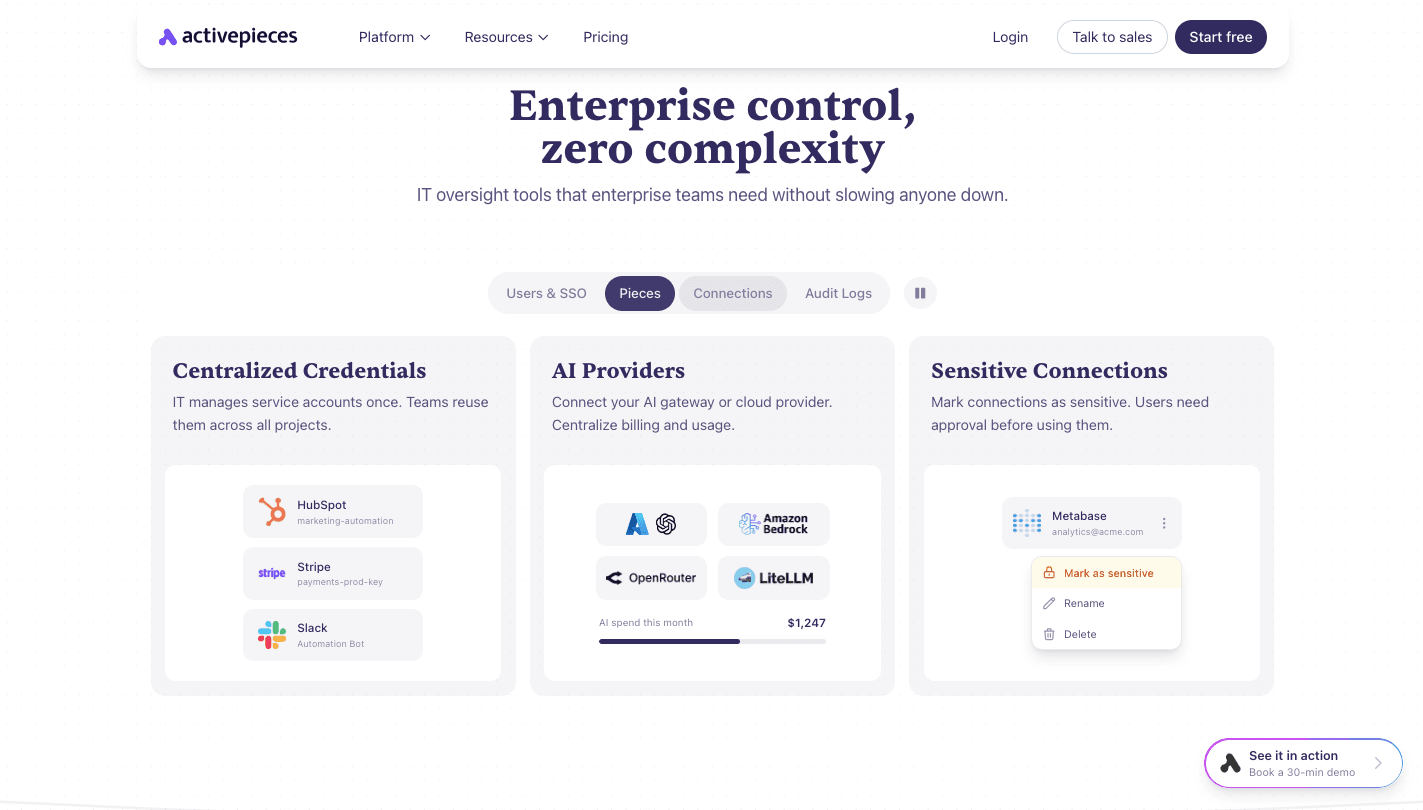
For stricter environments, the platform supports SSO, role-based access, and approval steps for sensitive actions. If a process needs review, it pauses and waits before continuing.
AI Capabilities
You can describe a task in plain language, and then the system builds the flow for you. After that, you can refine steps, connect tools, and adjust logic without starting over.
When workflows grow more complex, agents can act, pause, or ask for approval depending on the situation. That setup helps business users build advanced automation without coding.
With built-in AI, flexible logic, and full control, Activepieces handles both simple and complex automation in one place.
Upgrade How You Build and Manage Your Business Processes With Activepieces
After comparing MuleSoft and Zapier, you either pick something simple and hit limits later, or choose something powerful and spend months setting it up.
Activepieces removes that tradeoff, so you can start automating repetitive tasks and building complex flows immediately through the no-code interface.
Your sales team can begin with lead capture, then add scoring, routing, and follow-ups. Each step stays visible, so when something fails, you can trace the exact point and fix it.
Setup also feels different from both tools. For non-technical users, you can pick a template, adjust it, and run it within minutes. As usage grows, the system adapts to the most demanding and specific business needs, which means you do not outgrow it like simpler tools or slow down like enterprise systems.
FAQs About MuleSoft vs Zapier
What is a better alternative to MuleSoft and Zapier?
Activepieces is a better alternative to MuleSoft and Zapier if you want scalable integration solutions without choosing between simplicity and complexity.
Which integration platform is better for beginners, MuleSoft or Zapier?
Zapier is better for beginners since it does not require technical knowledge, while MuleSoft needs experience with APIs and system design.
What is the best alternative to Zapier for enterprise automation?
Activepieces is one of the best alternatives to Zapier for enterprise automation because it supports advanced workflows without the heavy setup MuleSoft requires.
Does MuleSoft have a steep learning curve?
MuleSoft does have a steep learning curve since it requires strong technical expertise and time to design and deploy integrations.
Still comparing
The fastest way to settle it is to build something.
Open source under MIT, so you can self-host the same thing later.
Start free Talk to sales