
What Is Zero-Touch Automation? A Comprehensive Guide
Learn what zero-touch automation is and what makes it different from other automated workflows. Discover how Activepieces can help you set it up.

February 12, 202612 min read @ashrafsam
You know that feeling when you’re stuck doing the same setup steps over and over, clicking through updates, or fixing small issues that should not need your attention?
Most IT teams manage a high volume of service requests from employees, including software access requests, password resets, and security concerns, which increases manual workload.
It is frustrating, and honestly, it eats up time you could spend on more important work.
As your systems grow, so does the effort to manage them. Zero-touch automation is all about easing that load.
In this guide, you’ll see how it can simplify your day-to-day tasks and help you work smarter.
TL;DR
- Zero-touch automation runs workflows from trigger to finish without manual intervention using APIs, AI, and event-driven logic.
- It handles onboarding, access control, provisioning, and security automatically, not just single tasks.
- Core tech includes APIs, AI and machine learning, RPA, orchestration, and event-based systems.
- Benefits include lower costs, faster deployment, stronger security, and higher productivity.
- Activepieces supports zero-touch automation with 630 integrations, built-in AI, and enterprise-grade control.
This takes minutes, not a project: automate it in Activepieces free.
What Is Zero-Touch Automation?
Zero-touch automation is driven by predefined rules, event triggers, and closed-loop logic. Once you configure the workflow, the system executes tasks for you.
Artificial intelligence (AI) and machine learning (ML) help it interpret events, apply logic, and complete automated workflows with minimal human intervention.
Let’s say a new employee’s entry in HR can trigger account creation, assigning system access, and applying security measures within seconds. Access management no longer depends on ticket queues.
In advanced setups, the system can detect failures or security risks and fix them automatically. It can detect sensitive data being shared incorrectly and immediately unshare the file while notifying the user of the policy violation.
That’s where zero-touch automation lies. It shifts your IT teams away from repetitive handling and frees them to focus on more strategic initiatives.
What Makes Zero-Touch Automation Different From Basic Automated Workflows?
You might already use automation tools that send emails or move data between apps. That helps, but someone still stays in the loop.
While basic automation speeds up a specific task that still requires a human to “push the button” or move data between steps, zero-touch automation manages the entire lifecycle of a process without any manual intervention.
During onboarding, you can create a simple workflow to set up an email account. After that, an admin assigns system access, updates user roles, and checks access management settings. That reduces repetitive tasks, but your IT teams still carry the responsibility.
Zero-touch automation handles everything once the trigger fires. A status change in HR can trigger account creation, permission setup, license assignment, and ticket closure in a single workflow.
Basic setups often require a “one-touch” or manual trigger, such as an IT admin clicking “approve” or running a script.
Advanced automated systems can “self-heal” by detecting security threats or network faults and remediating them autonomously before a human even knows there’s a problem.
What Technologies Power Zero-Touch Automation?
Zero-touch automation relies on:
APIs
Application programming interfaces (APIs) define how systems talk to each other. It defines exactly what data can be requested and what actions can be taken, such as “Create User” or “Revoke Access.”
Because the API follows strict rules like OpenAPI or REST standards, the automation engine knows exactly what to do next based on the “code” it receives back.
APIs chain actions in zero-touch. If the Slack API returns an “Out of Licenses” error, the zero-touch workflow can automatically trigger a “Purchase License” API call or alert a manager.
AI and Machine Learning
AI uses natural language processing (NLP) to read an incoming email from a client. It understands that the client wants to reset their password or cancel their subscription. The system then launches the right automated workflows.
Machine learning supports pattern detection. AI models review behavior and flag anomalies that may impact data security. For example, it can recognize that “Cust_ID” in one system is the same as “Account_Number” in another. That allows systems to map fields correctly.
When IT embeds AI into your service management solution and ITOps workflows, the system can handle predictive maintenance, resource optimization, and dynamic provisioning while strengthening security measures.
Robotic Process Automation
Some software tools lack APIs.
Robotic process automation (RPA) enables users to integrate legacy systems into a zero-touch workflow. An RPA bot is programmed to interact with the user interface (UI) as a human would. It can open an app, navigate to a specific screen, and scrape data or paste information.
Unattended bots respond to triggers from orchestration platforms. They process repetitive tasks within legacy software, keeping existing systems connected to the broader automation chain.
Orchestration Platforms
Orchestration platforms coordinate logic and sequence. They track state, retry failed steps, and maintain audit logs for regulatory compliance.
These platforms connect multi-vendor tools into one management solution. When a step fails, the platform reroutes or retries based on defined rules.
Event-Driven Systems
Event-driven systems react instantly. Your automation platform is “subscribed” to that specific type of event. The second it sees the event, it triggers the workflow.
There’s no human “start” button and no “waiting for the next sync.”
These systems also support high-volume activity. A traffic spike can trigger scaling. A login anomaly can update access management rules.
Types of Zero-Touch Automation
These are the primary types of zero-touch IT for your businesses:
1. Zero-Touch Provisioning
Zero-touch provisioning (ZTP) controls device setup without manual configuration.
When a new router or firewall powers on, it starts with no local settings. The device broadcasts a request for an IP address. It uses a special tag, such as “DHCP Option 60,” to tell the network, “I am a [Specific Brand/Model] device.”
The Dynamic Host Configuration Protocol (DHCP) server responds and provides a pointer to a configuration source. The device then connects these central file servers to download its operating system image, security patches, and custom configuration:
- Trivial File Transfer Protocol (TFTP)
- Hypertext Transfer Protocol (HTTP)
- Cloud service
Once the files are installed, the device reboots. It comes back online fully operational, secure, and integrated into your management system.
Every location follows the same template, which improves consistency in network operations and system access management.
2. Zero-Touch Enrollment
Zero-touch enrollment (ZTE) focuses on employee devices. ZTE is an “out-of-the-box” experience that enforces management policies from the first time a device is powered on.
It links a device’s unique hardware ID, such as an international mobile equipment identity (IMEI) or serial number, to a company’s management system at the factory or reseller level.
In the admin portal, you define a profile that tells the device, “When you wake up, connect to [This MDM Server] and download [These Apps and Policies].”
The reseller ships the factory-sealed devices directly to the employees’ homes.
When the employee powers on the device and connects to Wi-Fi, enrollment begins automatically. Apps install, security measures apply, and system access settings activate within minutes.
3. Zero-Touch Lifecycle Management
Zero-touch lifecycle management (ZTLM) governs access from hiring to departure.
Once HR marks someone as hired, the system creates accounts, assigns permissions, and provisions tools. When someone changes roles, it updates system access management rules automatically.
Without ZTLM, deprovisioning an employee takes an average of 30 to 60 minutes of manual clicking through different dashboards.
If HR marks an employee as terminated, the platform disables accounts, transfers files, and reclaims licenses within seconds. That keeps data secure and maintains consistent compliance.
4. Zero-Touch Network and Security Operations
Zero-touch network and security operations keep infrastructure stable.
The platform collects telemetry continuously. It compares live activity to known patterns. For instance, it’s normal for your New York office to send 1GB of data at 9 o’clock. Yet, it’s not normal for them to send 50GB to an unknown server in another country at 2 o’clock.
When abnormal behavior appears, the system can automatically detect the threat, update firewall rules, block sessions, and generate audit logs. That produces consistent responses to network performance issues and strengthens protection.
You can follow the rest of this with the builder open. Start free, no card.
Key Benefits of Zero-Touch Automation
Here are the key advantages of zero-touch automation:
Reduced Operational Costs
Zero-touch automation lowers operational costs by cutting manual labor and minimizing the risk of human error. In many organizations, repetitive support work consumes a large share of IT operations time.
When automated systems take over password resets, account provisioning, and license updates, you avoid hiring extra staff just to keep up.
Automation also improves operational efficiency by reducing downtime. According to the Uptime Institute, human error accounts for nearly 40% of major outages. When automated systems apply fixes based on predefined rules, incidents drop, and recovery time shortens.
License management creates another savings area. Automated systems continuously monitor software usage and reclaim unused subscriptions to prevent waste and support smoother operations with consistent outcomes.
Faster Execution and Deployment
Manual processes move at the pace of people, but zero-touch runs at the pace of events.
As HR marks an employee as terminated, the system revokes access within seconds. An IT admin no longer spends hours checking off items on a list.
Traditional configuration can take two to three hours per laptop. Zero-touch provisioning reduces that to a few minutes. Multiply that by hundreds of devices, and IT efficiency improves quickly.
Better Compliance and Security
Zero-touch automation strengthens data security by applying policies consistently.
Manual setups leave room for mistakes. Automated enforcement supports regulatory compliance policies and keeps consistent compliance active at all times.
Every action generates audit trails. When auditors ask for proof, you can show detailed logs instead of searching through emails.
Security updates apply automatically as soon as vendors release them, which reduces exposure windows and protects sensitive information.
When a threat appears, the system isolates accounts or devices immediately. You remove the delay from the response cycle.
Improved Employee Productivity
Zero-touch automation reduces manual workload for both IT staff and business users. Instead of handling routine tasks all day, you can focus on strategic work.
New hires start faster because access and tools are ready on day one. That improves employee satisfaction and boosts productivity from the start.
When automated systems manage ticket queues, your team can prioritize critical tasks, which improves resource allocation.
Activepieces Is the Perfect Platform for Zero-Touch Automation
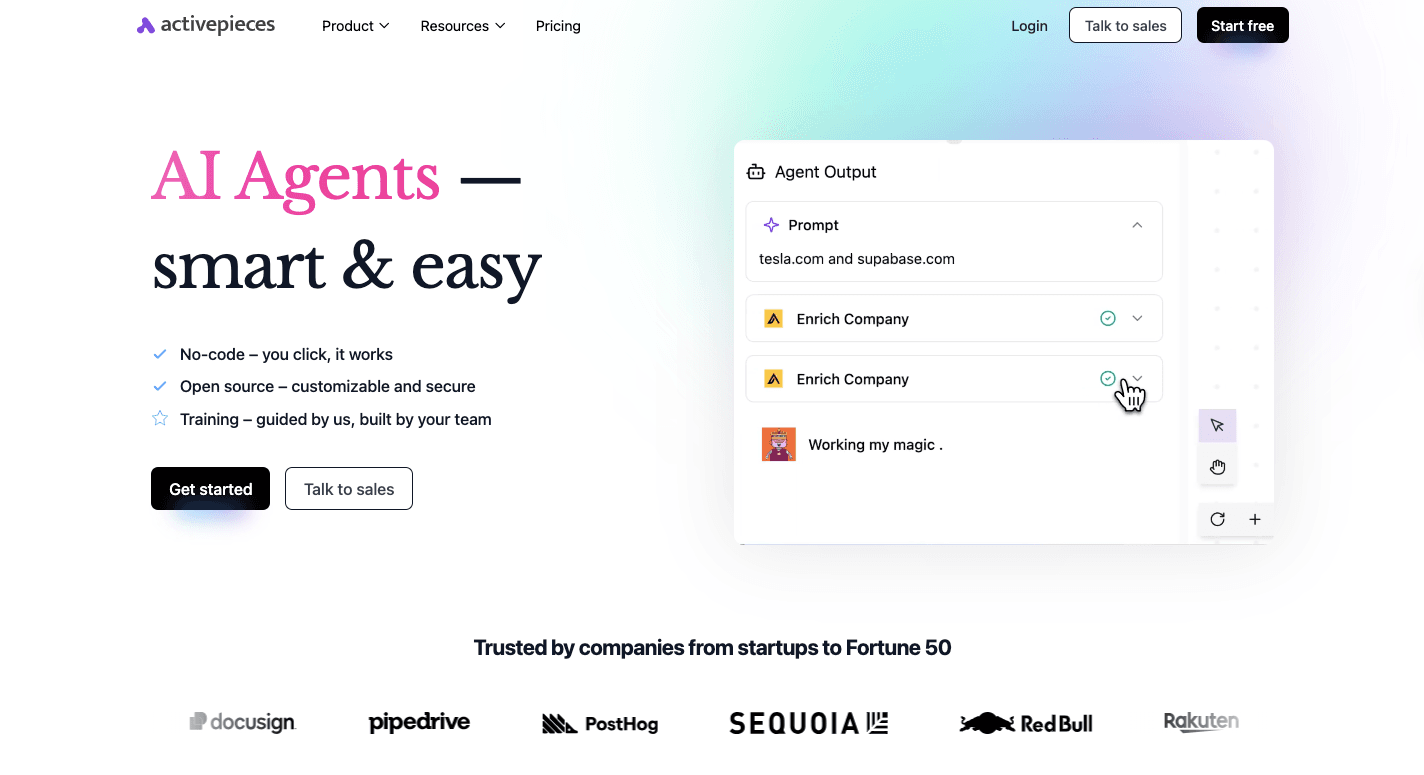
Activepieces is an open-source automation platform that helps you build automated workflows without turning every project into a coding task. It combines a no-code builder with developer-level control.
Check out how Activepieces supports zero-touch automation.
Built for End-to-End Automation
Zero-touch automation fails when platforms only automate fragments. Activepieces focuses on automating processes from trigger to resolution.
For example, you can create a workflow that creates accounts, assigns user roles, updates records in existing systems, sends notifications, and logs actions with no manual tasks in between.
The platform manages flow state, retries failed API calls, and keeps continuous monitoring active. If a step fails, the workflow can reroute or retry rather than stop completely.
Overall, it supports organizational needs where workflows span multiple departments and systems.
Seamless Integration With Existing Systems
Most companies rely on existing systems that can’t be replaced overnight. Activepieces offers 632+ pre-built integrations called pieces.
These connect tools, such as:
- GitHub
- Apify
- AWS Bedrock
- Oracle Database
If your environment includes multi-vendor platforms, you can seamlessly integrate them into one automated tool. Then, instead of writing custom scripts, you drag components into a visual builder and define logic.
When a connector does not exist, developers can create one in TypeScript and publish it to the ecosystem.
AI-Ready
Modern automation requires more than simple “if-then” rules. Activepieces includes native AI steps that allow you to analyze text, summarize content, evaluate data, and build decision logic directly inside your workflows.
For example, an incoming support email can pass through an AI step that identifies intent, assigns priority, and routes the ticket.
Since the human-in-the-loop feature is available, you can control when human oversight is required, especially for sensitive approvals.
AI logic lives inside the same platform as your automation flows, so you avoid stitching multiple tools together.
Enterprise Control and Governance
Activepieces supports:
- Custom role-based access control (RBAC)
- Single sign-on (SSO)
- Audit logs
- Management APIs
You can define who can create flows, who can edit them, and which authorized users can access specific connections.
Self-hosting provides another layer of control. You can deploy the platform inside your infrastructure and connect to private databases or internal APIs.
Set Up Zero-Touch and AI-Driven Automation With Activepieces
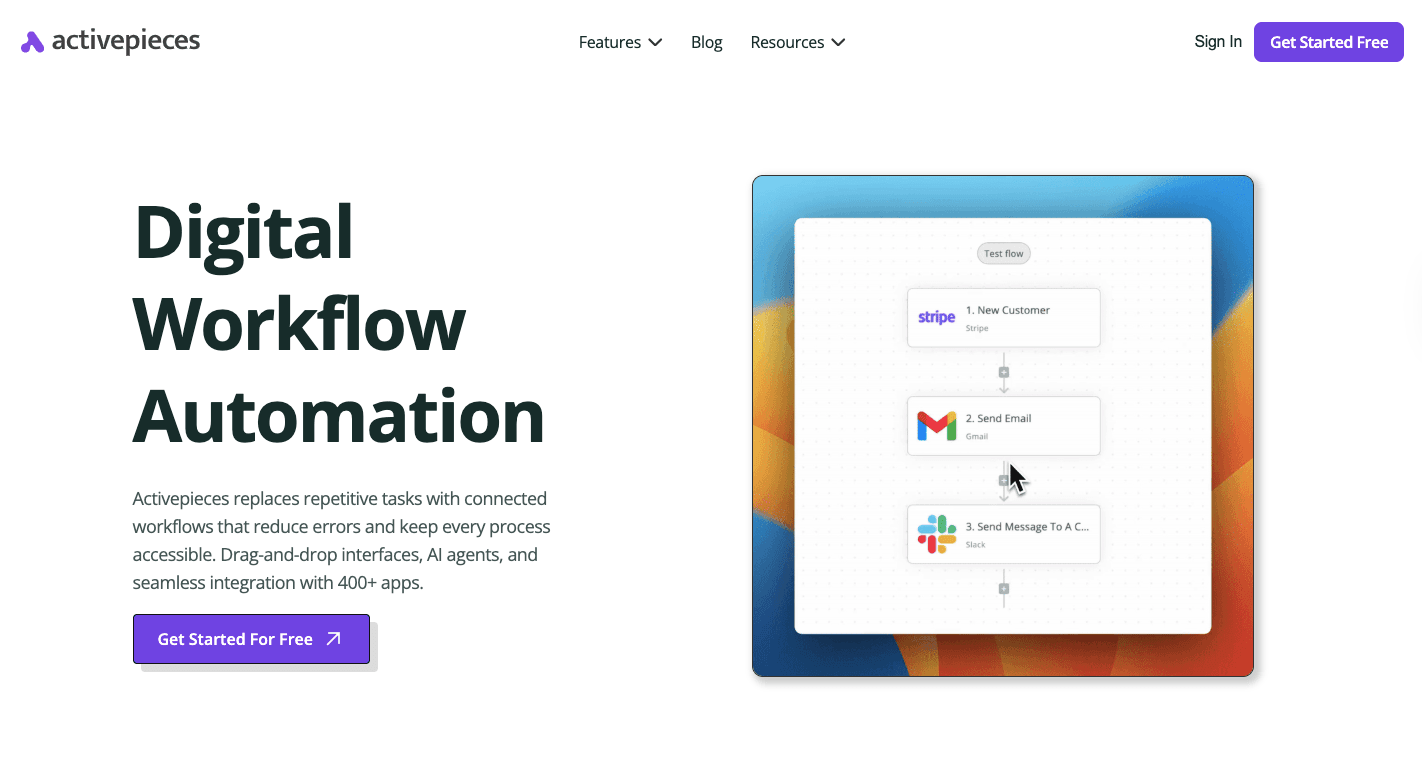
Activepieces is an open-source, all-in-one automation tool that supports intelligent automation by combining AI logic, API orchestration, and event triggers within a single platform.
With 632+pre-built data integrations, you can seamlessly integrate various platforms. Your existing workflows stay intact while you layer automation on top.
Native AI pieces allow you to build AI-driven automation that analyzes text, routes requests, and adapts decisions. You reduce manual tasks while keeping optional human oversight when approvals are required. An authorized user can step in only when necessary.
Continuous monitoring keeps flows stable and reliable. If a connection fails or data changes format, the system flags it before it disrupts operations.
Bring AI-driven automation and real orchestration into your stack. Get started with Activepieces!
FAQs About Zero-Touch Automation
What is zero-touch automation?
Zero-touch automation is an approach where systems execute tasks from trigger to completion. It uses rules, APIs, and artificial intelligence to run workflows automatically.
In practice, it minimizes errors, reduces delays, and can even apply self-healing actions when something breaks. What most companies implement today is just the tip of what zero-touch systems can handle.
What is the zero-touch process?
The zero-touch process starts with an event such as a new hire, device startup, or security alert. The system detects the event, applies predefined logic, executes actions across connected tools, and confirms completion.
It often includes continuous monitoring to adjust in real time without human input.
What are the four types of automation?
The four common types are basic task automation, robotic process automation, intelligent automation, and zero-touch automation. Each level increases autonomy and decision capability.
What are the top five automation tools?
Activepieces, Zapier, Make, n8n, and UiPath are widely used tools. They support different key areas such as workflow automation, RPA, and self-service integrations.
Build it
Set this up in minutes.
No code required. Connect your accounts, and Activepieces runs it from there.
Start free Talk to sales