
7 Best AI Agents for Industrial Firms in 2026
Explore the seven best AI agents for industrial firms available in 2026. Discover what makes Activepieces stand out as the superior choice.

Apr 9, 202614 min read
Delays, shortages, and last-minute changes keep disrupting your plans. Your workday starts with a plan and turns into going around and asking, “Why is this delayed again?”
Supply chains are harder to manage than ever. AI agents can improve forecasting, coordination, and response times.
In this article, you’ll find the seven best AI agents for industrial firms, which can help you reduce uncertainty and stay on track.
Turn delays and shortages into automated responses. Use Activepieces to keep everything on track!
TL;DR
Below are the seven best AI agents for industrial firms in 2026:
- Activepieces
- IBM watsonx Orchestrate
- Siemens Industrial AI
- Cognite Atlas AI
- MakinaRocks
- Ameba AI
- Kore.ai Agent Platform
Everything below works on Activepieces' free plan. Start without code or a credit card.
Common Use Cases of Agentic AI in Industrial Firms
Industrial teams use agentic AI systems in:
Production Monitoring
For instance, an agent can monitor spikes, recognize that they correlate with a specific motor’s vibration pattern, and autonomously slow the machine cycle to prevent burnout.
By integrating AI agents into production lines, you don’t rely on dashboards anymore. The system continues to execute tasks like shifting workloads, updating schedules, and triggering maintenance.
Agents now use high-speed computer vision to perform microscopic quality checks. When defects repeat, the system recalibrates machines so output stays consistent.
Predictive Maintenance
Predictive maintenance has shifted from simple alerts to agentic AI systems that connect detection with action.
The system starts by analyzing data from high-frequency sensors to calculate remaining useful life. Once it detects early failure signs, it schedules repairs before downtime happens.
Maintenance agents, for instance, are used to enhance operational efficiency by catching issues early and planning fixes. Many setups rely on multi-agent systems, too. One agent monitors signals, another studies wear trends, and another schedules repairs.
Technicians can even ask questions like, “What is the fix for hexadecimal error 0x4F?” The system then retrieves the exact manual page and past repair logs instantly.
Supply Chain Automation
Supply chain management no longer depends on tracking shipments and waiting for updates. Systems now act on goals and respond to changes automatically.
Supply chain agents operate as digital coordinators between internal enterprise resource planning (ERP) systems and external vendors. These agentic AI solutions focus on both machine readiness and predictive logistics.
Since agents operate continuously, adjusting schedules and routing shipments, you avoid delays. Because of that, you maintain customer satisfaction, even when supply conditions change.
Reporting and Data Processing
Regulatory requirements, such as carbon tracking, create heavy data loads for industrial firms. Information is often in logs, PDFs, and disconnected records.
Systems now process unstructured data and convert it into usable insights. For instance, generative AI can read legacy manuals, compare them with machine data, and produce repair steps.
Enterprise teams rely on this setup to turn data into a digital analyst for financial reconciliation. The system checks transactions, flags mismatches, and resolves issues.
In short, agentic AI handles complex business processes such as compliance tracking and performance analysis in one flow.
Customer and Internal Support Business Workflows
Deploying AI agents for customer service changes how support works. Customer support agents can access permitted ERP and customer relationship management (CRM) data, which allows them to complete actions automatically.
Support agents manage customer service operations by coordinating multiple steps, such as booking visits and updating records. That way, customer interactions become faster and more accurate.
Deploying autonomous AI agents also improves contact center operations by managing technical post-sales support.
An entry-level technician can ask, “How did we fix the pressure drop on Line 3 last summer?” The system searches past logs and returns the exact solution.
Top 7 AI Agents for Industrial Firms to Automate Business Operations
These are the seven best AI agent solutions for industrial firms:
1. Activepieces

Activepieces is a top AI agent and workflow automation platform that gives you a single platform to run agents that move data between production, supply chain, and internal systems.
You can describe a flow like “When a machine alert appears, create a maintenance task and notify the right engineer,” and the AI agent builder turns that into a working setup. Doing that removes repetitive tasks like updating logs or sending manual updates.
As operations grow, you can build and scale agents that handle complex workflows such as syncing supplier delays with production schedules. It keeps task management simple by moving data seamlessly between tools.
Non-technical staff can automate routine tasks, while engineers extend logic when needed. With seamless integration, you can deploy these capabilities in the entire organization with minimal human intervention.
Key Features
- AI agent builder - You describe production or maintenance steps, and the system creates agents that connect machines, alerts, and internal tools.
- Prebuilt templates for operations - Ready-to-use flows cover common cases.
- Real execution tracking - Every workflow run shows what triggered it, what data moved, and where issues occurred.
- Human approval steps - Agents pause when a decision needs review, such as ordering parts or adjusting schedules.
- Centralized credentials and access - IT controls system access once, and teams reuse it across all workflows.
- Enterprise security controls - SSO, RBAC, and audit logs keep production data and actions fully tracked.
- Flexible deployment options - Run in the cloud or self-host to keep factory data within your network.
- AI-ready integrations - Connect with AI providers to build agents that analyze logs, predict issues, or assist operators.
- Organization-wide adoption tools - Workspaces, templates, and onboarding features help you start fast.
2. IBM watsonx Orchestrate
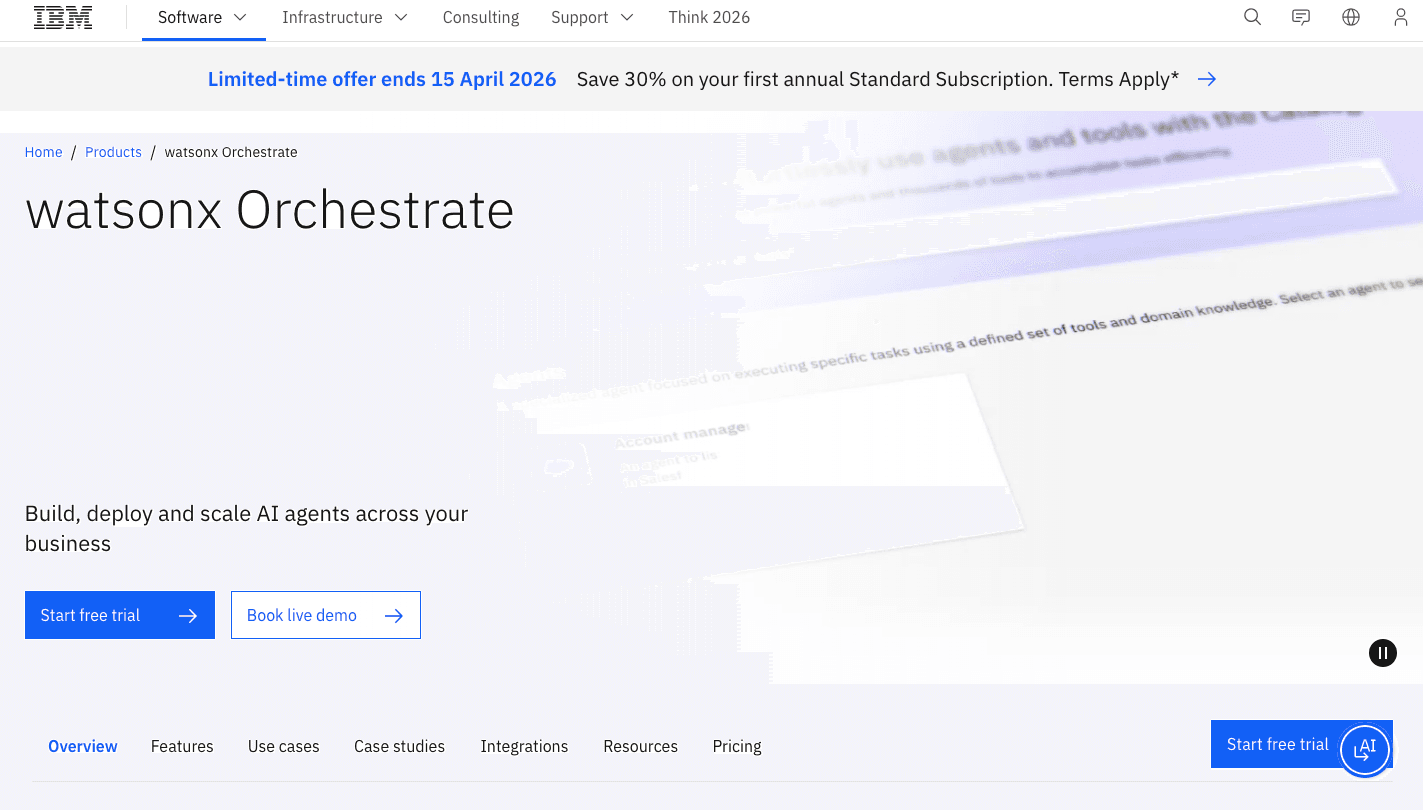
IBM watsonx Orchestrate is an enterprise-grade agentic AI platform designed to coordinate multiple autonomous agents to complete complex, multi-step business tasks.
It is a unified workspace where you can build, deploy, and manage AI agents that can reason about context, use specific tools, and collaborate with other agents.
A no-code or low-code studio lets non-technical staff create agents in minutes by defining goals and connecting them to existing data sources. Once deployed, agents move through tasks in sequence.
You can simply ask, “Show me the impact of last night’s power outage on our total Q1 throughput.” The agent pulls data from different systems and returns a summarized answer.
Key Features
- Multi-agent coordination - It connects multiple agents so each one handles a specific step, then passes results forward to complete workflows.
- Prebuilt agent catalog - Includes over 150 prebuilt AI agents for procurement, HR, and finance.
- Developer toolkit - Engineers use a Python-based kit to build advanced logic, extend agent behavior, and connect external frameworks.
- Task orchestration flow - The system coordinates multi-step business processes by assigning roles to each agent and executing tasks in order.
- Reporting and data synthesis - Agents collect data from multiple sources and generate summaries that explain results.
- Governance and monitoring tools - You can track agent activity, review outcomes, and maintain control over how decisions are made.
- RAG-based knowledge access - Agents query internal documents, manuals, and records to return answers grounded in company-specific data.
3. Siemens Industrial AI

Siemens Industrial AI is a comprehensive architecture built on the Siemens Xcelerator platform. It separates Industrial Copilots, which users interact with, from the underlying autonomous agents that orchestrate factory floor actions behind the scenes.
These agents behave as digital engineers who understand instructions and act on them. You can describe a task, and the system can generate PLC code, assist with it, check for errors, and prepare it for deployment.
To remove long testing cycles, you can develop AI agents that debug code autonomously in the Totally Integrated Automation (TIA) Portal.
The system connects simulations with physical enterprise operations. It tests changes in a digital model, validates outcomes, and then applies those adjustments to machines.
Additionally, intelligent agents monitor performance, detect slowdowns, and correct issues before they affect output.
A Siemens logistics agent can talk to a third-party procurement agent to resolve a stockout by autonomously rerouting a shipment or adjusting a factory schedule.
Key Features
- Digital twin coordination - The system runs simulations before applying changes, which allows safe adjustments to production.
- Multi-agent collaboration - Different agents handle design, planning, and maintenance, then coordinate actions to complete workflows.
- Real-time decision logic - Through their Industrial Edge platform, agents understand human intent and access external tools or other agents to correct errors during execution.
- Cross-system interaction - A Siemens logistics agent communicates with procurement systems to adjust supply flow when disruptions appear.
- Marketplace ecosystem - Available on the Siemens Xcelerator Marketplace, these agents can work with both Siemens-developed and third-party AI agents.
- Adaptive production control - Agents detect issues, adjust machine settings, and rebalance workloads to maintain stable output.
- Maintenance automation - The system identifies failure patterns, creates work orders, and prepares repair steps before machines break down.
4. Cognite Atlas AI

Cognite Atlas AI is a specialized low-code industrial agent workbench designed to automate complex workflows in asset-heavy industries like oil, manufacturing, and power. It focuses on building agents that understand how machines, processes, and systems connect.
An industrial knowledge graph that links sensors, equipment, and maintenance history into a single structure can connect to existing systems.
Unlike standard AI that retrieves data, Atlas AI uses context-augmented generation (CAG) to combine sensor inputs, 3D models, engineering diagrams, and historical logs into one reasoning flow. By integrating AI with these inputs, agents act based on the operational context.
It further lets you build custom AI agents using templates and a drag-and-drop interface, which simplifies the agent-building process without heavy coding.
Key Features
- Industrial knowledge graph - Connects enterprise data from machines, logs, and systems, which allows agents to follow relationships between assets and failures.
- Context-augmented reasoning - Combines sensor data, diagrams, and logs into a single reasoning flow, which improves accuracy during analysis.
- Low-code agent builder - A drag-and-drop agent builder allows engineers to create workflows and digital employees.
- 3D and engineering model integration - Agents use visual models along with live signals, which helps diagnose issues with more precision.
- Template-based deployment - Prebuilt workflows help teams build custom AI agents quickly for tasks like root cause analysis and reporting.
- Multi-agent interaction - Users switch between agents during analysis without losing context, which supports deeper investigations.
- Safety-first execution - Actions like running scripts or calling system APIs require human confirmation, which protects critical operations.
5. MakinaRocks

MakinaRocks provides an enterprise AI platform called Runway, along with specialized agents designed to solve problems such as downtime, energy waste, and quality defects.
On a production line, the agent monitors conditions continuously. If humidity starts affecting a chemical bond, it calculates a new temperature setpoint and suggests the adjustment directly to the PLC. Small changes like that prevent defects before they spread through batches.
These agents operate directly at the Edge on industrial PCs for split-second safety decisions, which avoids delays from sending data to the cloud.
Large manufacturers can scale AI agents between facilities and apply them to different business functions such as maintenance, yield improvement, and energy control.
Key Features
- Anomaly detection agents - The system learns normal machine behavior, then flags subtle changes such as vibration shifts that signal early failure.
- Predictive maintenance logic - Agents estimate remaining useful life and identify which component needs replacement before breakdown occurs.
- Process optimization agents - The agent monitors the production line and adjusts parameters when conditions change to maintain product quality.
- Energy optimization control - In energy-heavy sectors, the agent monitors external factors such as weather and load, then adjusts setpoints to reduce waste.
- Edge-based execution - Agents run on industrial hardware, which allows immediate response to safety risks and anomalies.
- Low-code pipeline builder - Engineers connect data tools and models into workflows.
- Lifecycle management - It tracks agent performance and keeps models updated as machine conditions change.
6. Ameba AI
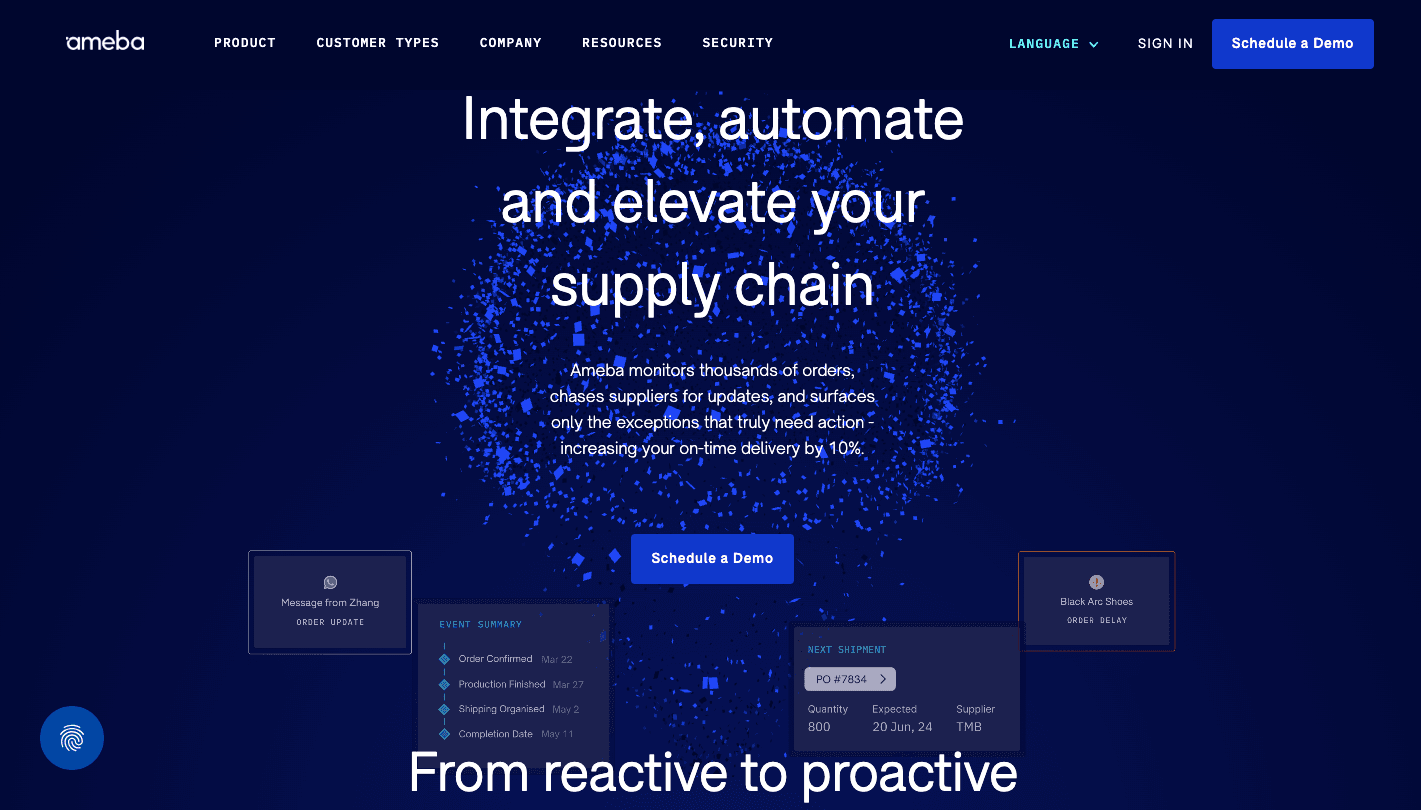
Ameba AI focuses on fixing one core problem: supplier data lives in emails, PDFs, chats, and spreadsheets that never match.
Ameba uses multiple AI agents to scan emails and PDFs for supply chain data, extract key details, and structure them instantly. After that step, it updates enterprise systems like SAP autonomously to ensure a single source of truth.
You can turn AI agents into digital coordinators that manage hundreds of vendors at once. When delays appear, the agent checks risks, suggests alternatives, and contacts suppliers.
Aside from that, you can set the agent behavior to nudge suppliers only when a critical redline is hit, which avoids unnecessary noise.
Key Features
- Unstructured data extraction - The agent reads supplier emails, PDFs, and even images, then pulls part numbers, delivery dates, and quantities with high accuracy.
- Automatic system updates - After extracting data, the system syncs records with ERP tools so schedules and inventory stay accurate.
- Supplier communication control - You define rules for when the agent follows up, negotiates timelines, or escalates problems.
- Multi-channel messaging - The agent contacts suppliers through email, chat apps, or portals based on their preferred method.
- Scenario planning - When delays happen, the system suggests rerouting shipments or switching suppliers based on current data.
- Autonomous coordination - The agent keeps production schedules aligned with supplier updates.
7. Kore.ai Agent Platform
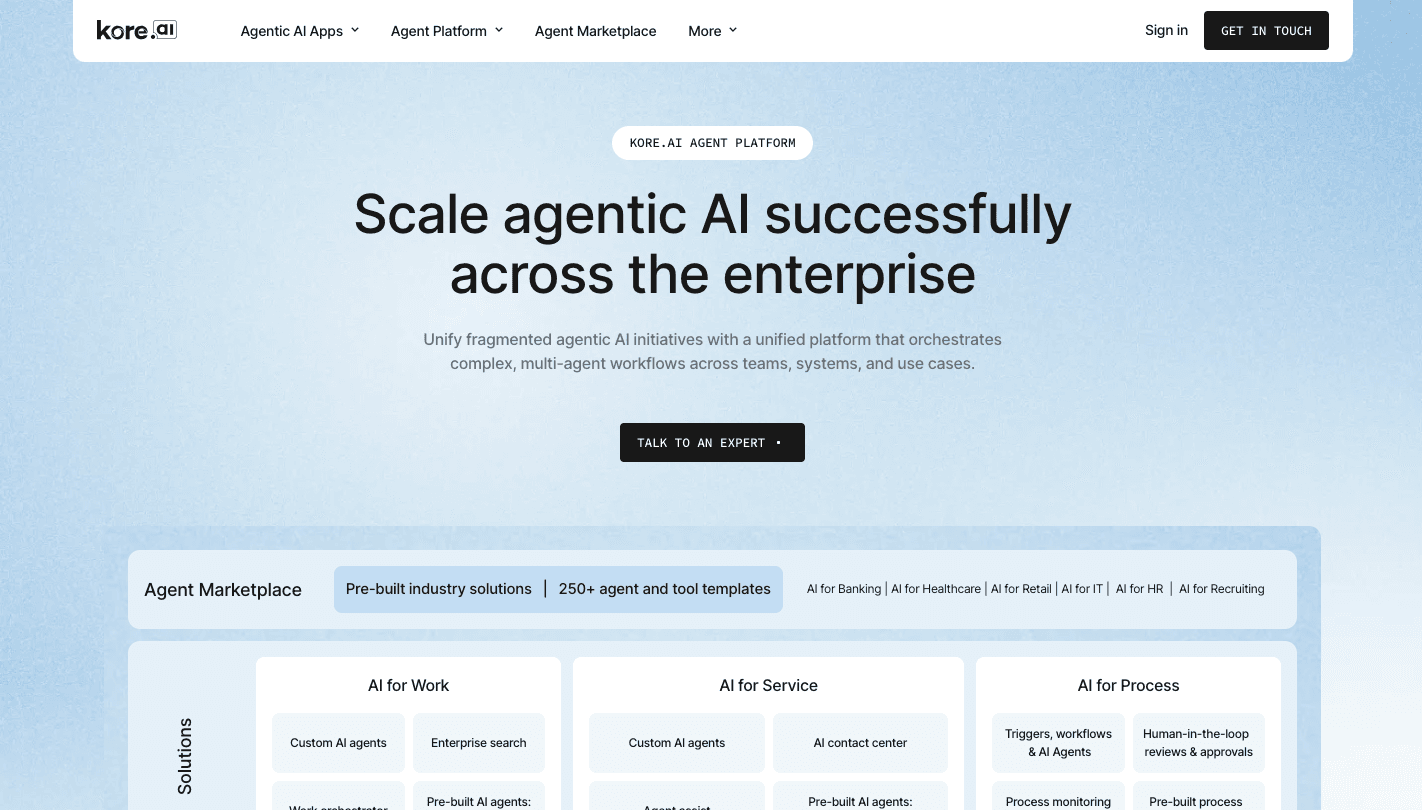
Kore.ai executes actions across tools like ERP, CRM, and maintenance systems.
A technician can say, “I’ve finished the repair on Turbine 4,” and the agent logs the update, creates a future work order, and orders parts automatically. That flow shows how agents orchestrate enterprise workflows while coordinating systems and users.
Each step stays controlled, and the platform provides an enterprise-grade solution with PII masking and strict security guardrails to make sure that sensitive customer data is never exposed.
Key Features
- Conversational execution engine - Users describe tasks in plain language, and the agent carries them out among connected systems without manual switching.
- System-to-system actions - The agent moves between ERP, CRM, and service tools to complete multi-step operations such as ordering parts or updating records.
- Multi-agent orchestration - Different agents handle tasks like inventory checks, maintenance updates, and supplier coordination in a single flow.
- Omnichannel access - Workers interact with the agent through chat apps, voice, or internal tools, which keeps communication flexible.
- Knowledge retrieval with context - The system reads manuals and past logs, then returns exact instructions linked to real equipment and history.
- No-code workflow builder - You can map logic visually, define steps, and control how agents respond to different scenarios.
Put AI Agents to Work in Your Business Operations With Activepieces
Getting started with AI in industrial firms usually slows down because teams wait on IT, training, or unclear use cases.
You don’t need to go through all that. Activepieces gives you a direct way to create custom agents and run automations tied to complex tasks in production, maintenance, and supply workflows.
To start, pick a template for something like monitoring inventory for low stock and expiry, then adjust it to match their process.
Each user gets their own workspace, so engineers, operators, and managers can test ideas. When a workflow runs, it logs every step, so your teams know exactly what happened if something fails.
Agents also interact on multiple channels, which means updates can reach teams through chat, email, or internal tools without delay.
Over time, those flows reduce manual checks and lead to real cost savings.
FAQs About the Best AI Agents for Industrial Firms
What are the best AI agents for industrial firms?
The best AI agents depend on what you need to automate. Siemens Industrial AI is for factory control and engineering tasks, MakinaRocks focuses on machine data and anomaly detection, and Activepieces is when you need AI agents, connect systems, and automate workflows for different operations.
Can AI agents integrate with legacy systems?
Yes, most platforms connect to legacy tools through APIs, middleware, or custom connectors. Strong platforms bridge old ERP, MES, and SCADA systems without forcing full replacement, which makes adoption faster.
How long does it take to build AI agents?
Simple agents can go live in hours using templates or no-code builders. More advanced setups that involve multiple systems, approvals, and logic can take days or weeks, depending on complexity.
What are the benefits of AI agents?
AI agents handle repetitive work, connect systems, and act without constant supervision. Their AI agent functionality lets them execute tasks, move data, and trigger actions, which reduces delays and frees human agents to focus on decisions that need judgment.